
Tuesday, July 2, 2013
I want to live in Austria, Is there anyone who can help me ? Ich möchte in Austria leben, Gibt es jemanden, der mir helfen kann?
Lieb mein Freund, ich möchte in Austria für den Rest meines Lebens mit einem Job zu leben.
~~~~~~~~~~~~~ Priyantha De Silva


Thursday, November 1, 2012
Educational deprivation and continuing neglect The Care of Children 15
Educational deprivation and continuing neglect
The Care of Children 15
-HDA-3.jpg)
By Prof. Rajiva Wijesinha
At the meeting last week of the Muttur Divisional Reconciliation Committee meeting, the Chairman of the Mediation Board reminded me of a suggestion made by the school principals I met during my last visit to Mutur. This was in 2008, while the conflict in the North still raged, but the East was limping back to normality.
The principals were from a Muslim school, a small Tamil school and a very small Sinhala school, all of which suffered from teacher shortages. They asked with one voice why they could not have a single English medium school. Not only would that bring the children of a very fractured area together, it would give them all chances of a better future.
I pointed this out in a letter to the Ministry. I went further and indicated how it would help government by reducing costs, since far fewer teachers would be needed for one school than for three, each with few students. The teacher shortages endemic in a distant place like Mutur could also thus be reduced, with less headache for education officials who would have to fill up fewer cadres.
The Ministry did not deign to reply. In discussion I have been told, when urging that English medium be made available more widely, given the tremendous demand there is for it all over the country, that there are not enough teachers. No efforts have been made however to increase the supply of English medium teachers, or to think of new ways of producing them.
A group that was set up by the Reconciliation Office, to promote Reconciliation, Education And Peace, wrote to the President offering to help. The group consists of individuals concerned with education in schools founded by religious organizations. Obviously many ideas are provided by the Catholic Church, which has done so much for education in Sri Lanka, but we also have representatives of Buddhist and Hindu and Muslim schools, as well as the Warden of S. Thomas’.
The group was hosted by Tilak Karunaratne, who had provided many ideas to the Parliamentary Consultative Committee on Education, on behalf of the Old Boys of Ananda College. He is part of a network that encompasses other Olcott schools, which were the main instrument of the development of a national system of education that aimed at high standards of a universal nature.
Javid Yusuf contributed to the deliberations and the letter to the President on behalf of Muslim educationists. He has been Principal of Zahira, in addition to all his other contributions to national and social wellbeing, which led to his recently receiving a Sahabdeen Award for sustained achievements. Hindu denominational education was represented by Mrs Duraiswamy, who also arranged a well attended meeting at Hindu Ladies College to promote twinning with less fortunate schools in the North.
I had also invited Mr Swaminathan, not because he is a member of Parliament, but because I wanted a representative of the Ramanathan family and the Navalar schools that had been set up at the same time as the Olcott schools. He however has not attended and I gathered from him that unfortunately that trust is not active now. The same goes for the Theosophist society, which is why the concept of a union of Olcott schools is so welcome. In addition, though, the Mahabodhi Society too has shown itself deeply concerned with modernizing education and also bringing children of different communities together, and their enthusiasm too should be harnessed more effectively.
Sadly there was no response to our letter to the President. Even more sadly, the Ministry of Education has not, despite a positive verbal response from the Minister of Education, responded to a letter from REAP asking for approval for a schools twinning programme. We had hoped to bring together a school from the south with one in the north and to encourage not only student links, but also projects that would help develop less advantaged schools in the catchment area of the northern school.
The idea was that, while links between students are always to be encouraged, more lasting friendships will be built when they undertake joint projects. Working together for a much less developed rural primary school would develop initiative and confidence jointly in students in both the southern and the northern school that implemented the project.
There has been a stunning silence however from the Secretary to the Ministry of Education. The same goes for the Northern Province Ministry, even though the Governor was positive. The one bright spot was the prompt response of the Western Province Ministry of Education, but given that many schools in the West are National Schools (another absurdity that the looseness of the 13th amendment has perpetrated), this is not much use. And so an excellent opportunity for bringing youngsters together productively, encouraged by the Cabinet through both the National Human Rights Action Plan and the Action Plan to implement the LLRC Recommendations, bites the dust.
Given such contempt for what has been agreed as National Policy, I have decided that there is little point in continuing with meetings of REAP, since I feel a fraud for having encouraged idealists to come up with ideas which no one is interested in. After all, as the acronym was intended to remind us, you can only reap what you sow, and the lack of interest in reforms to provide better opportunities for our children means that there will be yet more youth unrest in the future.
The children of Mutur – and Morawewa and Poonakary and Pachchilapallai and Velanai and Kopay, to name only the Divisional Secretariats in which we had meetings last week – will continue to suffer. The fact that educational shortcomings figure large in the problems brought forward by people simply will not register with government. This is tragic, for the improvement in school infrastructure shows that some elements in government care. But their efforts will be destroyed by those who do not care.
Renouncing gives rise to real victory
Renouncing gives rise to real victory
There are two things in the world called victory and defeat. Everybody prefers victory. Victory is twofold. One form of victory brings happiness. The other so called victory brings sorrow. We must admire the victory that brings happiness. There are people who are attached to something and think and say that they are victorious. It also is a victory. That does not bring real happiness but only a little with a huge suffering in it. So, we must not admire such a victory.
 There is a victory in the world that we must be desirous of. It is the victory gained through renouncing. It is not an easy task to gain victory through giving up. It is like swimming upward in a stream flowing down. It is also like turning something upside down. Be desirous to do so. One who does so with difficulty will enjoy comfort ultimately.
One may be anxious to own what is there to be seen. He would own it and think he is victorious. Likewise, he may like to own all the objects that are felt to his nose, tongue, body and mind. Along that so called victory suffering follows. So, never admire such victory which is filled with suffering. Think of a victory that follows the elimination of desire.
Don’t we think of being victorious by clinging on to the lust that strikes our minds? Isn’t this a world where we continue to enjoy whenever a lust strikes our minds. The Buddha instructs us to do away with lust. So is the hatred. Doesn’t the mind like to keep the hatred and continue to enjoy when hatred strikes the mind? Does the mind like to give it up? We must liberate ourselves from that world. That is why the Buddha indicates that the hatred is to be done away with. One who does not do away with the hatred, expects happiness from it. There is an unbearable suffering or a fire behind that happiness. So don’t be desirous of hatred. Do away with it.
The Buddha shows us that the delusion is also to be eliminated. Delusion also is a thing that contains a little amount of happiness. People like to continue Delusion in their minds and enjoy it. But along with that happiness immense suffering arises. That’s why we have been advised to eliminate delusion.
Be desirous to gain the victory followed by eliminating Raga, Dosa and Moha. As disciples we must always be willing to do what the Buddha has preached. The victory gained through renouncing above mentioned things even reluctantly are helpful for a person who wishes to develop the knowledge of Dhamma.
Not a least benefit can be gained from meditation without eliminating the things that should be eliminated even reluctantly. One who is capable of renouncing is immensely benefited and can achieve real victory by meditation. Even the person who doesn’t do so may meditate, may keep on sitting, may instruct others but he may not reach the real victory.
So, comprehend what are the things that should be renounced reluctantly and renounce them. Try to be the partners of the victory gained by renouncing.
Then we will be able to learn Dhamma and meditate that will bring great happiness to our lives. Without the knowledge of above facts, we won’t be able to develop meditation. May all be fortunate enough to acquire the victory gained by renouncing.
Translated by M.A Samarasinghe
Ultimate Realities in Buddhism
Ultimate Realities in Buddhism
Any entity that is not created, imagined, artificial or supposed to exist is said to be real. The quality of being real is reality or real existence (Hornby, 1974). According to Ahbidhamma (Higher Doctrine) in Buddhism, there are two types of Realities or Truths (Sacca): the conventional truths (Sammuti Sacca) an the Ultimate or Absolute Truths (Prama: ttha Sacca). Conventional truths are ubiquitous and subject to change. For instance a child becomes and adult with the passge of time. These are mostly names given to objects for identification purposes. Every human being has a name for identification. Proper names and common names alike are conventional truths. One would remember the old definition of a noun as the name of a person, place or thing.
But in Abhidamma absolute truths (Paramatha Sacca) are subject to exhaustive discourse. For instance “Man” according to ultimate truth is a compound of the body and the mind (na:ma-ru: pa). The body is a mass of changing states: a mass of waves, a volume of vibrations nothing stable and nothing static, while the mind is a process or a stream of thought-moments where every thought or consciousness rise and vanishes in succession. Thus, there is nothing permanent in this psychophysical stream called man (Anandamaitreya, 1983). According to Abhidamma there are four absolute truths. These are Cittas (mind/consciousness) Cetasika (mental factors), Rupa (physical phenomena/material form/elements of matter) and Nibbana (the supreme happiness/the summum bonum of Buddhist practice). The Citta, Cetasikas and Rupa are conditioned, impermanent and interdependent on one another. Nibbana is an unconditioned reality. It is neither created nor formed.
Citta or Vinnana (mind/consciousness) has been defined as the awareness of an object (A: rammana vija:nana lakhanan cittan). The mind operates through psychological laws or conditions known as citta niyama in Buddhism. Without anyone’s control or command, citta waves conform the flow of consciousness of beings appearing and disappearing according to the mental process. (Pemaloka, 2002). There should be an object and contact (passa) with it for consciousness to arise. There are six sense faculties. These are the portals or doors through which the objects enter the field of cognition. The eye, ear, nose, tongue, body and mind are these doors. The mind unlike the other doors can receive its own mental objects as well as the objects of the other five physical senses. In this manner six types of consciousness are established.
These are, eye-consciousness, ear consciousness, nasal/nose consciousness, lingual/taste consciousness, body consciousness and mind consciousness respectively. There are four levels of consciousness of the mind. These are thoughts related to the sensuous realm (kamma-lo:ka), which are linked with visual forms (ru:pa) sounds (sadda) odours (gandha), tastes (rasa) and tangible objects (photthabba). This level is ka:mavacara citta or Sense Sphere Consciousness which are 54 in number and exist in 11 planes.
The second level is the subtle corporeal level or the Form or Fine Material level (Ru: pavacara citta) where some people who have inhibited the arising of unwholesome thoughts pertaining to sensual enjoyment develop thoughts of a wholesome, relaxed and clam nature. These subjects are said to be born in the subtle corporeal realms after death. It is a higher level of the mind. There are 15 cittas in this category and can exist in 16 planes. The Third level is known as the incorporeal realm/Formless or immaterial level (Aru:pa:vacara citta). There are a few who are disgusted with material or corporeal existence and develop a mind after sublime concentration which is devoid of all attachments and defilements connected to materiality. Such persons after death are reborn into a state of incorporate existence (there is mind but no body). There are 12 such cittas and these can exist in four planes.
The last or the highest level the superabundance consciousness (Lokuttara citta) which are eight in number according to one analysis, but according to another analysis there are 40 such cittas. Those individuals who perceive the unsatisfactoriness of existence in the aforementioned three levels of existence, develop their minds to be pure and serene through the practice of vipassana or insightful meditation which leads to an intellectual understanding of the doctrine they gradually pass through the eight stages of consciousness and finally fix their minds on nibbana, the only superabundance object. This is the lokuttara citta stage. No plane of existence has been ascribed to the lokuttara state.
According to the nature of arising (ja:ti) of cittas, they are looked upon as belonging to three types: as resultant states or effects of consciousness or effects of previous kamma (kamma vipaka) as in the case of eye or ear consciousness; as causes of kammic action through body, speech or mind (causative citta) as in the case of an wholesome action is caused by a wholesome thought (kusala citta), and thirdly as kiriya cittas (functional consciousness/minds) as in the thoughts and actions of arahats who do not generate fresh kamma.
Cittas can also be classified in accordance to their association with wholesome and unwholesome mental factors as he: tu/mula (rooted) which can be wholesome (kusala) or unwholesome (akusala). The three akusala cittas are greed (lobha) hatred )Dosha) and delusion (moha) respectively. Cittas are associated with feeling (vedana).
Some many be pleasant (sukha ve:dana). Some may be painful (dukkha vedana) and some indifferent (upekka ve:dana). A citta that arises after deliberate premeditation is called a sasankarika citta which can be wholesome or unwholesome. A thought that arises spontaneously is called asanka: rika citta which too may be wholesome or unwholesome in character.
For instance in a greedy person the asankarika and sasankarika cittas may be unwholesome at all times. About the existence of one’s mind or consciousness Abhidamma declares that it can exist in two forms, namely as the primary from of mind passive from of mind (bhavanga) and the active form. The Bhavanga citta flows from conception to death of an individual and it is stimulated to its active form from stimulations received from the six senses into a thought process (citta vi:thi) A complete thought process comprises seventeen thought moments (citta khana) starting from bhavanga contact with the object (athita bhavanga) bhavanga vibration (bhavanga chalana), bhavanga that dissects the flow (bhavanga upaccheda), consciousness turning towards the object through the sense door (panchadavara vinnana), creation of the appropriate consciousness (vinnana as eye consciousness) receiving the object (sampaticcana citta) investigating the object (santirana citta) determinig the nature of the object (votapana citta), These eight thought moments are ahetuka and either kiriya or vipaka in nature, purely functional or resultants. From then onwards the mind begins to investigate whether the thought process is wholesome or unwholesome on ethical grounds.
Thus it enters the javana stage. There are seven such thought moments which produce new kamma following the seventh javana stage the thought is registered in two thought moments (the 16th and the 17th). These are called tada:lambana. At the second stage of registering, the bhavanga which has been on a stimulated situation so far is interrupted and gesstimulated by another thought process.
The entire process of stimulation is so rapid and there is no super power to control it. But through mindfulness the javana states could be governed by one’s will.
At the time of one’s death the five javanas are weak and can only determine the rebirth consciousness and may or may not be followed by the two registering moments (tadalambana). The death consciousness (cuti citta) arises which is similar to bhavanga citta. The jaana just before the cuti citta arise from a kammic process to determine the rebirth consciousness (patisandi vinnana).
The Cetasikas are the second variety of ultimate realities in Buddhism. These are the mental factors that arise and perish together with the consciousness. In the Abhidamma there are 52 kinds of cetasikas. While feeling (vedana) and perception (vinnana) are taken separately the other mental factors (50 in numbers) are collectivly known as sankaras (volitions).
Feelings
Feeling is momentary and arises with every type of mental action. It is an impersonal process. There are three types of feelings-pleasant (sukha vedana) unpleasant (dukkha vedana) and indifferent (upekkha vedana). But in the Abhidamma there are five kinds as mentally agreeable (cetasika sukhas vedana) feeling and mentally disagreebale (cetasika dukkha vedana) feelings or somanassa and domanassa vedana are added to it.
Again feeling is classified into six types in relation to organs of contract as eye-contact, ear contact etc. Generally the human beings consider feeling to be individualized and personalized and link it with the self who causes suffering. In Buddhism the importance of wise consideration (yo:nisomanisika:ra) of feeling is emphasized because of the transient nature of feeling.
Perception (sanna) is the awareness of object’s specific characteristic, and it is linked to the six senses. Like feeling perception too is momentary and impersonal. Perceptions are distorted by one adhering to four perversions (vipallasa). Some people consider impermanent entities as permanent ones. Some identify unsatisfactory (dukka) as pleasure (sukha). Some think of having a soul (atma) for soullessness (anatma). Some perceive impure (asuba) as pure (suba).
Defilements
These distortions are the result of ignorance, delusion, greed and hatred which are mental defilements. The development of memory is an outcome of the interplay of several factors. But perception plays a key role. When an object is encountered for the first time, the mind recognizes its distinctive mark through perception. When it is encountered in the second instance perception is very quick in identifying it.
Unwholesome
The Sankharas are the remaining 50 cetasikkas. There are four groups.; namely; the universal mental factors (sabha citta sankaras), the particular mental factors (pakinnaka), the unwholesome mental factors (akusala sankara) and pretty or beautiful mental factors (sobana cetisikas).
Out of the seven universal mental factors two; feeling and perception have been described already. The other five are contact (phassa) or coming in contact with a sense organ, concentration (e:kaggatata) or focus on one object, attention (manisikara) or mind getting bound to be object, psychic life (jivintgriya) or the vital force required to support the menal factors and volition (cetana) or the act of willful action by body, word or mind.
There are six particular or specific mental factors. Unlike the universals these are not found in all minds. These are initial application, (vitakka), continued application (vicara) resolution (adhimokka), effort (viriya) joy (pitti) and the desire to act (chanda).
Ignorance
The fourteen unwholesome mental factors are: delusion or ignorance (moha), shamelessness (ahirika), fearlessness of evil (anottappa), restlessness (uddhacca), attachment (lobha), false view (ditti), conceit (ma:na), hatred (Dosa),e Navy(issa), selfishness (ma:cchariya), worry (kukkuccha), sloth (thina), torpor (midda) and doubt (vicikiccha) respectively. False views (ditti) can be believing in a self (sakkaya ditti), externalism (sassantha ditti) and denying the effects of kamma (natiditti), noncausality (ahetuka ditti) and denying moral law (akiriya ditti).
There are 24 beautiful mental factors (so:bana sankhara). These are; confidence/faith in the three jewels (saddha), mindfulness/alertness(sati), shame of evil(hiri), fear of evil (otappa)non-attachment (alobha), loving
kindness (metta), equanimity (upekkha), composure of body (Kayo pasandhi), composure of mind (citta pasandi) buoyancy of body (kaya lahuta) buoyancy of mind (mano lahuta), pliancy of body (kaya muduta), plinacy of mind (mano muduta), body efficiency (kaya kammannata) mental efficiency (mano Kammannata), physical/body proficiency (kaya pagunnata), mental proficiency (mano pagunnata), physical/body rectitude (kaya ujukata) mental rectitude (mano ujukata), right speech (samma vaca) right action (Samma kammantha), right livelihood (samma a:ji:va), compassion (karuna), sympathetic joy (mudita) and wisdom (panna) respectively.
Insightful
The object of meditation is largely to clean the mind from unwholesome thoughts and develop wholesome thoughts. Thus through insightful meditation (vipassana bhavana) wisdom (panna) crystallises out to fully comprehend the
three key characteristics of existence impermanence (anicca), unsatisfactoriness (dukka) and selflessness (anatha). The third ultimate reality is material form or matter which is called Rupa or the material phenomena/matter or material form. The Abhidamma has identified 28 kinds of material phenomena.
These are the four primary elements (cattari maha bhutani), which include the earth element/solidity (pathavi dhatu), the water element/fluidity/adhesion (a:po:dhatu), the fire element/heat (tejo dhatu) and the wind element/motion (vayu dhatu) which are insightfully put into discourse by the Buddha in the Maha Rahulovada Sutta (Discourse No. 63 in Majjima Nikaya).
Then there are 24 secondary ones that are dependent upon the primary four elements. Out of these 24, there is a set of 14 secondary elements which are called directly caused secondary elements (nipphanna) which cover the five sensory receptors, like the matter of the eye, ear etc (pasada rupani), the four stimulating elements like sound and sight etc. (gocara rupani), the two gender elements (bhaava ru:pani) the male and female respectively, the mind base/heart base (hadaya vatthu), the life element (ji:vitendriya) and the nutrient element (a:ha:ra ru:pa). The remaining ten are indirectly caused secondary elements (annipphanna).
Reflections on the robe
Significance of Vap Poya:
Reflections on the robe
The rain retreat, having commenced in Esala, comes to an end in Vap. It is time for Buddhists to celebrate with much grandeur – spiritual grandeur. In Pali Katina means ‘unbreakable’.
Modern days do not have a proper rain calendar. But we are always fond of following the traditions, hence the rainy retreat, no matter whether rains come or not.
The Buddha, along with his disciples, initiated the rain retreat – vassana. Monks, especially higher ordained, are expected to follow the discipline code in a strict sense. How this ritual came to be is interesting.
When the Buddha’s monk disciples used to walk even in the rainy seasons, it was a good point for the non-Buddhist sects to attack the Buddha. That the Gautama’s followers kill thousands of living beings in the rainy season.
When monks stayed indoors and meditated, people mistook it. They thought monks suffer a lot, and reported this to King Bimbisara. The good-hearted king invited the Buddha and his followers to his city of Rajagaha.
It was the custom of the Buddhist monks to roam for their alms. This was so even during the rainy periods. This had been, as usual, criticised by the non-Buddhist sectors especially Jains. Their complaints were that the Buddhist monks walk on the lawns and crops. Jains believe destroying plants too is a sinful act.
They also opined that during the rainy season, many insect-like creatures come to the ground, and monks’ roaming affects their life. Any being, including even birds, will remain indoors during this season, while the Buddhist monks still roam here and there giving a cold shoulder to natural norms.
The Buddha listened to this, surprised them by ruling that the monks should stay indoors in the rainy season and named it rain retreat. It means vas in Pali, because viseema is dwelling in English. The retreat lasts for three months. The vas actually starts in Esala, which is called pera vas, and what happens in Nikini is called pasu vas. This paved the way to a strong bond between the monks and laypeople, as they get to meet oftener.
Katina robe
This period is considered utmost sacred. Many meritorious activities such as discussion and meditation are carried out. Whenever a layperson builds a new house, h/she invites the Buddhist monks to spend a while during this season.
Thirty monks of Paveyya country was on a journey to visit the Buddha who resided at Savatthi. Since it was the rain retreat, they stopped over in the city of Saketha. It was raining and their robes became wet. They came to Jetavana monastery in wet robes.
The Buddha noticed that the monks would not face this trouble if they had a separate robe. The Buddha then ruled the katina ritual. A monk is usually disallowed to spend a night without the three-fold robes. This was imposed as the robes were seen scattered around here and there. Wherever the monk goes, therefore, the three-fold robes had to be carried too. This was troublesome for the monk in general.
Offering a katina robe or being engaged in a katina activity is considered a great merit, which will yield results in this birth itself. It is considered as one of the eight great meritorious activities: katina itself, offering the eight basic requirements of a monk, building shrine rooms, offering alms, writing the Dhamma, offering lands, erecting the Buddha statues and building toilets for the benefit of the monk order.
A devotee who was already engaged in katina activity is considered a minor sotapanna, since h/she would not be reborn in hell. H/she is also considered as a noble layperson. This is, however, not so if h/she has done one of the five grave sins: patricide, matricide, physically assaulting a Buddha, making a wedge among the monk order and assassinating an arahant.
Some disciplinary rules are relaxed during the katina period. A monk is allowed to enter household even though they are supposed to stay inside at other times. A monk is allowed to keep any number of robes during the period.
Periodically the layperson should first make the place ready for katina monks. Then they invite the monks to spend the rain retreat in the particular place. Upon their arrival, the laity will continue attending to them from Esala to Vap.
The Buddha once made Arahant Nagitha speak out the blessings of katina merit. Ninety-one eons ago Nagitha was born rich during the Vipassi Buddha in the city of Bandumathi. He gave alms to the destitute, observed sil on poya days and offered alms to the Buddha. Above all he was engaged in a katina activity and made a wish that he should be able to become an arahant under a future Buddha.
Tuesday, August 21, 2012
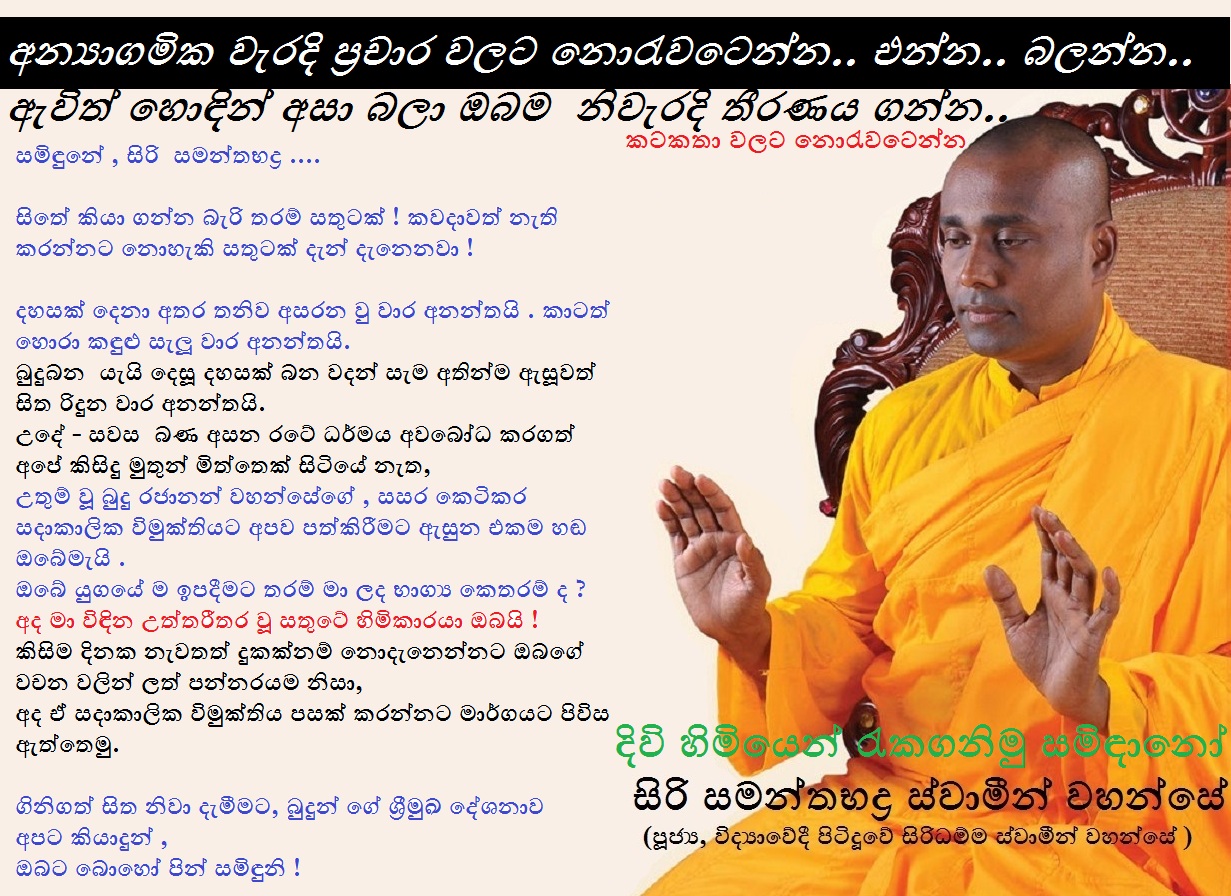
Protect ,Siri samanthabaddra Thero - Pitiduwe Siridhamma Thero
We Must Protect ,Siri samanthabaddra Thero
(Pitiduwe Siridhamma Thero)
 From the Facebook Comments ..
aththa athisatiyen nodana obawahansege surata nigraha karanna baha namuth antharjalaya haraha pitaunu pinthura swaminwahnse gana kalakirimak athi una me karanawala aththa athisatiyen lokayata penanna anna edata obawahanse haraha yana minisun pelagasei namuth e palagasima sathya awabodaya nisa pamanakma siddawewi
Answers :
eewata hamuduruwo pilithuru deela thiyenawaa.. meVideos 2 ma hondin balanna..
( Samanthabaddra Thero has given reply for all the questions and watch below 2 videos at all, without left any moment on the picture.)
PART 1
(Pitiduwe Siridhamma Thero)
aththa athisatiyen nodana obawahansege surata nigraha karanna baha namuth antharjalaya haraha pitaunu pinthura swaminwahnse gana kalakirimak athi una me karanawala aththa athisatiyen lokayata penanna anna edata obawahanse haraha yana minisun pelagasei namuth e palagasima sathya awabodaya nisa pamanakma siddawewi
Answers :
eewata hamuduruwo pilithuru deela thiyenawaa.. meVideos 2 ma hondin balanna..
( Samanthabaddra Thero has given reply for all the questions and watch below 2 videos at all, without left any moment on the picture.)
PART 1
PART 2
Sunday, August 12, 2012
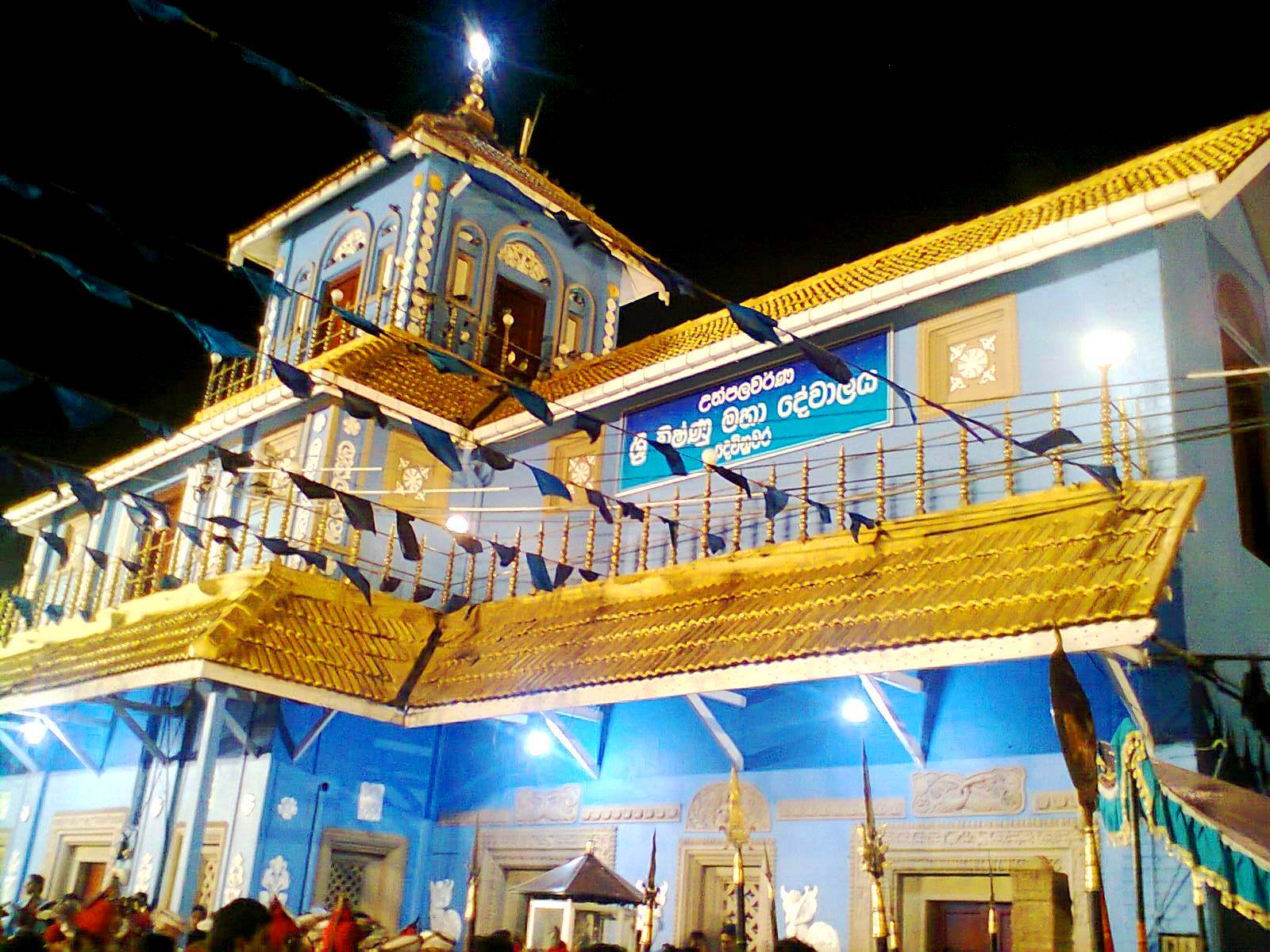
Tracing on Fire at Dondra Sri Vishnu Dewala - Esala Maha Festival 2012
ගිනි පෑගීම - Tracing on Fire at Dondra Esala Maha Festival, Final Day 2012~
~ Video
Sri Vishnu Dewala Festival - 2012
මෙහි මාතර, දෙවිනුවර 2012 ඇසළ මහා උත්සව මංගල්යයේ අවසන්දින 'ගිනි පෑගීමේ' දර්ශන් ඇතුලත්ව ඇත.එමෙන්ම පේළි පෙරහැර සහ අවසන් රන්දෝලි මහා පෙරහැරෙහි ඡායාරූපද මෙහි අඩංගුව ඇත.
ඔබ සැමට ශ්රී විශ්ණු දෙවි පිහිටයි ! තෙරුවන් සරණයි !
The final day of Dondra Festival 2012 with 'Tracing On the Fire' ceremony. Watch the video .


~ Video
Sri Vishnu Dewala Festival - 2012
මෙහි මාතර, දෙවිනුවර 2012 ඇසළ මහා උත්සව මංගල්යයේ අවසන්දින 'ගිනි පෑගීමේ' දර්ශන් ඇතුලත්ව ඇත.එමෙන්ම පේළි පෙරහැර සහ අවසන් රන්දෝලි මහා පෙරහැරෙහි ඡායාරූපද මෙහි අඩංගුව ඇත.
ඔබ සැමට ශ්රී විශ්ණු දෙවි පිහිටයි ! තෙරුවන් සරණයි !


Wednesday, August 8, 2012
ඔබගේ ජංගම දුරකථනයටත්, 100% නොමිලේ ලැබෙන TFGE1 , Free News Alerts
ඔබගේ ජංගම දුරකථනයටත්, 100% නොමිලේ ලැබෙන TFGE1 , Free News Alerts ලබා ගන්න.
f හිස්තැනක් tfge1 ඔබේ දුරකථනයෙන් type කර 40404 ට යවන්න.
F(space)TFGE1
* දවසේ තොරතුරු,
* ලෝකයේ සිදුවනදේ,
* විද්යාත්මක තොරතුරු
* සජීවී කාළගුණ තත්ව වාර්තා
* අධ්යාපනික තොරතුරු
* ක්රීඩා තොරතුරු හා සජීවී ලකුණු තත්ව වාර්තා
* රැකියා අවස්ථා සහ
* ජීවිතය සතුටින් ගෙවන්න පුංචි පුංචි ආරන්චි,
පලමු අවස්ථාවට ඔබගේ ජංගම දුරකථනයට නොමිලේ.
ශ්රී ලංකාවතුල Dialog/ Mobitel/ Etiselat සඳහා පමණයි. මේ අවස්ථාව මගනොහරින්න.

TFGE1 > 100% Free news alerts for your mobile phone... for Sri Lanka and Around the world ....
This is the 1st time in the world , that you will receive 100% free news alerts in SMS's without any monthly rates. in Sri Lanka tupe from your Dialog/Mobitel/ Etiselat phone like this.
F(space)TFGE1 ,and send to 40404
f tfge1 >>> 40404
* Home News
* World News and what is going in the world
* sports news and Live Scores
* Science Information
* Live Weather report
* Educational Information
* Job opportunity
* Tips for live happily in your life
and more on.. for your mobile.
Type from your mobile as SMS , and send for below numbers according to your living country.
F TFGE1
means, f(space)tfge1 and send to...
| Country | Mobile Operator | ShortCode | Supporting: | Notes | ||
|---|---|---|---|---|---|---|
| SMS | MMS | |||||
| Satellite Provider | Thuraya | 1888 | ✔ | |||
| Inmarsat | 898 | ✔ | ||||
| Iridium | 40404 | ✔ | ||||
| Afghanistan | Roshan | 40404 | ✔ | |||
| Etisalat | 40404 | ✔ | ||||
| Argentina | Movistar | 89338 | ✔ | |||
| Personal | 89338 | ✔ | ||||
| Claro | 89338 | ✔ | ||||
| Nextel | 89338 | ✔ | Nextel only supports sending updates to Twitter | |||
| Aruba | Digicel | 176 | ✔ | |||
| Antigua | Digicel | 176 | ✔ | |||
| Anguilla | Digicel | 176 | ✔ | |||
| Australia | Telstra | 0198089488 | ✔ | |||
| Azerbaijan | Bakcell | 4040 | ✔ | |||
| Bahrain | VIVA | 88000 | ✔ | ✔ | ||
| Zain | 98555 | ✔ | ✔ | |||
| Bangladesh | Airtel | 9594 | ✔ | |||
| Citycell | 9594 | ✔ | ||||
| Belarus | life:) | 40404 | ✔ | |||
| Bermuda | Digicel | 176 | ✔ | |||
| Brasil | TIM | 40404 | ✔ | ✔ | ||
| Nextel | 40404 | ✔ | ||||
| Bhutan | B-mobile | 40404 | ✔ | |||
| Bolivia | Entel | 40404 | ✔ | |||
| Tigo | 40404 | ✔ | ||||
| Viva | 40404 | ✔ | ||||
| Bonaire | Digicel | 176 | ✔ | |||
| Botswana | Mascom | 13123 | ✔ | |||
| Canada | 21212 | ✔ | MMS supported for Bell Mobility, Rogers Communications, and Telus Mobility. | |||
| Cambodia | Cellcard | 40404 | ✔ | |||
| Smart Mobile | 40404 | ✔ | ✔ | |||
| Cameroon | MTN | 8711 | ✔ | |||
| Colombia | Tigo | 40404 | ✔ | |||
| Côte d'Ivoire | MTN | 4443 | ✔ | |||
| Curacao | Digicel | 176 | ✔ | |||
| Democratic Republic Congo | Tigo | 40404 | ✔ | |||
| Vodacom | 40404 | ✔ | ||||
| Republic of Congo | MTN Congo | 6060 | ✔ | |||
| Denmark | Telmore | 40404 | ✔ | |||
| Egypt | Vodafone | 4040 | ✔ | |||
| El Salvador | Digicel | 40404 | ✔ | |||
| Tigo | 40404 | ✔ | ||||
| Movistar | 40404 | ✔ | ||||
| Fiji | Digicel | 40404 | ✔ | |||
| Vodafone | 40404 | ✔ | ||||
| Georgia | Beeline | 40404 | ✔ | |||
| Geocell | 40404 | ✔ | ||||
| Magticom | 40404 | ✔ | ||||
| Grenada | Digicel | 176 | ✔ | |||
| Guatemala | Tigo | 40404 | ✔ | |||
| Movistar | 40404 | ✔ | ||||
| Guinea Conakry | MTN | 40404 | ✔ | |||
| Guyana | Digicel | 1443 | ✔ | |||
| Haiti | Digicel | 40404 | ✔ | |||
| Voila | 40404 | ✔ | ||||
| Honduras | Digicel | 40404 | ✔ | |||
| India | Bharti Airtel | 53000 | ✔ | ✔ | ||
| Reliance | 53000 | ✔ | ||||
| Videocon | 53000 | ✔ | ||||
| TATA DOCOMO | 53000 | ✔ | ||||
| Indonesia | AXIS | 89887 | ✔ | |||
| 3 | 89887 | ✔ | ||||
| Telkomsel | 89887 | ✔ | ||||
| XL Axiata | 89887 | ✔ | ||||
| Bakrie Telecom | 89887 | ✔ | ||||
| TelkomFlexi | 89887 | ✔ | ||||
| Indosat | 89887 | ✔ | ||||
| Iraq | Zain | 71117 | ✔ | |||
| Asiacell | 1432 | ✔ | ||||
| KOREK | 9988 | ✔ | ||||
| Ireland | Vodafone | 51210 | ✔ | |||
| Meteor Mobile | 51210 | ✔ | ||||
| Isle of Man | Manx | 89887 | ✔ | |||
| Sure (CWC) | 86444 | ✔ | ||||
| Italy | Wind | 4880804 | ✔ | |||
| Vodafone | 3424486444 | ✔ | ✔ | |||
| TIM | 3399940424 | ✔ | ||||
| Jamaica | Digicel | 176 | ✔ | |||
| Jordan | Zain | 90903 | ✔ | ✔ | ||
| Umniah | 98788 | ✔ | ✔ | |||
| Kazakhstan | Beeline | 4040 | ✔ | |||
| Kcell/Activ | 4040 | ✔ | ||||
| Kenya | Safaricom | 89888 | ✔ | |||
| Airtel | 40404 | ✔ | ||||
| Kuwait | Zain | 89887 | ✔ | |||
| VIVA | 89887 | ✔ | ||||
| Korea | LG U+ | #1234 | ✔ | |||
| Kosovo | Ipko Kosovo | 16161 | ✔ | |||
| Kyrgyzstan | Megacom | 4040 | ✔ | |||
| Beeline | 4040 | ✔ | ✔ | |||
| Liberia | Cellcom | 4040 | ✔ | |||
| Macedonia | VIP | 40404 | ✔ | |||
| ONE | 40404 | ✔ | ||||
| Madagascar | Zain | 335640404 | ✔ | |||
| Malaysia | Maxis | 28933 | ✔ | |||
| Tune Talk | 28933 | ✔ | ||||
| DiGi | 28933 | ✔ | ||||
| Celcom | 28933 | ✔ | ||||
| Maldives | Wataniya | 4040 | ✔ | ✔ | ||
| Mexico | Nextel | 6464 | ✔ | |||
| Telcel | 6464 | ✔ | only supports sending updates to Twitter | |||
| Montenegro | Telenor | 14774 | ✔ | |||
| Morocco | inwi | 404 | ✔ | |||
| Nauru | Digicel | 40404 | ✔ | |||
| New Zealand | Vodafone | 8987 | ✔ | |||
| Telecom NZ | 8987 | ✔ | ||||
| Nicaragua | Movistar | 89887 | ✔ | |||
| Nigeria | Zain | 40404 | ✔ | |||
| MTN | 40404 | ✔ | ||||
| Glo Mobile | 20644 | ✔ | ||||
| Visafone | 40404 | ✔ | ||||
| Oman | Nawras | 90914 | ✔ | |||
| Omantel | 91200 | ✔ | ✔ | |||
| Pakistan | Mobilink | 40404 | ✔ | |||
| Zong | 40404 | ✔ | ||||
| Ufone | 40404 | ✔ | ||||
| Telenor | 40404 | ✔ | ✔ | |||
| Waridtel | 40404 | ✔ | ||||
| Palestinian Territories | Wataniya | 40404 | ✔ | |||
| Jawwal | 37373 | ✔ | ||||
| Panama | Digicel | 3010 | ✔ | |||
| Movistar | 89887 | ✔ | ||||
| Papua New Guinea | Digicel | 40404 | ✔ | |||
| Paraguay | Personal | 40404 | ✔ | ✔ | ||
| Tigo | 40404 | ✔ | ||||
| Romania | Vodafone | 89338 | ✔ | |||
| Cosmote | 89338 | ✔ | ||||
| Russia | Beeline | 8080 | ✔ | |||
| MegaFon Moscow | 7070 | ✔ | ||||
| Rwanda | MTN | 3434 | ✔ | |||
| Saudi Arabia | STC | 840404 | ✔ | |||
| Zain | 710001 | ✔ | ||||
| Mobily | 606040 | ✔ | ✔ | |||
| Serbia | Vip mobile | 40404 | ✔ | |||
| mt:s | 40404 | ✔ | ✔ | |||
| Telenor | 40404 | ✔ | ||||
| Seychelles | Airtel | 9695 | ✔ | |||
| Cable & Wireless | 9695 | ✔ | ||||
| Sri Lanka | Dialog | 40404 | ✔ | |||
| Telecom Mobitel | 40404 | ✔ | ✔ | |||
| Etisalat Lanka | 40404 | ✔ | ||||
| St. Lucia | Digicel | 176 | ✔ | |||
| St. Vincent | Digicel | 176 | ✔ | |||
| St. Kitts | Digicel | 176 | ✔ | |||
| Sudan | Zain | 40404 | ✔ | |||
| Sweden | 3 | 71017 | ✔ | |||
Tanzania
| Tigo | 15508 | ✔ | |||
| Tonga | Digicel | 4040 | ✔ | |||
| TCC - UCALL | 1040 | ✔ | ||||
| Trinidad and Tobago | Digicel | 40404 | ✔ | |||
| Tunisia | Tunisiana | 871220 | ✔ | |||
| Turkey | KKTC Telsim | 2444 | ✔ | |||
| Vodafone | 2444 | ✔ | ||||
| Turkcell | 2555 | ✔ | ||||
| Uganda | MTN | 179 | ✔ | |||
| UK | Orange | 86444 | ✔ | ✔ | ||
| Vodafone | 86444 | ✔ | ✔ | |||
| O2 | 86444 | ✔ | ✔ | |||
| 3 | 86444 | ✔ | ||||
| Sure (CWC) | 86444 | ✔ | ||||
| Ukraine | life:) | 40404 | ✔ | |||
| United Arab Emirates | du | 8080 | ✔ | |||
| Uruguay | Antel | 40404 | ✔ | |||
| US | 40404 | ✔ | MMS Support for AT&T, Verizon, C Spire, US Cellular, MetroPCS | |||
| Uzbekistan | Beeline | 89338 | ✔ | ✔ | ||
| Ucell | 89338 | ✔ | ||||
| Venezuela | Movistar | 89338 | ✔ | |||
| Yemen | MTN | 7070 | ✔ | |||
Subscribe to:
Posts (Atom)
