| Ruwanveli Seya gets ready for Poson Poya | |
| By D.C. Ranatunga - The Sunday Times | |
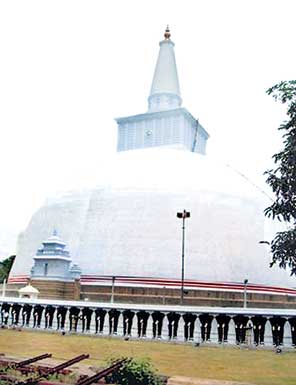
It's around six in the evening. We are in the 'salapatala maluva' - the stone-paved compound at Ruwanveli Seya, the hallowed place of worship in Anuradhapura. This is the area where devotees offer flowers and other offerings and worship the stupa. We hear cries of 'sadhu', 'sadhu'. We look towards the main entrance. What a sight! Devotees of all ages – men, women and children – come up the steps and start going round the stupa carrying a deep brown robe. The robe is spread out and they carry it above their heads.
The cries of 'sadhu' continue. It looks a never-ending procession. They are carrying a robe 280 metres long, sufficient to go right round the stupa. We watch the procession gradually moving away from us. Once a full round is made, a few monks climb on to the area just above the three terraces ('pesavas') and start placing the robe to cover the stupa. This is the climax of an annual event after the Ruwanveli Seya gets a new coat of paint in time for Poson Poya when devotees in their thousands throng to the holy city. Annually 'sudu hunu' – a mix of chunam and salt - is applied to give a new look to the great stupa. On completion of the gigantic task, which is administered by the office of the Public Trustee, a 'pinkama' is held. A robe or the Buddhist flag is spread out covering the stupa, 'Buddha puja' is offered, and a monk delivers a sermon tracing the history of the Ruwanveli Seya and explaining the tremendous amount of merit gained by the devotees who undertake this mammoth task. The cost of the operation has been rising year after year and today stands at Rs. 3.5 million. Ten years ago the figure was around Rs. 500,000. The wages for about 50 workmen for a period of nearly three months in itself add up to a tidy sum. Yet there is never a problem in finding philanthropists to undertake the job. If no one comes forward, the Public Trustee publishes an advertisement in the newspapers. The response has always been most favourable. With Poson just a few days away, the dagoba is a blob of white. When lights are switched on at 6.30 in the evening, it's a beautiful sight. The dagoba as well as the compound is well illuminated. A cool breeze blows across. There is silence all round. It's an ideal setting for the devotees to recite the stanzas, to chant 'pirith' and to meditate. For security reasons, gates are closed at 9 p.m. About the stupa Though not the tallest stupa in Anuradhapura, Ruwanveli Seya is the most impressive and imposing possibly because over the years it has been maintained well. Referred to as the Maha Thupa in the Mahavamsa, Great Chronicle, it was built by warrior king Dutugemunu in the 2nd century B C to a height of 73.2 metres. The fact that a large quantity of corporeal relics of the Buddha had been enshrined in the stupa makes it so popular among the devotees. Many are the legends relating to the construction of Ruwanveli Seya. The way the materials had been obtained is fascinating reading. As for the design, a master-builder named Sirivaddhaka is supposed to have taken a golden bowl filled with water, poured a little water into his hand and let it fall on the surface of the ball. Then a great bubble rose up. "Thus will I make it," the master-builder said. King Dutugemunu liked it and rewarded him with cash and kind. |

Thursday, July 24, 2008
Ruwanveli Seya In Sri Lanka , For the Last Poya Day


A simple man with many a talent - Kalakeerthi Pandit Wimal Abhayasundara
| A simple man with many a talent Kalakeerthi Wimal Abhayasundara --- The Sunday times | |
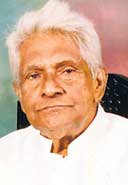
Sinhala poet and writer Kalakeerthi Pandit Wimal Abhayasundara, passed away on the morning of Thursday, June 12 at the age of 87. Poet, lyricist, art critic, scholar, veteran author and musicologist, he was born on September 17, 1921 in Welitota in Galle. He had his primary education in his village and his secondary education in Galle. His spoken language as well as written language was Sinhala and he was also conversant with Sanskrit, Prakrit, Pali, Hindi and English. Though he moved away from the village, he loved the rural landscape, the coconut and cinnamon plantations, the sea, the islands of the Madu Ganga by the side of his village.
In the past seven decades during which he had become a well-known literary figure in Sri Lanka, he had published about one hundred books, collections of poems, short stories and novels. Some of his books on poetry and prose have been translated into English, Yugoslavian, Chinese and Malay. Wimal Abhayasundara started his career as a journalist and worked as a sub-editor on both daily and weekly newspapers. In 1955, he was appointed sub-editor in the first Editorial Board of the Sinhala Encyclopaedia. In 1958, he joined the Sri Lanka Broadcasting Corporation as script writer in the Sinhala service. He was promoted to drama organizer and Editor, Publications. He also composed and produced musical programmes and radio operas. In 1964, he followed a six-month course in broadcasting television at the BBC in London on a Commonwealth scholarship. He travelled extensively in countries such as India, UK, France, Switzerland, Germany, Egypt, Yugoslavia, Chjina and Malaysia. He represented Sri Lanka at international poets’ conferences in Yugoslavia and Malaysia. As an author, his interest lay in experimenting with various styles of composition. Though he had a vast knowledge of Sinhala literature, he was also deeply interested in world literature, especially third world literature. Four of his books won State Literary Awards and three won first prize in All-Island competitions. His first State Literary award was for a book of poetry in 1936. His most recent works were Conquering Hearts (in English) and Manesa (Mind’s Eye) in Sinhala, published in 2005. He was honoured with the Kalakeerthi award by the Government of Sri Lanka in 1992 and received the Mahakavi award from the Aganuwara Tharuna Kawi Samajaya in 2006. In 1994, the book ‘Wimal Abhayasundara Samprasadawa’ and in 2007, ‘Aseniya Kusum’ was published in appreciation of his services to literature. At the diamond jubilee conference of All-Ceylon Poets Association, he was honoured with the ‘Kavya Kala Parameshwara’ award. It was his wish that he make his last journey in a simple manner, without flower wreaths, flags, decorations, banners, posters, cutouts and polythene disfiguring the environment. |
Meditation: The key to being mindful
| Meditation: The key to being mindful | |
| By Rajah Kuruppu - The Sunday Times. LK | |
The human being comprises mind and body. Modern medical science is now according an important place to the mind, but over 2, 500 years ago the Buddha emphasized the invaluable role of the mind. In fact, the opening lines of the Dhammapada, a collection of important sayings of the Buddha, state that the mind is the forerunner of all states of being, mind is supreme, mind made are they. Accordingly, Bhavana, commonly translated to English as meditation, is assigned an important role in the practice of the Dhamma. Bhavana means the culture or the development of the mind and perhaps the English word meditation does not adequately describe Bhavana but it could be used for want of a better word, provided the true meaning of the term Bhavana is understood.
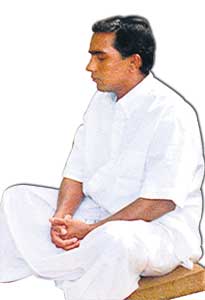
There are two kinds of Bhavana-- Samatha or the pointed concentration of the mind on a wholesome subject to the total exclusion of any others and Vipassana Bhavana (insight Bhavana) or to see things as they truly are as anicca, dukkha and anatta or impermanence, unsatisfactoriness and the absence of a permanent, enduring, unchanging self or soul or ego. Importantly, Bhavana also includes sati or mindfulness, to be aware of all activities of the body, feelings, thoughts and phenomena. So, on one hand there is the formal Bhavana where one sits in a given posture and on the other, the informal, where one is aware of one's activities all the time. Objective and results The final objective of Bhavana is to overcome the root mental defilements of greed, aversion and delusion, to see things in their true perspective and realize the Buddhist goal of Nibbana. However, there are benefits to be gained here and now if Bhavana is practised in the correct manner, namely, the decline of negative emotions such as the deep desire for pleasures, aversion, conceit, jealousy and the gradual development of Upekkha or balance of mind to face better the vicissitudes of life, the pleasant and unpleasant experiences. It is often remarked that many who engage in Bhavana do not reflect on their behaviour-- the decline of negative qualities mentioned earlier or the development of positive values such as metta - loving kindness, karuna -compassion, mudita - joy in the success of others and Upekkha - equanimity or balance of mind. This may be due to many confining their Bhavana to formal practice in the recommended posture for a specific period of time in the morning and night and believing that they have performed their task for the day. Actually Bhavana should be undertaken as a full-time exercise where one has sati or mindfulness of all activities throughout one’s wakeful life. In relating Bhavana to everyday life, one should be aware of what is happening in the mind and the body as often as possible. This observation should be undertaken wherever you are, whether it is at home, at the place of work, driving or being driven in a vehicle, exercising, during leisure and ablutions. One should also be alive to one's posture—whether it is sitting, standing, walking or reclining. When one is aware of what is happening in the mind and body, one is in the present. The Buddha advised His disciples to be in the present and not in the past which is already gone and which we have no control of or the future that has not yet come. We have to plan for the future, but that should be done with our feet on the ground in the present. Breath Bhavana One of the best ways to be in the present is to anchor the mind to the anapana sati Bhavana or mindfulness of inhaling and exhaling the breath. The breath is always with us from birth to death and some Bhavana masters say that it is our best friend that will never desert us through life. The Buddha has prescribed a precise posture for this Bhavana -- to be seated upright on the ground or on a chair, looking forward, hands on the lap one over the other and eyes closed or slightly open. However, this does not mean that one should not observe the breath in any posture and at any time. It is said that when one is agitated, depressed or even overjoyed, the concentration on the breath for a short time would bring the mind to a state of balance and develop the great quality of Upekkha or equanimity. This is an important aspect in the mindfulness of the activities of the body. The well known Bhavana master, Ven. Henepola Gunaratana Nayaka Thera, Head of the Theravada Buddhist Meditation Centre and Forest Monastery in West Virginia, USA, in a recent Buddhist discussion with this writer over the English Services of the SLBC recommended the practice of Bhavana on the breath for one minute every hour. This would help he said to calm the mind which is often bombarded with sense stimuli and consequently confused and disturbed. This is relating Bhavana to daily life and it would help to be in the present and engage in the mindfulness of all activities, mental and physical. To be in the Bhavana mode in daily life one should also observe the thoughts. During wakeful hours thoughts occur in the mind, about oneself, others or both. They could be thoughts of the present, past or future. When observing the thoughts it is realized how often they are of the past and the future and seldom on the present except in a well trained mind. Through mindfulness, our task is to wean away from unwholesome thoughts to wholesome ones. In everyday life we have our emotions and experiences, some pleasurable, some not so and others neutral. We have a problem with unpleasant emotions and experiences as we do not like them. One way to dissolve the unpleasant experience is to make it a subject of Bhavana. If there is pain you concentrate on the pain. Unbearable and excruciating pain due to serious ailments has been eventually overcome by practising Bhavana on the experience of pain. Initially, it is said that the pain would be aggravated by being alive to it but by persistent effort it could be overcome. Another unpleasant experience is the problem we have with some people with whom we associate in life. If there is a person who makes life difficult or even miserable, we should treat that person not with ill-will but as a teacher. He teaches us or provides us an opportunity to develop the great quality of patience or santi. We could also observe our mental reaction to the trouble maker and see that the problem is not so much with the other person but our own way of relating or reacting to him. If we react with sympathy, understanding and goodwill considering that that person may have a problem or deficiency and extend compassion to him, a better relationship could perhaps be established. In any event that person provides us an opportunity to observe our own mind in a difficult situation. Pleasant emotions and experiences also give rise to problems. They encourage negative factors such as over confidence and conceit which could lead towards one's own down- fall. So we should be mindful of accepting our successes with a sense of humility and equanimity noting that they are also impermanent and a passing show. If we are mindful of our thoughts we would be vigilant and careful before speaking and acting. Gradually, we will become aware before speaking and acting reflecting whether what we intend to say or do is harmful to us or others. Thus our intended speech or action could be modified or totally withdrawn if necessary. Thus, one should not confine one's Bhavana only to formal Bhavana undertaken in the usual Bhavana posture. It should be extended to the mindfulness of daily activities in wakeful hours, both physical and mental, as far as possible. For the latter exercise the training that is developed in formal Bhavana is undoubtedly an asset. |
The cultural dimension of Poson
| The cultural dimension of Poson | |
| By Lenard R. Mahaarachchi | |
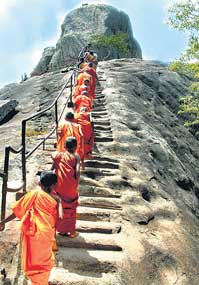
This week, Sri Lankan Buddhists celebrate Poson Poya. It is no exaggeration to say that the Lankan culture and Poson Poya are synonymous. History says it was on a Poson Poya day that Arahath Mahinda, son of the great King Asoka of India, and a group of missionaries came to Sri Lanka to spread the word of the Buddha.
Asoka was a harsh king. He was known among his subjects as “Chandasoka”, meaning “cruel Asoka”, but after embracing Buddhism he came to be known as “Dharmasoka”. He accepted the new religion that was fast spreading in his native India and wished to propagate the Buddha Dhamma in the island adjacent to his country. Arahath Mahinda, after putting King Devanampiyatissa to the test with a series of questions and satisfying himself on the matter of the king’s wisdom, then introduced the Buddhist philosophy to Sri Lanka. This year’s Poson marks the 2,311th year of that historic event. The Sinhala king accepted Buddhism, and the people of the country followed. This acceptance resulted in a cultural revolution, coloured by the teachings of the great teacher, Lord Buddha. The Sinhala culture became a Buddhist culture, and so it has remained ever since. The meeting of King Devanampiyatissa and Arahath Mihindu at Mihintale (the present Missaka Pawwa), was a defining moment in our history. Foreign invasions and incursions have, to some extent, modified the cultural identity of the Sinhala Buddhists, especially in maritime areas where, since the 15th century, the Portuguese, the Dutch and the British ways of life have influenced the local culture. Sinhala customs have their roots in Buddhism. The Sri Lankan Constitution requires that the head of state be a Buddhist. With that first Poson, 2,311 years ago, Buddhism and the Sinhala culture became one. The Poson experience has led Sri Lankans to believe that the Lord Buddha chose Lanka as the place that would preserve his teachings. Lankans believe the nation was reborn on that august day. Non-Buddhists appreciative of the Buddhist way of thinking would gain insights into the country’s ethnic, cultural and religious character. This awareness leads to a deeper understanding of the country. It is only through such an understanding that all communities in Sri Lanka can live in peace and harmony. |
--- The Sunday Times
Saturday, July 5, 2008
We are going to have a new website .................
Star Lanka Online Dot Com
we proudly present our new fixed web site,
www.starlankaonline.com in very near future. Also we are going to keep our download files like Dialog TV Monthly Programme Guide ( Unofficial ) , songs, TV Programmes and many more. That's why we were so silent past few weeks without many posts. But these free blogs remain same as before with new posts.
Many thanks to
Mr. Tharindu Shashindra webmaster of, www.arunella.com
and
Mr.K.D.Manuka Lakshitha , the webmaster of www.srizone.net
. Who are the ones , show us the way.
Await......
With More ....
Star Lanka Online Dot Com,
coming to your PC ...........
Click here
Tuesday, June 10, 2008
The actual meaning of refuge in the Triple Gems and the Precepts, for the lay person
The Lord Buddha showed us the Eightfold Path as the only way for the eternal ending of suffering - the attainment of Nirvana. This is something that the Buddha realized by himself and preached to the world. Eventhough he was knowledgeable in everything in the whole universe in and out, the Great Teacher taught primarily as to how to end suffering. Therefore, the teachings mainly revolve round and incorporate the essence of His Declaration that 'the cause of suffering is attachment and the only way to end suffering 'is non-attachment'. As such, the recitals -in Pali - the language in which the Buddha preached - for daily chanting for the lay person pertaining to 'taking in refuge' and the Precepts also were meant to go along with this concept.
These teachings of the Buddha can be correctly interpreted only by a person who is enlightened upon them i.e. by an Arahant. But down the years many of those who had translated the Teachings from Pali to other languages, had not been Arhants and had not even being the achievers of the lower ranking Super Mental Status and as such they had mis-interpreted the right meaning. Some of these authors were Indian and they have even incorporated ritualistic aspects of Hinduism into Buddhist teachings. Because of this what Buddha really meant in His Teachings has become clouded, buried under, with the result that an intelligent learner often gets confused and the follower misled. Thus it is understood that there are a number of misinterpretations to Buddha's Teachings but only one actual meaning. This actual meaning is the one which is in relevance to the Eightfold Path and the one which the Buddha really meant. Therefore, it fits right into the Eightfold Path. The actual meaning is quite intriguing. and interesting to the learner. It is useful to know the actual meaning of the verses so that the chanting becomes understandable and meaningful. This however does not mean that the conventional meaning of these disciplines is not significant because a careful study of the actual meaning of these shows that the former is already incorporated in the latter. The actual and conventional meanings of the reverence, the refuge and the precepts are shown in comparison here for the reader to have a right understanding of these.Vesak Reflection on the Medical Profession
‘Physicians’ as the very term implies deal with the body, which is subject to sickness, decay and death. As such physicians seem to be engaged in a Sisyphean task – an absurd, but for many lucrative, preoccupation devoted to propping up what Shakespeare called "this muddy vesture of decay". But if we shed the devaluation of the body on the basis of an assumed dichotomy of body and soul or the body and a rebirthing identity consciousness in mainstream Buddhism, we will have an exhilarating perspective on human existence. It helps us to cultivate a holistic view of the human person as a totality of vital processes or synergies. Whatever our religion, ethnicity or social status all human beings are subjected to the paradoxical character of the human condition. We must all die. What ethics has the science of medicine to teach us?
In Genealogy of Morals German philosopher Friedrich Nietzsche inquired into the historical origins of our moral concepts of ‘good’ and ‘evil’. Nietzsche’ writings are remarkable for the absence of footnotes. But there is one rare footnote in Genealogy of Morals..In it he questions the value of rational or intellectual philosophical constructs of ethical imperatives and speaks of the need "to reconfigure the relationship between philosophy and physiology and medicine". All our moral tablets of "dont’s", he adds, "wait upon a critique on the part of medicine". His meaning is clear; the critique on the part of medicine will make us ‘physio-logical’.
This means that every physician critically reflecting on the object of his profession could become the noblest of moral philosophers. This is because a physician in his surgery must keep his mind well earthed to tangible facts not fancies.
Physicians and health-carers are situated at the cutting edge of life and death and are everyday and night experiencing anicca and anatta. Therefore they, more than any other professional, including religious professionals, are in a privileged position to grasp the finiteness, the fragility and the perishability of human life. This is what makes life precious and sacred, not because it is an earnest of another more sublime life but because it is ephemeral and fraught with fragility. To live for another life, as Nietzsche pointed out, is to devalue this life on behalf of another. Physicians should be in the forefront of those who stand up for this life and speak up on issues which diminish and destroy life through war, reckless road use, unhygienic social conditions and medical malpractices because they are confronted with the tragic victims of these atrocities day in and day out.
Physicians follow the life process from the moment of conception to death. From the womb to the tomb; they follow the process of growth, the occurrence of illnesses, onset of the process of decay and physical infirmity and the final breakdown we call death. The physician perhaps more than any other professional is an intimate and daily witness of the ravages of disease and decay. They smell the stench of putrefying flesh while life still lingers, they see the way beauty withers, strength fades and how life ceases. This is also really his/her condition. The physician more than any other can see the relativity of things we cling to, pride of caste, family or class, social status and wealth. The physician has by his/her very profession the possibility of becoming a sage and a saint. In fact one of the pledges undertaken by the Hippocratic Oath is, "With purity and with holiness I will pass my life and practice my Art". If life is sacred, a physician treating a sick person is standing on holy ground.
It is customary to refer to people who come to be ministered by physicians as ‘patients’ A ‘patient’ is one who suffers illness and is a passive object subjected to the supervision and judgement of physicians – who are regarded as the competent speakers on the condition of the suffering ’other’. This perception of the doctor ‘patient’ relationship is reinforced by the ideological paradigm of Western medicine, which is the dominant form of medical practice in Sri Lanka. Western medicine is very strongly influenced by Cartesian and Newtonian asumptions of the mind as the sovereign subject (res cogitans – thinking substance) of thought and external reality as the object of thought and action (res extensa – material substance)
The body of the ‘patient’ is seen as ‘the other’ – the passive object of a physician’s invasive intervention. Physicians tend to forget that the seriously ill ‘object’ is a human person of flesh and blood in an acute state of distress – or dukkha – that he/she has equally distressed loved one’s like the physician and his/her similarly afflicted loved ones.
The Newtonian- Cartesian model of the world on which Western medicine developed has been superseded at the sub atomic level by quantum physics. Professor Carl von Weizsacker, German atomic physicist and philosopher, was interviewed in a Dutch TV programme on the challenge posed by the New Physics to religion and philosophy. The New Physics, the professor commented, calls for a new understanding of our world and a new ethical attitude to life and the world we live in. I quote from the transcript:
Consider the implications of quantum theory. In quantum theory we are describing the behaviour of stars and atoms and produce tables and figures as if we are spectators. But at the same time we realize, and we are reminded so profoundly of that old truth already understood by the Buddha that we are in fact telling our own story. Our own bodies consist of atoms; our own lives are part of that nature we are analyzing. We cannot separate it. We cannot speak of nature as if we did not belong to it. That is more or less the message of quantum theory. Now look at all the immense number of beings who are born, who live and die, who suffer because all life is suffering according to Buddha. But you cannot speak of this truth as something outside yourself, you yourself are born and you will die and you are going through a life of suffering because you build your life on false expectations which are frustrated, And in this situation you cannot distinguish between the onlooker - the one who looks and the one who is looked. You are one and the same you are in both roles at the same time.
It must become evident to mindful physicians that they are in the patient-healer roles at the same time. The microbes, the viruses, the bacteria in the patient, may be in the doctor himself. The blood pressure, the blood and urine samples studied are no different to what are measured in physician’s own body. The carcinoma, the weakened heart muscle or affected kidney or liver is no different to potential ailments in the organisms of physicians..Physicians heal bodies but do not have extra corporeal immunity.
Instead of the ‘object-other’, suffering patients who passively ‘suffer’ the all powerful gaze and determinations of physicians should evoke anukampa and karuna because the patient’s story of his-her ailment is also the physicians story. The patient is morphologically and physiologically no different to the physician. The form is the same, the heart is the same, the lungs ,the digestive processes, the genitals, the reproductive act, – conception and the birth processes are the same as that of the physician and his/her spouse, their children and parents. The orifices of the body and what ‘enters’ and ‘exits’ are similar. The difference of para /apara – ‘other’ and ‘not other’ should dissolve and with it the Buddha’s norm should come to mind "In protecting myself I protect others. In protecting others I protect myself".
Physicans and physiologists can come to a realisation of the fundamental equality of all humans beings, better than any bookish professor of law. The birth process is the same even if it takes place in the luxury of an air-conditioned delivery room with the best of gynecologists in attendance or in a wretched refugee camp. The little new born baby of affluent parents is as much a human as the child of impoverished parents. A virus can afflict the rich as well as the poor, even though the poor are more prone to sickness because of their weak physical condition as well as unhygienic environments.
We need body wisdom. It is the head which attaches ethnic labels and speaks of Sinhala, Tamil or Muslim. The profane stomach is innocent of such discrimination. The concepts of the womb are far less discriminating than the ‘concepts’ of the head. The womb can take the seed of a man of any race, caste or ethnicity and deliver a human child. What divides us is not our physiology but the conceits in our heads. If the doctor is not an ethnocentric or a class conscious prig, he must know that there is no such thing as a distinctive Sinhala, Tamil or Muslim features on the human body. "Not in the head the mouth, the eyes, the ears, the breast, etc., and not even in the genitals, which could divide humans into different species", as the Buddha pointed out in the Vasettha Sutra. If there were, there could be no universally effective medicine or surgery. The same course of medicine prescribed will heal irrespective of whether a physician is a Sinhala Tamil or Muslim and the patient Sinhala, Tamil, or Muslim. This is not some abstruse theory. It is happening everyday in real life in every clinic in every hospital. When a blood transfusion is needed only a bigot will ask who whether the patient and donor is Sinhala, Tamil or Muslim, There are no such blood types. We strip to be examined or are stripped for a major operation. The white cassock or the saffron robe, the skull cap and the pottu and burkah are of no consequence. We ‘dress ourselves up’ to demarcate differences. Naked and under the skin we are the same. Every doctor knows this.
Perhaps the best place to start a movement for radical democracy is not the temple or the parliament, but the hospital ward and the clinic. But this is where doctors and health workers hold poor patients to ransom by going on strike at the drop of a medical cap. Sickness does not discriminate. Therapists often do, though their very profession should compel democracy – the democracy of the body – not the proud sectarian ‘spirit’. Physicians must be in the forefront of those who are struggling to defend the sanctity of life and the right to the fullness of life.
Given this inexorable subjection to a common condition, the attitude of haughty and uncaring physicians and of uncaring health workers is incomprehensible. Doctors infected by the curse of commercialism seem to think that a ‘bill of health’ depends on the size of a purse. It is this cupidity and callousness which is paradoxical because: Each day doctors see fellow humans die, yet, many live and behave like immortal gods!
All life is passing passage. What nobler vocation can there be than to be called to ease the suffering of one's fellow human beings and help them live in good health and in wholesome and secure conditions? What greater joy can there be than this? The lure of pecuniary benefits and the luxuries they bring can hardly compare with the satisfaction that comes from serving one's suffering fellows - especially the poor and the powerless. Physicians have the potential to become noble men and women whose outlook on life is inspired by the compassionate prayer: sakale sathveyan niduk vethwa; sakala sathavyan nirogi vethw;, sakala sathavyan suvapath vethwa – May all beings be free of sorrow, may all beings be free of disease, may all being be well..
(This is the text of a lecture on Buddhism and Medical Ethics delivered at the SLMA auditorium in 2003. A summary was published in the February 2008 Bulletin of the College of General Practitioners ofSri Lanka.)
Full moon Poya day of Vesak – 2552
Today is the full moon Poya day of Vesak in the Buddhist year 2552, as well as the 19th day of May 2008 as per the Gregorian calendar – the day on which the birth, the englightenment and the final passing away of the Buddha occurred within a span of 80 years over two and half millennia ago, exactly 2632 years ago today.
A noble prince who was destined to be the greatest religious teacher of the world was born on the full moon Poya day of Vesak in the year 623 BC at Lumbini Park at Kapilavattu on the Indian borders, to the King Suddhodana of the aristocratic Sakya clan, the ruler of the sakyas (in the modern Nepal) and the queen Maha Maya of the Koliya clan.
On the fifth day after the birth of the prince he was named Siddhartha which means ‘wish fulfilled’. On the seventh day Queen Maha Maya breathed her last. Then the Queen Maha Prajapathi Gothami, the other consort of the King as well as the younger sister of the queen Maha Maya gave her own son Nanda to a nurse and brought up Prince Siddhartha as her own son.
He was given a very good education. His teacher was Sarva Mitra. As a scion of the warrior class he received special training in the art of warfare too.
According to the customs of the time, he married at the young age of 16, Princess Yasodara. She was his cousin of the same age. They spent a very luxurious life. But all of a sudden, confronted with the reality of life and the suffering of mankind he murmered to himself: "Why do I, being subject to birth, decay, death, sorrow and impurities, thus search after things of like nature?"
So he decided to find the solution – the way out of this universal suffering.
Soon after the birth of his only son Rahula, he left his Kingdom and became an ascetic in search of this solution at the age of 29.
He wandered about the valley of Ganges for six years meeting famous religious teachers such as Alara Kalam and Uddaka Ramaputta, studying and following their systems and methods and submitting himself to rigorous ascetic practices. Any of them did not satisfy him. He abandoned all those traditional religious practices and methods and went his own way.
He felt that his quest for highest truth was not achieved. He had gained complete mastery of his mind, but his ultimate goal was not far ahead. He was seeking for the highest, the Nibbana, the complete cessation of suffering, the total eradication of all forms of craving.
He understood that his spiritual aspirations were far higher than those under whom he was studying. Further he understood that there was none capable enough to teach him what he yearned for – the highest truth. Ultimately he realized that the highest truth is to be found within oneself and ceased to seek external aid.
He, the ascetic Gothama, wandered through the district of Magadha and arrived at Uruwela, the market town of Senani. There he resolved to settle down to achieve his desired object.
The five ascetics – Kondanna, Baddiya, vappa, Mahanama, and Assaji – having heard the renunciation of the Prince Siddhartha, renounced the world and joined his company. Ascetic Siddhartha Gothama made a superhuman struggle practising all forms of severest austerity. His delicate body was reduced to almost a skeleton.
The more he tormented his body the farther his goal receded from him. The colour of his skin impaired owing to lack of food.
After all that he understood that prolonged painful austerities proved utterly futile. One day he fainted. Then a shepherd came and gave him some milk and that made him better. Then he realied that enlightenment could not be gained with such an utterly exhausted body. Physical fitness was essential for spiritual progress. So he decided to nourish the body sparingly and began to take more milk and food both hard and soft.
At this juncture his favourite five ascetic friends who were attending on him with great hopes thinking that whatever truth the ascetic Gothama would comprehend, that would he impart to them, felt disappointed at this unexpected change of method and leaving him and place too, went to Isipathana, saying that the ascetic Gothama had become luxurious, had ceased from striving, and had returned to a life of comfort. The ascetic Gothama was not discouraged when his companions deserted him at a time their assistance was most welcome.
After giving up austerities, eating moderately to maintain his body strength, he sat under an "Asatu" tree, later which came to be known as "Bodhi" tree, with the firm resolution "let my skin and sinews become dry, let all the flesh and blood dry up, but never will I stir from this seat until I attain the supreme status of Buddhahood."
At the age of 35, after a stupendous struggle of six strenuous years he, unaided and unguided by any supernatural agency and solely relying on his own efforts and wisdom, eradicated all defilements, ended the process of grasping and realising things as they truly are, by his own intuitive knowledge, became a Buddha – an enlightened or awakened one under the Bodhi tree at Buddha Gaya, exactly 2597 years ago, today. Thereafter he was known as Gauthama Buddha, one of a long series of Buddhas who appeared in the past and will appear in the future. He was not born a Buddha, but became a Buddha by his own efforts. Prior to his enlightenment, he was known as Bodhisatta which means one who is aspiring to attain Buddhahood.
The Buddha had no teacher for his enlightenment. "Na me achariyo atthi" – A teacher have I not – are his own words. He did receive his mundane knowledge from his lay teachers, but teachers he had none for his supramundane knowledge which he himself realised by his own intuitive wisdom.
The Buddha was neither a god, nor a son of a god, not an incarnation of a god, not a prophet sent by such an agency. He was a human being, a Prince of Skaya clan.
He spent seven weeks under the Bodhi tree and its neighbourhood after his enlightenment. Thereafter he proceeded to deer park in Benares where he met the five ascetics who were his former companions during the period he was struggling to attain Buddhahood. There the Buddha preached them the Dhammackkappawattana sutta which deals with the Four Noble Truths. It was the first discourse he delivered. Hearing it Kondanna, the eldest ascetic attained the first stage of sainthood. On hearing the Anattalakkana sutta which deals with soullessness all the five ascetics attained arahatship, the final stage of sainthood. The five monks who thus attained Arahanttship and became Buddha’s five disciples were Kondanna, Bhaddiya, Vappa, Mahanama and Assaji. Of the Brahmana clan they were also known as Pasvaga Mahanun. This noble order of Bhikkus, which stands to this day is the oldest historic body of celibates in the world.
The number of Bhikkus became 60 when Yasa and his 54 friends came to Isipathana and became the disciples and attained Arahantship after hearing the Dhamma of the englightened one.
The Buddha after spending three months of training at Isipathana deicded to propagate his sublime Dhamma to those who wish to hear.
The Buddha decided to send his 60 monks as messengers of truth to teach his Dhamma to all without any distinction. Before sending them to preach the Dhamma he exhorted them as follows; "Free am I, O Bhikkus, from all bonds, whether divine or human.
'Go forth, O Bhikkus, for the good of the many, for the happiness of many, out of compassion for the world, for the good, benefit, and happiness of gods and men. Let not two go by one way. Preach, O Bhikkus the Dhamma, excellent in the beginning, excellent in the middle, excellent in the end, both in the spirit and in the letter. Proclaim the holy life, altogether perfect and pure."
After sending them as messengers of truth he too proceeded to Uruwela in Senanigama, in order to preach Dhamma.
Thus the Budhha was the first religious teacher to send his disciples to propagate the Dhamma, out of compassion for others.
On the way to Uruwela, the Buddha met 30 young men with their wives who were there to amuse themselves. When they saw the Buddha, they all forgot their objective and answered the questions posed by him and attentively listened to the Dhamma and entered the Sangha.
At Uruwela three Jatila ascetics known as Uruwela Kassapa, Nadi Kassapa and Gaya Kassapa, all brothers living separately with 500, 300 and 200 disciples respectively, came across the Budhha who preached them the Aditttapriaya sutta. There all the Jatilas attained Arahantship,eradicating all defilements.
It was at that time that Upatissa and Kolitha entered the Sangha. They were Reverent Sariuth and Mugallan respectively who rose to positions of the first and the second disciples in the Sangha.
The Buddha’s ministry lasted 45 years from his age of 35, the year of his enlightenment till his final passing away in Kusinara in 543 BC on the full moon Poya daya of Vesak. Exactly 2552 years ago today.---------island.lk
Living stress free
The other day I met a friend of mine. He said "I decided to migrate to a better country." I asked why he wanted to migrate. "There are lots of problems in the country. I want to give the best education to my children. I asked "what do you want them to be in the future"? He was not sure. "After all I want to live in peace" was his answer. My friend is not the only person who decided to migrate for peace of mind. There were so many, there will be too.
This conversation provided me some insight as to how some people take serious decisions in their lives in search of peace and 'contentment.
People migrate to greener pastures citing various aim to do so. Some people within the country mostly towards cities. Those who live in cities go to villages to get away from the busy life. People seem to run here and there in search of comfort and happiness. Where is this comfort and happiness they are restlessly looking for? Has migration solved their problems? Is everybody who migrates happy? In which country or place can one live in absolute peace? Is there a country that can give someone complete, contentment? What should you give your children as education? These are unsolved problem to many.
This article describes how one can transform several important problematic life issues into comfortable healthy and stress free ones. Children's education, driving in busy unruly streets are the issues addressed. One method to bring about this transformation is also presented.
Body mind and memories
People dope themselves with various substances, enjoy spa's saunas and a dip in the pool, and spend money on picnics, dances, parties, etcetera to get happiness. They fantasize, keep sweet memories in photographs, some times computers full of such photos of picnics weddings and birthday parties and so on. The attachment to this bank of good memories may make them temporarily happy. They have something in these to talk about They are in search of happiness and comfort revisiting these memories However, all these cause stress and sense of loss after that moment of enjoyment This attachment to physical body and finding happiness in it make them unhappy after each effort. This is not a viable method of being happy.
Children's education
"We going abroad to educate our children better" is the frequent answer given by many to migrate.
What should really be given to children as education?
Children show wide variation in their Preference to different subjects in schools.
They show talents of varying nature and magnitude. If given appropriate opportunity they excel in thew areas and become economically productive adults. However, what ever the position they hold as adults ultimate purpose of many of them is to enjoy life through five sense organs eye, ear, nose, tongue and body. This enjoyment is sought in money, big houses, vehicles are being members of clubs and associations etcetera. Attachment to pleasures of five sense does makes them stressed, dissatisfied and unhappy when they cannot continue the as long as they want.
This degree of attachment to sense pleasure and resultant consequences are not influenced significantly by modern education. They are rather influenced by the conditioning in the consciousness due to previously collected information from five sense doors. Its conditioning is what determines the difference between individuals and is not identical. Some educated professionals such as doctors, engineers, accountants and scientists need more and more qualifications, recognition, new cars and better positions and the politicians power, wealth and supporters etc. Who ever accrue these things is destined to be troubled in protecting and perpetuating these, things and finally becomes worried when they lose those.
Hence educated or not they we were vulnerable to attachment and associated suffering.
Where, ever one is educated and where ever the life is spent these people show signs of stress, dissatisfaction and
The answer is not changing the country of education or residence. It's how much they are able to detach themselves from sensual pleasures. Degree of detachment determines how much health and happiness is generated. So is conflict (or aversion). If one is in mental conflict with some one or some thing, that person is suffering because of it. One has to avoid conflict or get out of it as soon as possible to avoid mental discomfort Freedom form attachment and conflict can create permanent happiness and contentment within oneself.
This paradise within has to be achieved through diligent training. The method of training has been described by Lord Buddha 2500 years ago.. It is called The Noble Eight-Fold. One has to follow the conventional education to earn a living. But one has to get the skill of living with confidence, happiness and health with minimal stress and dissatisfaction. Such skills of permanent health can only be achieved in this method of training. The Noble Eightfold Path is unique in that it de-conditions a person from attachments and conflicts resulting in relief from stress and discontentment gradually. Amount of relief depends on the consistency and the accuracy of the practice. In this Path one should have courage and determination (Suseema sum, Samyutta Nikaya). This method does not involve praying or worshipping. Praying or worshipping is based on a superstition or belief that some one is there to give relief from pain, dissatisfaction and stress.
Hence education should be in line with, what the child is talented in. Accordingly, various children may receive different educations. However, all of them deserve a training to be at peace and healthy by giving them the opportunity of practising the Eight Fold Path, Once on the Path no other person can reverse the skills by the practitioner and hence attains a, secure and permanent (Dhamsak pavathum sutta). This method of practice is not confined to a religion. It can be practiced by people from any religion without losing identity. This is the most transferable method of mind ever to have been discovered.
Life on the road
Driving in unruly highways needs specialist skills. Very often, drivers get angry and disturbed when another vehicle robs them of their lane, when someone crosses the road unexpectedly and in short range, and when another vehicle knocks theirs from behind. These incidents often spoil the day, at least few hours of the day. Whose fault is that when you are disturbed by such an incident?
These things are day to day incidents. Even if we are not there these things happen. Fault is we have a feeling that, as we are obeying road rules, these should not happen to us. This thinking is fair though not realistic. We should develop ourselves so that we are not disturbed by these occurrences, we can take action with emotional disturbances. We are often angered or disturbed as we are attached to a set of values attitudes and expectations, we are conditioned by these superstitions and this conditioning is registered in the consciousness. If we really count, such disturbing incidents are actually few. If we take them in the light that these things are the regular happening out there we can negotiate with them with out much conflict. If one is able to allow lane to an indecent fellow driver, and avoid a mental conflict with unruly pedestrians he is at peace while driving on busy roads. Such a mental condition will not come automatically. This is just one benefit in the Eight Fold Path in modern times.
Stress at work
High level of stress at work is a frequent problem encountered by people. This is partly through fear of losing position or promotion. It can also be as a result of a failure to complete the planned work within the stipulated time. This causes unhappiness, fear -A dissatisfaction as psychological problems. As physical problems of long term stress one can suffer from gastritis, gastric ulcers, diabetes mellitus, heart disease and paralysis to name a few.
If all these problems can be prevented and exceptional amount of work can be accomplished within a unit time without stress, that skill will be very comforting.
Theory in Happiness
Happiness and contentment is strongly linked to ones purpose of life. Some people have never thought of what to accomplish in their lives. Best treasures they have
am their body, material possessions, enjoying, seeing, listening, smelling, tasting, and touching. They treasure the memories of the happy moments of these sense pleasures.
They strive to acquire .similar things perpetuate this happiness. Everything-they do is for this purpose. Is enjoying sense pleasures and revisiting these memories are the only purpose of life? The wise should have an answer to this. Others will not bother.
However, there is no one who could keep their happy moments as long as they want. Some people change the country, car for a new car, spouse, and job. But there are very, few who could keep this happiness for as long as they wanted.
These sense Pleasures may give temporary comfort with regretful consequences particularly when the pleasure ends. In this never ending search of the sense pleasure people get angry, get in to competitions, bother themselves and subsequently become stressed, tired and fed up still refusing to stop the search. This situation is not largely dependant on the place they live. But it depends on how much one is attached to the sense pleasures and how much effort is put into acquire and Happiness, contentment or mental health does not depend on where one lives physically. In the third stanza of Maha Mangala Sutta Lord Budda described where one should live. The true ,%I=" of the stanza "Pathirupa desa vasocha" is living in a world in which an individual is not attached to the physical body inputs from the five sense doors and the consciousness (desa without rupa). This describes the state of Nirodha where one is in complete mental health.
In this, the word desa (meaning land) is a state without attachment, One enjoys this in the practical Eight- fold path, the way of life discovered by the Lord Buddha in 500 BC. One who practices this Path is able to get into a state of total detachment from body, sense pleasures and consciousness. One who achieves this final goal is called an Arahant and he has his mind in Nibbana a state of unconditioned happiness, contentment and permanence. This non attachment is the permanent answer to many social problems faced by people. However to achieve this status one does not need to change the country or the area of residence. Hence "right land to live" is not really in geographical sense, But it is a state of mind.
This happiness is independent of sense pleasures and, when acquired stops a person bothering to search for sense pleasures. This situation is called Nibbana or Nirobha. A person gets in to this situation is called Arahant. He doesn't get angry, he is not bothered to find external happiness, and he won't die (Dying is minds transfer from the previous body to a new one. Mind of an Arahant will not grasp a new body at the end of present life, but remains in Nirodha, hence, is not a death.) He will not get a physical body at parinibbana (passing away of an arahant) hence, he will not be decayed, aged or sick.
This person has no particular place to live; everywhere is the same for him. This is a living reality. It is a realistic target that any one can try to achieve. One who enters the Noble Eight-fold path gradually develops these skills.
Actual practice
The practice described below is not the conventional descriptions in the texts but a true practice that leads to a unique realization. Without sitting down to practice, reading and discussions have no meaning.
The eight components in The Path should be practiced together, the Middle Path. First component is the vision that I should attain the perfection, complete health or the ultimate happiness. This is called the Right Vision, also meaning vision for detachment from defilements. This should become the attitude, driven in to the person and remaining with him or her. This is called Right Attitude or attitude of detachment.
With this vision and attitude the practitioner sits on the ground preferably in the lotus position or semi lotus position. He has to sit for a predetermined time period. He practices the third component of the Eight-Fold path by not using any language 1 primarily I by closing mouth with the two lips. This completes right speech or language of non attachment (Aryathushnimbutha).
The Practitioner does not move his body or part of it, thereby not doing any action, stopping any wrong doing by the physical body, Right Action or action of non attachment Right Speech and right action will automatically lead to Right Livelihood or livelihood of non-attachment
Sitting down in this manner with mouth shut and body still with the Right Vision and attitude will complete five components of the Eight-Fold Path. To sit and to stay in this position it needs an enormous amount of courage and effort without which the completion of journey in the Path is not possible. This effort of non attachment is called Right- Effort. With this the practitioner starts contemplation of the body (kayanupassana), pain (vedananupassana), the behaviour of mind (Cittanupassana) and practices for a state of non-attachment (Dhammanupassana) through wisdom. When contemplation of body and pain is done the other two will follow.
Contemplation of the body (kayanupassana): The practitioner is asked to consider 25 parts of the body, head, forehead, right eye, nose, left eye, right check, left cheek, mouth, chin, neck, upper chest, lower chest, upper abdomen, middle abdomen, lower abdomen, right thigh, right knee, right lower leg, right foot, right toes, left thigh, left knee, left lower leg, left foot and left toes. The practitioner takes his mind to one part at a time and contemplates "may all be well, happy and peaceful" and goes on to the next part and contemplates the same thing. He does this for all twenty five parts from head to the toes of the left leg, and restarts from head. This method trains the mind to give up those body parts with loving kindness.
Contemplation of pain (vedananupassana): When the parts of the body are given up like this with loving kindness without changing the posture, the practitioner starts feeling pain in various parts of the body. To the maximum point of pain the practitioner contemplates "may all be well, happy and peaceful" three times. If he feels pain elsewhere he wishes the same to that pan. The Practitioner goes on like this. Whether the pain subsides, or not he gets back to the contemplation of the body. When this is being practiced, sounds from the environment are heard. They are recognised as sounds and refrained from tying to identify these further (stopping at Vedana Sanna and not going to Sankara).
Thoughts that are generated from the consciousness are also identified only as thoughts and not tried to identify these further thereby preventing a thought process being generated.
The practice of non-attachment is called in Magadha language "Samatha". This is mistakenly by many as tranquilly achieved by fixing mind to a focus of meditation conventional understanding of Buddhism The practice of non-attachment is"Samatha" and the swing the detachment is "Vidharshana" as taught by the Lord Buddha. One who practices this regularly and with vigour will attain the fruitions of the Path and finally the permanent detachment from all defilements, which is Nibbana, Perfection, the complete mental health. During this exercise, the practitioner realizes the four Noble Truths (ill health and dissatisfaction Dukkha, reason for ill health and dim dissatisfaction Samudaya, state of complete health Nirodha and the path to achieve it, Margo). A person who has achieved complete mental health will subsequently achieve complete physical health too once the mind gives up the body That is when he goes into Parinibbana where only the mind remains in a state of happiness associated with non attachment.
Purpose of the life of all, expressed overtly or correctly, is to be happy, stress free and make others near and dear also be so. However, where they -look for this comfort is almost invariably is with the outside rather within. The day they realize that this paradise is within they will look for it there. The day they find Noble Eight Fold Path they discover the most precious thing in their lives. The day they enter the Path will make the beginning of the no- return Journey to permanent health happiness and contentment: The Nibbana - the Paradise within.
wasantg@hotmail.com--------island.lk
Relating Bhavana to daily Life

Man comprises of mind and body. Modern medical science is now according an important place to the mind, but the Buddha over 2,500 years ago emphasised the invaluable role of the mind. In fact the opening lines of the Dhammapada, a collection of important sayings of the Buddha, state that the mind is the forerunner of all states of being, mind is supreme, mind made are they. Accordingly, Bhavana commonly translated to English as meditation, is assigned a crucial role in the practice of the Dhamma. Bhavana means the culture or the development of the mind and perhaps the English word meditation does not adequately describe Bhavana but it may be used for convenience provided the true meaning of the term Bhavana is understood.
There are two kinds of Bhavana, one being Samatha or the one pointed concentration of the mind on a wholesome subject to the total exclusion of any others. The other is Vipassana Bhavana or insight Bhavana to see things as they truly are as anicca, dukkha and anatta or impermanence, unsatisfactoriness and the absence of a permanent, enduring, unchanging self or soul or ego. Importantly, Bhavana also includes sati or Mindfulness, to be aware of all activities of the body, feelings, thoughts and phenomena. So on the one hand there is the formal Bhavana where one can sit in a given posture and the informal where one is aware of ones activities all the time.
Objective and Results
The final objective of Bhavana is to overcome the root mental defilement of greed, aversion and delusion, to see things in there true, perspective and realise the Buddhist goal of Nibbana. However, there are benefits to be gained here and now if Bhavana is practiced in the correct manner, namely, the decline of negative emotions such as the deep desire for sense pleasures, aversion, conceit, jealousy and the gradual development of Upekkha or balance of mind to face better the vicissitudes of life, the pleasant and unpleasant experiences.
It is often remarked that a significant number of those engaged in the practice of Bhavana do not reflect in their behaviour the decline of negative qualities mentioned earlier or the development of positive values such as metta- loving kindness, karuna- compassion, mudita- joy in the success of others and Upekkha- equanimity or balance of mind. This may perhaps be due to many confining their Bhavana to formal practice in the recommended posture for a specific period of time in the morning and night and believing that they have performed their task for the day. Actually Bhavana should be undertaken as a full time exercise where one has sati or mindfulness of all activities throughout the wakeful life. Although this is the ideal an effort could be made in this direction with gradual progress as one proceeds in this exercise.
In relating Bhavana to every day life, one should be aware of what is happening in the mind and the body as often as possible. This observation should be undertaken wherever you are such as at home, place of work, driving or being driven in a vehicle, exercise, leisure and ablutions. One should be also be alive to ones posture, sitting, standing, walking or reclining.
When one is aware of what is happening in the, mind and body one is in the present. The Buddha advised His disciples to be in the present and not in the past that is already gone over which we have no control or the future that has not yet come. We do have to plan for the future but that should be done with our feet on the ground in the present.
Breath Bhavana
One of the best ways to be in the present is to anchor the mind to the breath and engage in anapana sati or mindfulness of the in and out breath. The breath is always with us from birth to death and some Bhavana masters say that it is our best friend that will never desert us throughout life. The Buddha has prescribed a precise posture for this Bhavana which is to be seated upright on the ground or on a chair, head looking forward, hands on the lap one over the other and eyes closed or slightly open. However, this does not mean that one should not observe the breath in any posture and at any time. It is said that when one is agitated, depressed or even overjoyed, the concentration on the breath for a short time would bring the mind to a state of balance and develop the great quality of Upekkha or equanimity. This is an important aspect in the mindfulness of the activities of the body.
The well known Bhavana master, Ven. Henepola Gunaratana Nayaka Thera, Head of the Theravada Buddhist Meditation Centre and Forest Monastery in West Virginia, USA, in a recent Buddhist discussion with the writer over the English Services of the SLBC recommended the practice of Bhavana on the breath for one minute every hour. This would help he said to calm the mind which is often bombarded with sense stimuli and consequently confused and disturbed. This is relating Bhavana to daily life and it would help to be in the present and engage in the mindfulness of all activities, mental and physical. There are many opportunities that one has in life to observe the breath informally such as when one has nothing specific to do, travelling in a vehicle when there is no talk, waiting for some one to come and many more.
When undertaking anapana sati Bhavana, some Bhavana masters advise to mentally recite the words 'arising' when inhaling and 'ceasing' when exhaling the breath. Such recitation would bring to the forefront the impermanence and changing nature of things. This in turn would help the mind to ease itself from the attachment to things which is at the root of mental suffering. Here we are changing from samatha or tranquil Bhavana to vipassana or insight Bhavana.
The development of the practice of letting go is an important aspect of Bhavana. Formal Bhavana is helpful in that it is a training ground to let go when other thoughts come to the mind while engaged in bhavana where one casts them aside and returns to the subject of Bhavana. When this habit is developed in formal Bhavana it could be gradually extended to everyday life. When engaged in some work and other thoughts come to the mind we could let such thoughts go unless they are relevant to the work that is being undertaken.
With the practice of the mindfulness of the breath and extending it to our other daily activities, it would be observed that it tends to calm the body and that in turn leads to the calming of the mind. A calm and clear mind would enable one to observe the arising of thoughts and emotions and learn to let them pass away without proliferation.
To be in the Bhavana mode in daily life one should also observe the thoughts. During all wakeful hours thoughts are going on in the mind, about oneself, others or both. They could be thoughts of the present, past or the future. When observing the thoughts it is realised how often they are of the past and the future and seldom on the present except a well trained mind. There are selfish thoughts and selfless thoughts, thoughts of goodwill and ill-will, thoughts of attachment and detachment, thoughts of craving for sense pleasures and non craving for such pleasures. Ascertaining the quality of our thoughts by mindfulness our task is to wean away from unwholesome thoughts to wholesome thoughts.
Pleasant and Unpleasant Experiences
In every day life we have our emotions and experiences, some pleasurable, some not pleasurable and others neutral. We have a problem with unpleasant emotions and experiences as we do not like them. One way to dissolve the unpleasant experience is to make it a subject of Bhavana. If there is pain you concentrate on the pain. Unbearable and excruciating pain due to serious ailments have been eventually overcome by the very serious practice of Bhavana on the experienced pain. Initially it is said that the pain would be aggravated by being alive to it but by persistent effort it could be overcome. Volumes have been written of successful cases especially in Myanmar and Thailand and even in the USA.
Another unpleasant experience is the problem we have with some people with whom we associate in life. We cannot live in isolation. We have to associate with people at home, at the place of work, in our extracurricular activities such as sport and recreation and so on. If there is a person who makes life difficult or even miserable, we should treat that person not with ill-will but as a teacher. He teaches us or provides us an opportunity to develop the great quality of patience or santi. We could also observe our mental reaction to the trouble maker and see that the problem is not so much with the other person but our own way of relating or reacting to him. If we react with sympathy, understanding and goodwill considering that that person may have a problem or deficiency and extend compassion to him, a better relationship could perhaps be established. In any event that person provides us an opportunity to observe our own mind in a difficult situation.
Pleasant emotions and experiences also give rise to problems. They encourage negative factors such as over confidence and conceit which could lead towards ones own down fall. So we should be mindful to accept our successes with a sense of humility and equanimity noting that they are also impermanent and a passing show.
If we are mindful of our thoughts we would be vigilant and careful before speaking and acting. Gradually we will become aware before speaking and acting reflecting whether what we intend to say or do is harmful to us or others. Thus our intended speech or action could be modified or totally withdrawn if necessary.
We could also be mindful of our eating. Eating in Buddhism is not considered a social activity but our full attention should be on the act of eating. Mindfully mixing the food, taking the food to the mouth, chewing and tasting it, and eventually swallowing. Mixing of the food should not be simultaneous with eating since then the attention is divided between the two activities. This is not possible when we eat with guests but on many occasions we eat alone or with our immediate family and these are opportunities to eat mindfully. It will also be observed that the pleasure of the taste would be for a brief moment when the food is over the tongue before it goes down the throat.
Concluding Remarks
The practice of sati, an important part of Bhavana, would slow down things but whatever the task it would be performed better when undertaken with mindfulness.
Thus, one should not confine ones Bhavana only to formal Bhavana undertaken in the usual Bhavana posture. It should be extended to the mindfulness of daily activities in wakeful hours, both physical and mental, as far as possible. For the later exercise the training that is developed in formal Bhavana is undoubtedly an asset.\
island.lk
