This is the Matara Hittatiya Wesak Maha Thorana 2011. It was again , shown in Kamburupitiya at Poson 2011.
මේ 2011 වර්ෂයේ මාතර හිත්තටියේ ඉදිකළ වෙසක් මහා තොරණයි. මාතර හිත්තටිය තරුණකැළ සමඟ ප්රේමතිලක මහතා විසින් සංවිධානය කළ මේ උතුම් පුන්යකර්මය සඳහා දර්ශනීය චිත්ර, කිරින්දේ සරත්චන්ද්ර විසින් නිර්මාණය කරන ලදී. මේ වෙසක් තොරණ, 2011 පොසොන් උත්සවය සඳහා කඹුරුපිටියේදීද ප්රදර්ශනය කරන ලදී.

Showing posts with label Wesak Poya Day. Show all posts
Showing posts with label Wesak Poya Day. Show all posts
Sunday, June 19, 2011


Tuesday, June 10, 2008
Full moon Poya day of Vesak – 2552
Full moon Poya day of Vesak – 2552
Today is the full moon Poya day of Vesak in the Buddhist year 2552, as well as the 19th day of May 2008 as per the Gregorian calendar – the day on which the birth, the englightenment and the final passing away of the Buddha occurred within a span of 80 years over two and half millennia ago, exactly 2632 years ago today.
A noble prince who was destined to be the greatest religious teacher of the world was born on the full moon Poya day of Vesak in the year 623 BC at Lumbini Park at Kapilavattu on the Indian borders, to the King Suddhodana of the aristocratic Sakya clan, the ruler of the sakyas (in the modern Nepal) and the queen Maha Maya of the Koliya clan.
On the fifth day after the birth of the prince he was named Siddhartha which means ‘wish fulfilled’. On the seventh day Queen Maha Maya breathed her last. Then the Queen Maha Prajapathi Gothami, the other consort of the King as well as the younger sister of the queen Maha Maya gave her own son Nanda to a nurse and brought up Prince Siddhartha as her own son.
He was given a very good education. His teacher was Sarva Mitra. As a scion of the warrior class he received special training in the art of warfare too.
According to the customs of the time, he married at the young age of 16, Princess Yasodara. She was his cousin of the same age. They spent a very luxurious life. But all of a sudden, confronted with the reality of life and the suffering of mankind he murmered to himself: "Why do I, being subject to birth, decay, death, sorrow and impurities, thus search after things of like nature?"
So he decided to find the solution – the way out of this universal suffering.
Soon after the birth of his only son Rahula, he left his Kingdom and became an ascetic in search of this solution at the age of 29.
He wandered about the valley of Ganges for six years meeting famous religious teachers such as Alara Kalam and Uddaka Ramaputta, studying and following their systems and methods and submitting himself to rigorous ascetic practices. Any of them did not satisfy him. He abandoned all those traditional religious practices and methods and went his own way.
He felt that his quest for highest truth was not achieved. He had gained complete mastery of his mind, but his ultimate goal was not far ahead. He was seeking for the highest, the Nibbana, the complete cessation of suffering, the total eradication of all forms of craving.
He understood that his spiritual aspirations were far higher than those under whom he was studying. Further he understood that there was none capable enough to teach him what he yearned for – the highest truth. Ultimately he realized that the highest truth is to be found within oneself and ceased to seek external aid.
He, the ascetic Gothama, wandered through the district of Magadha and arrived at Uruwela, the market town of Senani. There he resolved to settle down to achieve his desired object.
The five ascetics – Kondanna, Baddiya, vappa, Mahanama, and Assaji – having heard the renunciation of the Prince Siddhartha, renounced the world and joined his company. Ascetic Siddhartha Gothama made a superhuman struggle practising all forms of severest austerity. His delicate body was reduced to almost a skeleton.
The more he tormented his body the farther his goal receded from him. The colour of his skin impaired owing to lack of food.
After all that he understood that prolonged painful austerities proved utterly futile. One day he fainted. Then a shepherd came and gave him some milk and that made him better. Then he realied that enlightenment could not be gained with such an utterly exhausted body. Physical fitness was essential for spiritual progress. So he decided to nourish the body sparingly and began to take more milk and food both hard and soft.
At this juncture his favourite five ascetic friends who were attending on him with great hopes thinking that whatever truth the ascetic Gothama would comprehend, that would he impart to them, felt disappointed at this unexpected change of method and leaving him and place too, went to Isipathana, saying that the ascetic Gothama had become luxurious, had ceased from striving, and had returned to a life of comfort. The ascetic Gothama was not discouraged when his companions deserted him at a time their assistance was most welcome.
After giving up austerities, eating moderately to maintain his body strength, he sat under an "Asatu" tree, later which came to be known as "Bodhi" tree, with the firm resolution "let my skin and sinews become dry, let all the flesh and blood dry up, but never will I stir from this seat until I attain the supreme status of Buddhahood."
At the age of 35, after a stupendous struggle of six strenuous years he, unaided and unguided by any supernatural agency and solely relying on his own efforts and wisdom, eradicated all defilements, ended the process of grasping and realising things as they truly are, by his own intuitive knowledge, became a Buddha – an enlightened or awakened one under the Bodhi tree at Buddha Gaya, exactly 2597 years ago, today. Thereafter he was known as Gauthama Buddha, one of a long series of Buddhas who appeared in the past and will appear in the future. He was not born a Buddha, but became a Buddha by his own efforts. Prior to his enlightenment, he was known as Bodhisatta which means one who is aspiring to attain Buddhahood.
The Buddha had no teacher for his enlightenment. "Na me achariyo atthi" – A teacher have I not – are his own words. He did receive his mundane knowledge from his lay teachers, but teachers he had none for his supramundane knowledge which he himself realised by his own intuitive wisdom.
The Buddha was neither a god, nor a son of a god, not an incarnation of a god, not a prophet sent by such an agency. He was a human being, a Prince of Skaya clan.
He spent seven weeks under the Bodhi tree and its neighbourhood after his enlightenment. Thereafter he proceeded to deer park in Benares where he met the five ascetics who were his former companions during the period he was struggling to attain Buddhahood. There the Buddha preached them the Dhammackkappawattana sutta which deals with the Four Noble Truths. It was the first discourse he delivered. Hearing it Kondanna, the eldest ascetic attained the first stage of sainthood. On hearing the Anattalakkana sutta which deals with soullessness all the five ascetics attained arahatship, the final stage of sainthood. The five monks who thus attained Arahanttship and became Buddha’s five disciples were Kondanna, Bhaddiya, Vappa, Mahanama and Assaji. Of the Brahmana clan they were also known as Pasvaga Mahanun. This noble order of Bhikkus, which stands to this day is the oldest historic body of celibates in the world.
The number of Bhikkus became 60 when Yasa and his 54 friends came to Isipathana and became the disciples and attained Arahantship after hearing the Dhamma of the englightened one.
The Buddha after spending three months of training at Isipathana deicded to propagate his sublime Dhamma to those who wish to hear.
The Buddha decided to send his 60 monks as messengers of truth to teach his Dhamma to all without any distinction. Before sending them to preach the Dhamma he exhorted them as follows; "Free am I, O Bhikkus, from all bonds, whether divine or human.
'Go forth, O Bhikkus, for the good of the many, for the happiness of many, out of compassion for the world, for the good, benefit, and happiness of gods and men. Let not two go by one way. Preach, O Bhikkus the Dhamma, excellent in the beginning, excellent in the middle, excellent in the end, both in the spirit and in the letter. Proclaim the holy life, altogether perfect and pure."
After sending them as messengers of truth he too proceeded to Uruwela in Senanigama, in order to preach Dhamma.
Thus the Budhha was the first religious teacher to send his disciples to propagate the Dhamma, out of compassion for others.
On the way to Uruwela, the Buddha met 30 young men with their wives who were there to amuse themselves. When they saw the Buddha, they all forgot their objective and answered the questions posed by him and attentively listened to the Dhamma and entered the Sangha.
At Uruwela three Jatila ascetics known as Uruwela Kassapa, Nadi Kassapa and Gaya Kassapa, all brothers living separately with 500, 300 and 200 disciples respectively, came across the Budhha who preached them the Aditttapriaya sutta. There all the Jatilas attained Arahantship,eradicating all defilements.
It was at that time that Upatissa and Kolitha entered the Sangha. They were Reverent Sariuth and Mugallan respectively who rose to positions of the first and the second disciples in the Sangha.
The Buddha’s ministry lasted 45 years from his age of 35, the year of his enlightenment till his final passing away in Kusinara in 543 BC on the full moon Poya daya of Vesak. Exactly 2552 years ago today.---------island.lk
Wednesday, June 4, 2008
Significance of Vesak
Significance of Vesak |
| |
The significance of Vesak lies with the Buddha and his universal peace message to mankind.
As we recall the Buddha and his Enlightenment, we are immediately reminded of the unique and most profound knowledge and insight which arose in him on the night of his Enlightenment. This coincided with three important events which took place, corresponding to the three watches or periods of the night. During the first watch of the night, when his mind was calm, clear and purified, light arose in him, knowledge and insight arose. He saw his previous lives, at first one, then two, three up to five, then multiples of them .. . ten, twenty, thirty to fifty. Then 100, 1000 and so on.... As he went on with his practice, during the second watch of the night, he saw how beings die and are reborn, depending on their Karma, how they disappear and reappear from one form to another, from one plane of existence to another. Then during the final watch of the night, he saw the arising and cessation of all phenomena, mental and physical. He saw how things arose dependent on causes and conditions. This led him to perceive the arising and cessation of suffering and all forms of unsatisfactoriness paving the way for the eradication of all taints of cravings. With the complete cessation of craving, his mind was completely liberated. He attained to Full Enlightenment. The realisation dawned in him together with all psychic powers. This wisdom and light that flashed and radiated under the historic Bodhi Tree at Buddha Gaya in the district of Bihar in Northern India, more than 2500 years ago, is of great significance to human destiny. It illuminated the way by which mankind could cross, from a world of superstition, or hatred and fear, to a new world of light, of true love and happiness. The heart of the Teachings of the Buddha is contained in the teachings of the Four Noble Truths, namely, The Noble Truth of Dukkha or suffering; The Origin or Cause of suffering; The End or Cessation of suffering; The Path which leads to the cessation of all sufferings. The First Noble Truth is the Truth of Dukkha which has been generally translated as 'suffering'. But the term Dukkha, which represents the Buddha's view of life and the world, has a deeper philosophical meaning. Birth, old age, sickness and death are universal. All beings are subject to this unsatisfactoriness. Separation from beloved ones and pleasant conditions, association with unpleasant persons and conditions, and not getting what one desires - these are also sources of suffering and unsatisfactoriness. The Buddha summarises Dukkha in what is known as the Five Grasping Aggregates. Herein, lies the deeper philosophical meaning of Dukkha for it encompasses the whole state of being or existence. Our life or the whole process of living is seen as a flux of energy comprising of the Five aggregates, namely the Aggregate of Form or the Physical process, Feeling, Perception, Mental Formation, and Consciousness. These are usually classified as mental and physical processes, which are constantly in a state of flux or change. When we train our minds to observe the functioning of mental and physical processes we will realise the true nature of our lives. We will see how it is subject to change and unsatisfactoriness. And as such, there is no real substance or entity or Self which we can cling to as 'I', 'my' or 'mine'. When we become aware of the unsatisfactory nature of life, we would naturally want to get out from such a state. It is at this point that we begin to seriously question ourselves about the meaning and purpose of life. This will lead us to seek the Truth with regards to the true nature of existence and the knowledge to overcome unsatisfactoriness. From the Buddhist point of view, therefore, the purpose of life is to put an end to suffering and all other forms of unsatisfactoriness - to realise peace and real happiness. Such is the significance of the understanding and the realisation of the First Noble Truth. The Second Noble Truth explains the Origin or Cause of suffering. Tanha or craving is the universal cause of suffering. It includes not only desire for sensual pleasures, wealth and power, but also attachment to ideas', views, opinions, concepts, and beliefs. It is the lust for flesh, the lust for continued existence (or eternalism) in the sensual realms of existence, as well as the realms of form and the formless realms. And there is also the lust and craving for non-existence (or nihilism). These are all different Forms of selfishness, desiring things for oneself, even at the expense of others. Not realizing the true nature of one's self, one clings to things which are impermanent, changeable and perishable. The failure to satisfy one's desires through these things; causes disappointment and suffering. Craving is a powerful mental force present in all of us. It is the root cause of our sufferings. It is this craving which binds us in Samsara - the repeated cycle of birth and` death. The Third Noble Truth points to the cessation of suffering. Where there is no craving, there is no becoming, no rebirth. Where there is no rebirth, there is no decay. no, old age, no death, hence no suffering. That is how suffering is ended, once and for all. The Fourth Noble Truth explains the Path or the Way which leads to the cessation of suffering. It is called the Noble Eightfold Path. The Noble Eightfold path avoids the extremes of self-indulgence on one hand and self-torture on the other. It consists of Right Understanding, Right Thought, Right Speech, Right Action, Right Livelihood, Right Effort, Right Mindfulness and Right Concentration. These path factors may be summarised into three stages of training, involving morality, mental culture and wisdom. Morality or good conduct is the avoidance of evil or unwholesome actions -- actions which are tainted by greed, hatred and delusion; and the performance of the good or wholesome actions, - actions which are free from greed, hatred and delusion, but motivated by liberality, loving-kindness and wisdom. The function of good conduct or moral restraint is to free one's mind from remorse (or guilty conscience). The mind that is free from remorse (or guilt) is naturally calm and tranquil, and ready for concentration with awareness. The concentrated and cultured mind is a contemplative and analytical mind. It is capable of seeing cause and effect, and the true nature of existence, thus paving the way for wisdom and insight. Wisdom in the Buddhist context, is the realisation of the fundamental truths of life, basically the Four Noble Truths. The understanding of the Four Noble Truths provide us with a proper sense of purpose and direction in life. They form the basis of problem-solving. The message of the Buddha stands today as unaffected by time and the expansion of knowledge as when they were first enunciated. No matter to what lengths increased scientific knowledge can extend man's mental horizon, there is room for the acceptance and assimilation for further discovery within -the framework of the teachings of the Buddha. The teaching of the Buddha is open to all to see and judge for themselves. The universality of the teachings of the Buddha has led one of the world's greatest scientists, Albert Einstein to declare that 'if there is any religion that could cope with modern scientific needs, it would be Buddhism' The teaching of the Buddha became a great civilising force wherever it went. It appeals to reason and freedom of thought, recognising the dignity and potentiality of the human mind. It calls for equality, fraternity and understanding, exhorting its followers to avoid evil, to do good and to purify their minds. Realising the transient nature of life and all worldly phenomena, the Buddha has advised us to work out our deliverance with heedfulness, as 'heedfulness is the path to the deathless'. His clear and profound teachings on the cultivation of heedfulness otherwise known as Satipatthana or the Four Foundations of Mindfulness, is the path for the purification of beings - for the overcoming of sorrows and lamentation, for the destruction of all mental and physical sufferings, for the attainment of insight and knowledge and for the realisation of Nibbana. This has been verified by his disciples. It is therefore a path, a technique which may be verified by all irrespective of caste, colour or creed. |

Saturday, May 31, 2008
Verse for Vesak that contains a hidden story
Verse for Vesak that contains a hidden story
The Buddha’s birth is revealed in a scholarly unlocking of a cryptic poem
Riddle poems are an important part of the Sri Lankan literary tradition. These ingenious brain-teasers in poetic form constitute a centuries-old art form, going back as far as the 13th century.
The participants would compose riddles on the spot, and these compositions would be analysed, word by word, and then explained. What is interesting is that a fair cross-section of the population took part in these intellectually challenging exercises, suggesting an unusually high level of literary sophistication among the common people of past times.
The riddle poem was especially popular in the intellectually alert and active Kotte period. (Unfortunately most of the Kotte-period riddle poems have disappeared as a result of neglect and a gradual lack of usage over the years.)
The following Kotte period Gira Sandesa (parrot verse) ditty vividly evokes those times, when people would gather to entertain each other with poems and riddle poems.
Samaharu Udara
Ununata demin Vara
Basin basa Thora
Kiyathi sitivana banda Thora
In this article we will look at a riddle poem that makes a cryptic reference to the birth of the Buddha, and the signs of the Zodiac.
Back in 1954, during a discussion about the doctrinal riddle poems of the “Daham – Gata – Malava”, composed by the scholar monk, Ven. Vidagama Maha Maithreya Thera, the most Ven. Palane Siri Vajiranana Maha Nayaka Thera told me that the monk and poet composed dozens of riddle poems anonymously, many of which have been handed down from generation to generation.
The scholar monk pointed out that distortion was unavoidable when poems and riddle poems were passed on through repetition by oral tradition, and that scholars had to tread cautiously when elucidating these riddle poems.
He then quoted the following poem, which refers in cryptic form to the Buddha’s birth:
(1.) Guruhami gosin vatuna kakulu gule
(2.) Handahami badu kiruva velenda sale
(3.) Ratuhami dabara-kara kara mora vale
(4.) Kaluhami nondi-gaha-gena vatini kale
(5.) Manamalaya malu godakataya yata une
(6.) Nanavathi lines elu galakaya asu une
(7.) Sura Bamba pirisa e vata thutini ras une
(8.) Evani dineka apa Piya thuma ipedune.
Each line of the poem is a symbolic representation of the signs of the Zodiac.
I give below a translation of each verse, followed by an explanation.
(1.) Jupiter fell into a Crab hole
(2.) The Moon weighed the goods in the marketplace
(3.) Mars, kicking up a row, fell into the shark pit
(4.) Saturn, limping along, fell into the pot
(5.) Venus (Manamalaya) got under the shoal of fish
(6.) Mercury and the Sun got trapped in the ram-fold
(7.) From the outskirts, the hosts of god and Brahmas gathered in mirth
(8.) On such a day, there took place our Father’s birth.
Here is a reading of the poem, explaining each verse in astrological terms:
(1.) Jupiter is in the asterism of Cancer
(2.) Moon is in the asterism of Libra
(3.) Mars is in the asterism of Capricorn
(4.) Saturn is in the asterism of Aquarius
(5.) Venus is in the asterism of Pisces
(6.) Mercury and the Sun are in the asterism of Aries
(7.) From the outskirts, hosts of gods and Brahmas gathered in mirth.
To understand and appreciate the poem and its references, you should be aware of the Zodiacal signs and their significance as planetary symbols: Aries (ram); Taurus (bull); Gemini (twins); Cancer (crab); Leo (lion); Virgo (virgin); Libra (balancing scales); Scorpio (scorpion); Sagittarius (archer); Capricorn (goat); Aquarius (water-bearer), and Pisces (fish).
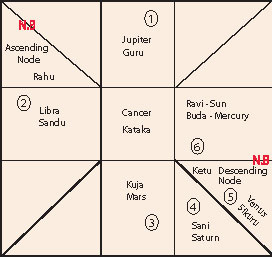 |
| The above chart shows Lord Buddha’s horoscope, according to the cryptic verse of the scholar monk, Ven. Veedagama Maha Thera. Lord Buddha’s birth took place in the year of Kali Yuga, era 2,478, on Tuesday, Vesak Full Moon Poya Day. 1. Jupiter (Guru); 2. Libra (Sandu); 3. Mars (Kuja); 4. Saturn (Sani); 5. Venus (Sikuru); 6. Sun (Ravi); Mercury (Buda). The ancient seers did not consider the Ascending Node (Rahu) and the Descending Node (Ketu) as planets; these asterisms are therefore not indicated. |
I would like to call the
reader’s attention to the poetic and linguistic values contained in the verses. In the first line, “Guruhami” refers to a Hindu mendicant, teacher, or preceptor. Guru, also known as Amara Guru, is the preceptor of the immortals. The planet Jupiter is also known as Brahaspathi, because it was discovered by the Amara Guru. Cancer (crab) is the smallest, least noticeable element in the Zodiac constellation, lying between Gemini and Leo.
In the second line, the Moon is presented as a male body, Handahami. This may be because the Moon is the most important of the celestial bodies. The calendar is largely based on the moon and its phases (the movement of the tides is determined by lunar influence). Libra (balancing scales) is the seventh sign of the Zodiac. It is a small Zodiacal constellation in the southern hemisphere, lying between Virgo and Scorpio.
In the third line, “Rathu hami” refers to the red planet Mars. Here the “Rathu hami” is presented as an aggressive, rowing type. The words “dabara kara-kara” are appropriate here, because Mars is the Roman god of war. It is in the asterism of Capricorn, the Zodiacal constellation lying between Sagittarius and Aquarius. The figure in the sign of Capricorn has the forelegs of a goat and the tail of a fish.
In the fourth line, “Kalu hami” refers to Saturn. The adjective “kalu” or black refers to the black arts or black-magic. According to astrology, Saturn produces a cold, gloomy temperament, and by extension signifies life’s less pleasant realities. The word “nondi”, meaning limping (walking with an uneven step), may suggest the ring system of Buddhism, the ever-changing circle of cause and effect. The asterism of Aquarius refers to the Water-bearer. His place is indicated by an ancient poet: “Down from Vega cast your glance across the Dolphin’s space; then just as far again you will find the Water-bearer’s place.”
In the fifth line, “Manamalaya” implies “Sikuru” or the planet Venus, also the Roman goddess of love. Venus stands for sexual love, amorous desires and related influences. It is an asterism of Pisces and does not contain any bright stars. It lies between Aquarius and Aries.
In the sixth line, “Nanawathi” and “Dines” signify “Buda” and “Iru”, namely Mercury and the Sun. The Sun suggests a wise, learned one, and the Sanskrit “Budh” suggests awareness, thinking power, inspiration, restraint, etc. Mercury is the Roman god of skill, eloquence and theft. He is the son of Zeus and Atlas, and is said to be graceful and swift of foot. The Sun is the source of all energy, a colossal display of solar energy, through which all life on earth is possible. Its light and heat keeps the earth warm, gives life and helps living things to grow.
He who conquers himself is the greatest of conquerors’
The thrice blessed Vesak Poya Day falls on 19 ,Monday in May:
‘He who conquers himself is the greatest of conquerors’
 |
| The birth of Prince Siddartha at the Lumbini Sal grove |
Through out history human beings have gone on yielding to their worldly passions undergoing immense suffering, not knowing a way out of it. Only a Buddha can explain to the world the truth related to the world phenomenon-the causes for suffering and the way to get out of it.
A Buddha is born to dispel the darkness of ignorance and to show the world how to be free from suffering. It is only a Buddha who could give human beings the power to think for themselves and show that man can attain supreme enlightenment through his own efforts. “Sukho Buddhanan Uppado” The birth of a Buddha is a bliss)
The Gauthama Bodisatta dwelled in Thusitha heaven prior to his final birth until the appropriate time arrived for him to descend to the earth in attainment of the initiation to become a Buddha. In fact it is believed that the birth of a Buddha which is an extremely rare incident, takes place when the Gods invite the Bodisatta to be born on the earth.
 |
| A mission that lasted forty-five years |
It is said that Bodisattas are reborn in Thusitha heaven, before their last birth on earth. When the gods invited the Bodisatta to be born as a human being, the Bodisatta told them that the five factors-time, country, continent, family and mother being considered, he will descend to the earth.
As the appropriate period arrived the Bodisatta decided to be born in India. He chose the Middle country as the best country. The best family was the Sakyas and the best mother was Queen Mahamaya.
The Buddhist literature finely describes the birth of Prince Siddartha which took place in Lumbini Sal grove about 2610 years ago on a Vesak Full Moon poya day. Amidst the thunderous ovation of millions of people and the gods the newly born prince walked seven steps to the North and uttered thus;
“Aggo Hamasmi Lokassa,
Jetto hamasmi lokassa,
Setto hamasmi lokassa,
Ayamanthi Maathi Naththi dhani Punabbavo”
(I am the great, I am the senior, This is my last birth.)
It was on the same Vesak day that ascetic Asitha, an advisor to King Suddhodana who was well known for his supernormal vision, came to see the prince.
The king who held him in high esteem carried the baby up to the old ascetic in order to make the baby pay him due veneration. But to the utter amazement of everyone present, the baby’s legs turned and rested on the matted hair of the ascetic.
The ascetic who foresaw that the child would definitely attain Buddhahood, soon got up and worshipped the prince. Both amazed and thrilled at the sight, the King Suddhodana too followed his advisor thus marking his first worship on a Vesak Full Moon Poya day.
On the fifth day after his birth 108 hermits were invited to the palace and was asked to give him a proper name. He was named as “Siddartha” as the hermits knew for sure that this birth would bring immense relief to entire mankind (In Sanskrit books the name is given as Sarvasidda.)
| |

As Queen Mahamaya passed away on the seventh day after his birth, it was Queen Prajapathi, (queen Maya’s sister who became the chief queen after her death), who looked after the prince.
The prince spent an extremely luxurious life surrounded by peers like Prince Nanda and Kaludai and aides to look into his each and every need. As he reached the proper age, Sarvamiththa was invited to the palace to give him the necessary education.
The king took every possible measure to stop the young prince coming across any incident that would disrupt his mental stability. Three palaces were constructed for three seasons - summer, winter and rainy season.
At the age of sixteen he entered into matrimony with Princess Yasodara (also known as Badra Kanchana), the daughter of King Suppabuddha. But no one could prevent him from seeing the stark realities of life.
During his tours outside the palace, the young prince came across four sights-an old man, a sick man, a dead body and an ascetic on four different days. The prince was deeply moved by the first three sights, but the sight of the ascetic gave him immense relief. Determined to find the way out of suffering, the young prince decided to leave the palace at the age of twenty nine.
Once Channa, his favourite charioteer saddled the horse Kanthaka, the prince renounced the palace bidding a silent farewell to his sleeping wife, and the baby who was born on the same day.
He crossed the River Anoma and became an ascetic commencing his extremely difficult mission- the quest for the truth.
Having followed the teaching patterns of many teachers of the era like Alara Kalama and Uddaka Rama Putta, and also the methods practised by the ascetics like Kondangna, Vappa, Baddiya, Assaji and Mahanama, Siddartha Gauthama understood that he had been groping in the dark.
He finally understood that either practising extreme austerity or engaging in extreme comforts would not let him find out what the truth is.
So he switched over to the Middle path. He too would not have certainly died, had he not realized the futility of self mortification.
Analysing the five dreams that he saw on the day prior to the Vesak Full Moon poya day (Usually known as Vesak Pura Thuduswaka day), the Bodisatta came to the conclusion that he would surely attain enlightenment on the following day.
 As he was meditating under the Banyan tree the following morning (Vesak Full Moon Poya day), a rich land lady called Sujatha offered him a bowl of milk rice. Having had a bath on the bank of the river Neranjana, the Bodisatta consumed the milk rice after making 49 pellets. As he finished his meal he let the golden bowl float on the river making a solemn wish.
“If I were to become a Buddha today, let the bowl go upstream.”
As he wished it did go upstream for a considerable distance!
Thus on the Vesak Full Moon Poya day, the Bodisatta spent the day at the Sal grove near by. In the evening as he headed his way towards the Bo tree in Gaya (which is known as Buddha Gaya today) a grass cutter named Swasthika gave him eight handfuls of grass. After laying the grass under the tree, the Bodisatta had sat down under the tree facing East of course with a solemn promise.
“Never will I get up from the place till I attain the supreme enlightenment.”
The Buddhist literature finely describes how much the Maras have tried to disturb the Bodisatta’s concentration, conjuring up many fearful apparitions. (It is also believed that Devaputhra Mara symbolises the remaining desires in the mind of the Bodisatta that were struggling to come to the fore despite his attempt to silence them.) As he was deeply engaged in meditation, his mind ‘burst the bubble of the Universe and he could realize the true nature of everything.’
It was an extremely difficult achievement which was gradually fulfilled step by step. In the early part of the morning he achieved “Pubbe Niwasanussathi Gnana” (The reminiscence of past births.) Next as he could gain “Dibba Chakkurabhi Gnana” (“The perception of the disappearing and reappearing of beings”), he perceived beings disappearing from one state of existence and reappearing in another. Towards dawn the Bodisatta could achieve “Asawakkaya Gnana”. His effort was a success as he could understand the truth he so fervently sought - the Four Noble Truths.
More than 2598 years ago, the Bodisatta could attain the supreme enlightenment conquering all the desires and defilement on a Vesak Full Moon Poya day. That is why the Buddha is normally referred to as the greatest of all the conquerors. As the Buddha has said ‘even though a man conquers ten thousand men in battle, he who conquers but himself is the greatest of conquerors.”
It was not only the Buddha who ‘won’, but entire man kind.
This is how the Buddha explained to the world the battle he had won.
“Through out the Sansara, I ran through not finding the builder of the house, searching for (him). It is a suffering to be born again and again.
O! builder of the house, you art seen (now).
You cannot not make a house, all the ribes are broken, the ridge ofthe pole is destroyed, the mind is divested of all material things, the extinction of craving is attained.”
After spending seven weeks, paying his gratitude to the Bo tree in Gaya that sheltered him, responding to the invitation of Sahampathi Brahma the Buddha headed his way towards Isipathana in Benares to preach the Dhamma to the five ascetics.
He preached to them pattichcha samuppada - the essentials of his teachings. (Four Noble Truths - Suffering, causes for suffering, the way out of suffering, cessation of suffering). His sublime mission which thus started continued for 45 years till his demise.
He walked on the paths of India, many a thousand years ago to preach to them, so that they could be ennobled and free from suffering. In fact his tours were of two types namely Thuritha Charikha and Athuritha charika.
After rendering a great service and leaving behind a noble doctrine and a set of disciples, the Buddha passed away in the Sal grove of Mallas at Kusinara at the age of eighty , about 2552 years ago again on a Vesak Full Moon Poya day. Even a few minutes before his demise, he displayed extreme benevolence and was ready to dispel the doubts of those who sought clarification.
As mentioned in the Maha Parinibbana Sutta, when a hermit called Subadda, (his last disciple) approached him to criticise other teachers (Shat Sastruwaru), the Buddha explained to him that what is more important is to listen to the Dhamma. The Buddha’s advice benefitted him.
Channa, the charioteer who was with Prince Siddartha on the day of his Renunciation, could not attain even one stage of the path to Nibbana (Marga Pala). Though he entered the Order, he tried to stay aloof from the others out of sheer arrogance.
The Buddha who knew that his life would be wasted if he did not shed his arrogance, told Ananda thera to impose “Brahma Danda” on Channa after his demise. As a result Channa could enter the first stage of the path to Nibbana
“Handadani Bikkawe amanthayami,
Vaya dhamma sankara,
appamadena sammadetha.”
(I address you, all components are subject to decay, engage in meritorious deeds. These are the last words of the Thathagatha.) To celebrate this thrice blessed Vesak day even the ancient kings of Sri Lanka had conducted festivals. Also it was on a Vesak day that the Buddha preached the Dhamma to his father, King Suddhodana in Kimbulwathpura.
The Buddha’s third visit to Kelaniya too took place on Vesak poya day. His foot print was marked on the Samanala mountain on a Vesak day. According to the Chronicles the coronation of Devanampiyatissa too had taken place on a Vesak day. It was also on a Vesak day that King Dutugemunu had commenced on constructing Ruwanveli Seya.
www.sundayobserver.lk
Subscribe to:
Posts (Atom)
