“ANatTA” (NON-SELF) IN BUDDHISM |
| Ven. Ajahn Brahmavamso Daily Mirror.LK "All conditioned things are impermanent. All conditioned things are suffering. All dhammas (all things conditioned and unconditioned) are anatta". These are the three basic factors of all existence. It is in order to penetrate these truths that we practice the Noble Eightfold Path. We equip our minds with power through the abandoning of the five hindrances; then we can actually uncover these truths by experiencing the deep states of meditation. In fact, once one of these three basic characteristics of existence (ti-lakkhana) is seen in its fullness one will also see the other two in their fullness. As the Buddha said, "What is impermanent, subject to change, is suffering, and that by its very nature cannot be taken to be 'me', 'mine', or a 'self'. Whatever is taken to be a self will cause suffering" (SN 22, 59). In fact, the permanent happiness of a self is impossible. Delusion The Buddha's teaching on anatta (non-self) is deep and profound because it challenges something very basic to our assumptions about life. The Buddha talked about avijja (delusion) being the root cause of all problems, of all rebirths, the root cause of defilements. He explained what avijja is through the teaching of the vipallasas (the perversions or distortions of view, thought and perception). Namely, the vipallasas say that by view, thought and perception we take what is dukkha to be sukha (happiness); we take what is impermanent to be permanent; we take what is not beautiful (asubha) to be beautiful (subha) and we take what is anatta to be atta, a self. Never in that teaching of the vipallasas did the Buddha say that we take what is self to be anatta. It's always something that is anatta that is taken to be a self. This is because throughout the Buddha's teachings there never was, in any way whatsoever, an atta (self) postulated. One of those wrongly formed questions is: "Who am I?" This is an inquiry that many people in the world follow, "Who am I?" However, a little bit of reflection should make it very clear that this question already implies an assumption that you are someone. It already implies an answer. It's not open enough. Instead, one needs to rephrase the question from, "Who am I?" or even, "What am I?" to, "What do I take myself to be?" or, "What do I assume this thing called 'I' is?" Such questions dig very deep into one's avijja (delusion). Only then can one start to really look at what it is that one takes one's 'self' to be. Consider the human body. Do you consider the body to be yours? It' is very easy to say, "The body is not self" when one is young, healthy and fit. The test comes when one is sick, especially when that sickness is very deep and lasting, or can even be life threatening. That's when one can really see at a deeper level whether one is taking the body to be 'me' or 'mine'. Why does this fear arise? The fear is always because of attachment. One is afraid that something which one cherishes is being threatened or taken away. If ever a fear of death comes up at any time, that will show with ninety nine percent certainty, that in that moment one is seeing or thinking that this body is 'me', or is 'mine'. Satipathana Sutta Contemplate this body. Contemplate the death of this body, contemplate the contents of this body, and take it apart as it says in the Satipathana Suttas. See that with whatever parts of this body, that it's just flesh and blood and bones. It's just the four great elements (earth, water, heat and air), just atoms and molecules and chemicals, that's all. Continually contemplating the body in this way, one will eventually break down the delusion that this body is substantial, beautiful, delightful and one's 'own'. When there is a self, there will be things that belong to a self. When there are things belonging to a self there will be control, there will be work, there will be doing. This illusion of a self (taking oneself to be something substantial) is what creates craving and attachment. This is what creates will. That's why when people take the body to be the self, then they go and take it to the gym, they take it to the beauty parlour, they take it to the hair dressers, they wash it, they preen it, they try hard to make it look nice. "This is important, this is me. It's my self-image." Such people think that it's very important what they look like. They think that it creates their happiness. Other (wiser) people say how stupid they are. Other people tell the truth. The point is that if you take the body to be you, you will want to control it. Some people get upset when they start to get old and ugly and smelly. They start to get upset when they get sick, because they realise they can't control this body. The struggle to control Some people who I've seen dying try and control their body to the very end. To be with someone when they are dying, and to see them struggling for the last breath, and trying to control everything, this is one of the saddest things to see in life. This is real suffering. Then you see those other people, who have more wisdom, those who can let go and not struggle at death. Realising that this body is not theirs any more, they don't care about it any more and they don't try to control it. The 'controller' has gone. When this controlling has gone, then so much peace, ease and freedom naturally arises in the mind. Even deeper than the body is the stuff of the mind. First of all, let us consider the objects of the mind. So often people identify themselves with their thoughts, or with the perceptions or objects, which come up in their minds. That's why in the world when someone makes a mistake they usually say, "I wasn't feeling my self today". "When I do something right, that's the real me." Anatta; not 'me'; ‘not mine' When thoughts come up in the mind it's both useful and fascinating for one to consider, "Why did I think that? Where did that thought come from?" Very often one can trace these thought patterns back to teachers who inspired you, either in words or in books. Why did you think that thought? Is it really your thought, or is it the thought of Ajahn Brahm, or maybe the thought of your father, or the thought of your mother? Where did that thought come from? Thought does not belong to you. Thoughts come according to their conditions, they are triggered in the mind because of causes. It's fascinating to see that thought is anatta, not 'me', and not 'mine'. Why is it that thoughts obsess the mind? Thoughts come in and we grab hold of them. We make them stay because of the illusion that they are important. People sometimes have such nice thoughts, they come and tell me later, and they call them 'insights'. They are just thoughts, that's all. Just leave the thoughts alone. Don't take them to be 'mine'. If one takes thoughts to be 'mine', then one will go and beat someone else over the head with them, and argue about who's right and who's wrong. Letting them go is far more peaceful, far more joyful. Thinking is one of the biggest hindrances to deep meditation. Thinking so often stops one from seeing the truth, from seeing the true nature of things. Therefore, give thinking no value. Give it no interest. Instead, give that value and interest much more to the silence. For those of you who have experienced long periods in meditation, where not a thought has been going on in your mind, isn't that nice, isn't that beautiful, isn't that just so lovely, when there is peace in the mind and not a thought coming up? Remember to cherish that thought of no thought. Then it's a thought that ends thought. All truth, all insight, all wisdom, arises in the silence. |

Saturday, September 13, 2008
“ANatTA” (NON-SELF) IN BUDDHISM


Tuesday, September 9, 2008
Munnesweram temple festival: A call to the faithful
Munnesweram temple festival: A call to the faithful
| |

Hindu religious festivities commenced at Shri Munnesweram Ishwara Maha Devale, Chilaw with the hoisting of the flag on August 19, and the annual Nikini Maha Chariot festival carrying the sacred deities will be held with great pomp and pageantry on Sunday, September 14, followed by the Water cutting ceremony at Deduru Oya, Chilaw on September 15, 12.00 noon.
The other festivals take place on the following dates:
Maha Vishnu Perahera: September 9, at 6.00 p.m.
Fire walking ceremony: September 10, at 5.30 p.m.
Bhikshadana Perahera: September 11, at 6.00 p.m.
Nadesar Perahera: September 12, at 6.00 p.m.
Amba Vidina Perahera: September 13, at 6.00 p.m.
Water cutting Perahera: September 15 at 12 noon
Mangala ceremony: September 17, at 7.00 p.m.
A Police Post was opened at Munnesweram to enforce law and order at the temple premises. The officers at the post will supervise the smooth flow of traffic and stop vehicles at the time of processions and maintain orderly parking of vehicles.
| |

The officers will also ensure adequate police protection by day and night to prevent any form of harassment to devotees flocking to the temple to pay obeisance to the deities and perform their acts of penitence to purify their iniquities and when taking part in the processions.
Some penitents are seen lying prostrate or walking about with their flesh pierced with spikes and darts or ashes sprinkled on their foreheads to atone for their failings and omissions.
The traditional ‘Kavadi’ dancing, the beating of drums and sounding of trumpets form part of the procession which continue unabated in the atmosphere of the festivities akin to Hindu customs and ceremonies. The devotees keep vigil at the precincts of the temple engrossed in prayer and meditation with remorse for their past sins.
They also take time to visit the Shri Bhadrakali Amman Kovil which is just a stone’s throw away from the main temple to seek favours.
They also fulfil their vows at this temple as the goddess Kali is believed to punish wrong-doers and lost articles are found through her intercession. She is known to show speedy results and their prayers are answered instantly.
| |

With peace and normality prevailing in many parts of the island, it is predicted that thousands of devotees from all corners of the country will converge at this Shrine to participate in the festivities.
Therefore, unlike other previous years, vast crowds are expected and a gala setting will prevail in Chilaw. Vendors and hawkers have a good time selling their goods.
A Merry-go-round and other types of entertainment sited away from the temple will regale the visitors who throng the place to buy merchandise which is an annual enterprise and what is distinctive is that Chilaw Catholics, Buddhists and Muslims visit Munnesweram to see the festivities.
The Great Chariot wends its way to Deduru Oya for the Water cutting ceremony and on its return, stops in the heart of Chilaw in front of the Chilaw Urban Council for about one hour where ‘Kavadi’ dancing, beating of drums and sounding of trumpets take place before reaching the promenade of the Chilaw beach where Hindu festivities continue till late midnight watched by the crowds before returning to the temple proper at Munnesweram about two miles away from Chilaw.
So, the delightful and idyllic season of festivities comes to an end and the Munnesweram hamlet goes to hibernating and once again returns to its customary slumber to wake up in anticipation of the succeeding year.
SOWING THE SEEDS OF THE DHAMMA
| SOWING THE SEEDS OF THE DHAMMA |
The objective of ‘Daham Pahana’ is to ingrain the principles of the ‘Dhamma’ in all faiths By Rebecca Fleming Daily Mirror.lk At a juncture where divisions among the people are becoming impediments to unity, the first ever all-religious prayer rally to bring followers of all faiths together in a spirit of love was held recently with the blessing of leaders of all religions. A timely effort by ‘Daham Pahana’ , an organization that aims to promote righteousness and peace in Sri Lanka through the medium of music has already touched many hearts irrespective of their race, caste or creed. Led by a layman, Anton Charles Thomas, everybody calls ‘Brother Charles’, the movement was founded 16 years ago. Today, it is a multi-religious organization which has its group comprising Sri Lankan expatriates from around the world including; England, Italy, Israel, Dubai and The Netherlands. Over the years the movement has conducted its services both in the southern and the northern regions of the country in churches, temples, seminaries, rehabilitations centres, prisons and among youth groups. The packed audience at Sugathadasa Indoor Stadium on the evening of Sunday, August 31, included a large number of Venerable Buddhist prelates, Catholic Bishops, hundred of priests and nuns, Bikkhunis and religious leaders of Islam, the Hindu faith, intellectuals, politicians and over two thousands of people representing different faiths. Among the Buddhist monks who had joined Daham Pahana movement were Ven. Vitiyala Kavidhaja Thera, Ven. Weligama Dhammessara Thera, Ven. Madampegama Assaji Thera, Ven. Vijitha Thera while the Christians were represented by Catholic Bishops, Rt. Rev. Norbert Andradi, the Bishop of Anuradhapura diocese, Rt. Rev. Vinstant Fernando, Bishop of Badulla diocese, the Rt. Rev. Frank Marcus Fernando, Former Bishop of Chilaw diocese and a large number of priests and a number of Islam and Hindu religious leaders including Rev. Alhaj Niyaz Maulavi representing the Islam and Rev. Mohan Sharma Saami representing the Hindu . The message of the inter-religious rally was a plea to each and every one to return to their original religions and to search its spirituality and instil unity, love and compassion among the people of this country. Ven. Vitiyala Kavidhaja Thera, the Chief Incumbent of Paramadharmodhaya Temple in Wellampitiya, who is also well-known for his ‘Mapiya Doodaru Senehasa’ programme conducted in schools to develop a better parent- children relationship said that the love and ‘Maithree’ is the core of every religion and all faiths must join around this and unite themselves. “When the Lord Buddha preached that all creatures be blessed and free from sorrow, he referred to all beings without bias,” the Ven. Monk said. Well known songs about Buddhism, peace and the beauty of our island nation were sung by popular singers along with the thirty member orchestra led by musician Mahinda Bandara. The rally which was a giant step in bringing people of different faiths together, bridging their differences through the universal language of ‘Music’ assisted by the use of latest technology in an audio-visual medium has never been used at a religious rally in Sri Lanka so far. The prayers were through songs like ‘Surakinna Barai Sambudu Sasane…” a song that tells about Buddhism and its teaching of ‘Maithree’ ( love) sung by Muslim singer, Ishak Mohideen Baig was analysed by Brother Charles describing its deep spiritual meaning. “Buddhism in this country has taught its followers unity, love and coexistence and that it why with 68% of Buddhists in this country live peacefully with other religions and that Sri Lanka has become a haven for multi-religious coexistence. As a Catholic I must be grateful to all Buddhists in this country because they have created an environment for such co-existence .They have given the message enabling the nation to reach forward towards peace which can only be restored by returning to the teachings of each religion.” “The message of this effort is that compassion and charity for all is the essence of every religion. The only hope we can have for peace is through the lights of religions we all believe and the effort initiated by Daham Pahana to empower the spirituality of every religion is only way to win everlasting peace and a righteous society,” Professor Carlo Fonseka, a leading member of the organization said. “We are a blessed nation as we have got the opportunity of having people following the world’s major religions preached by Lord Buddha, Jesus Christ, Prophet Mohammed and the teaching of Hinduism is followed,” former Bishop of Chilaw, Rt. Rev. Frank Marcus the Spiritual Director to Daham Pahana appointed by the Bishop’s Conference of Sri Lanka said. Towards this objective, the Sri Lankan branch of Mahathma Gandhi Centre (MGC) too has joined with ‘Daham Pahana’ and a group of them too joined the event. “Today the country has failed to use its ethnic diversion for its betterment and instead it is being led to ethnic polarization. We are pleased to be associated with this movement,” a MGC representative said. With this beginning, all religious leaders vowed that they would illuminate peoples’ hearts and lead them towards a spiritually empowered nation and compel the leaders in the country to participate in this movement to achieve this goal. |
Monday, September 8, 2008
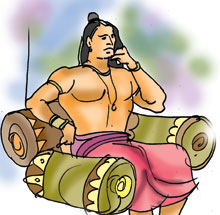
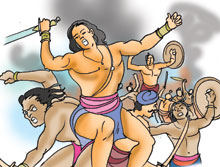
Rebellion in Gampola
| Mahavamsa | ||||||
|
Saturday, September 6, 2008
Pirith Dashana, Only on Star Lanka Online
*******Listen
* Click Here to Listen From,
Star Lanka Online :
*******Watch
* Click here to Watch On U-Tube >>>
TNL TV's Pirith Chanting
>>>> These two programs are
Different versions.

Kassapa Thero
**************************************
Kassapa Thero with crew. Los Angeles in California, America, . He is the one , Everyday we can watch on " TNL",'s Pirith , where the right corner of others on the screen.
Now, He lives in Dharmavijaya Buddhist Vihara , Los Angeles, U.S.A. Before that He lived in Hunupitiya Gangaramaya and also in the Gunarathna Mudalinda Pirivena in Hittatiya, Matara as a small monk.Still we can see him on TNL Television in Sri Lanka everyday before the end of transmission
Sunday, August 24, 2008
The Alagakkonaras
| The Alagakkonaras | ||
This article is part of a continuing series on the ‘Mahavamsa,’ the recorded chronicle of Sri Lankan history | ||
| By Halaliye Karunathilake Edited and translated by Kamala Silva Illustrated by Saman Kalubowila | ||
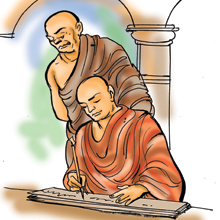
1. Ibn Batuta had to land in the northern coast of Sri Lanka in 1344 AD, when he was caught in a storm. It is believed that it was to the Jaffna ford that he came. Whatever that may be, the ruler there was Aryachakravarti. According to the travel records of Ibn Batuta, Aryachakravarti was treated as the Sultan of Lanka. This Sultan had given a warm welcome to the traveller, Ibn Batuta.
2. He had even made all arrangements for the traveller to visit 'Sri Pada' (Adam's Peak). These records mention that Arychakravarti got involved in the pearl business too. He had been an independent ruler. There is mention of a place named 'Konakar,' where a ruler named Alkonar was ruling. Ibn Batuta had visited this place on his trip to Adam's Peak. This Alkonar would have been Alagakkonara. 3. Many believe that 'Konar' was Kurunegala. Others say it cannot be and according to them, 'Konar' is either Ratnapura itself or a place close to it. According to Ibn Batuta, Alagakkonara's area of rule is named a kingdom. He says that Alagakkonara had a white elephant and that would have been the regal symbol of his kingdom. 4. However, going by these reports, it is clear that Alagakkonara was not a ruler under either the Gampola or the Dadigama kings. During the period that Ibn Batuta was in this island, he would have been chased out of power. In later years, this ruler had been blinded by his area followers. Later on, his son had been made the ruler, according to the records of Ibn Batuta. 5. Alagakkonara had a Malayali connection. Therefore it can be, that the Sinhala officers secretly opposed him and conspired against him. They would have wished to put an end to him and make a Sinhala prince the ruler. Hence this plan to make Alagakkonara's sister's son the king. The sister was Padmavathie. The prince's father had been an Attanayake. Some scholars point out that this one may be the prince whom Ibn Batuta says was Alagakkonara's son. 6. One aim of this revolt however, was to avoid the rightful heir becoming king of Raigama and make the king of Gampola more powerful. The people of Gampola too would have supported this move. Venerable Vilgammula Sangharaja Thera, who received support and maintained friendly relations with Alagakkonara came to Dadigama and took ups residence there.
7. When he came to Dadigama, the king there was Parakramabahu V and it was about 1344 AD. A nephew and a student of Vilgammula there, who was a monk has written a book of Pali verses, praising King ParakramabahuV. The king of Gampola at this time was Buwanekabahu IV and his Prime Minister was Senadhilankara. This prime minister was a devout Buddhist. 8. He was instrumental in getting the king to bring about a reformation of the 'Sasana.' It was he, who got the Lankatillake and the Gadalani temples in Gampola built. It is said that he got temples built even in Dondra and Weligama, which belonged to the Kingdom of Raigama. A poet who lived during this time, has written in praise of this prime minister, Senadhilankara. ------------- The Sunday Times |

Wednesday, August 20, 2008
Dondra, Devinuwara Sri Vishnu Devala Festive Season Has Begun for the year 2008

************************************************************

************************************************************

************************************************************

************************************************************

************************************************************
One day in our house,(Last Year) about 15 people in the second floor, and about twenty , in the first floor. To organize a trip to Dondra (Devinuwara), I’ve asked who wants to come in a van , to worship the Lord Buddha, in Dondra, with God Upulwan Devindu. In the first floor all the people agreed without any comments to do that without get so long in the day after that day. In the Second floor, without one person, all others didn’t like to go there on that day. Then I gave them a lesson, saying a God can’t do every thing only we can do that like driving, but some unexpected events we can’t resist. Only God know. While the speech, a smell like we smell in Dondra, came to our room, every one felt that. Then I said “If this is God’s power wnen I going to change the topic, this coming smell must be stopped.” As I said , It has vanished with my topic changed. Nothing smelt.
After that I came downstairs and asked others did you feel some thing like that sort of smell. Everyone said NO. Then I realized, It was only for the 2nd floor, near this floor. This is one of my many experiences regarding the God Vishnu in a short period of time. In my early years I didn’t want to believe, Gods like Vishnu and I trusted myself These stories are false. After My A/L ( In Maths Subjects) in school times I’ve done many experiments regarding Gods and many Un-Seen subjects. ( I can’t write down every thing here). My experiences , you will be able to know in the future if you are with me in my blogs and the site , named “StarLankaOnline.Com”.

************************************************************

************************************************************

************************************************************

************************************************************

************************************************************

************************************************************

************************************************************

************************************************************

************************************************************

************************************************************

************************************************************

************************************************************

************************************************************

************************************************************

************************************************************
Again to the topic, now the festive season has begun and you’ll be able to worship the Lord Buddha, and God there. If you really want to get bless from the site, Don’t visit there getting Meat, Fish or Beer, Arrack or having drunk. The God really help you if you can do that. As long as you keep the things going on, your ill or sick health going to be vanished forever and the development of in your life will be done.
Here are some Photos in 2008 season.( In this time, Main, Basnayaka Nilame , The Highest Position of the programme, is Mahinda Wijesekara’s Son,)

************************************************************

************************************************************

************************************************************

************************************************************

************************************************************
All The Photos has been taken by me, Priyantha De Silva, Using my NOKIA, Camera Phone.
************************************************************
In their religious observances the Sri Lankan Buddhists have adopted from Indian tradition the use of the lunar calendar. The four phases of the moon are the pre-new-moon day, when the moon is totally invisible, the half-moon of the waxing fortnight, the full moon, and the half-moon of the waning fortnight. Owing to the moon's fullness of size as well as its effulgence, the full-moon day is treated as the most auspicious of the four phases. Hence the most important religious observances are held on full-moon days and the lesser ones in conjunction with the other phases. In the Buddhist calendar, the full moon, as the acme of the waxing process, is regarded as the culmination of the month and accordingly the period between two full moons is one lunar month.[10]
The religious observance days are called poya days. The Sinhala term poya is derived from the Pali and Sanskrit form uposatha (from upa + vas: to fast) primarily signifying "fast day." Fasting on this day was a pre-Buddhist practice among the religious sects of ancient India. While the monks use the monthly moonless day (called amavaka in Sinhala) and the full-moon day for their confessional ritual and communal recitation of the code of discipline (Patimokkha), the lay devotees observe the day by visiting temples for worship and also by taking upon themselves the observance of the Eight Precepts.
A practicing Buddhist observes the poya day by visiting a temple for the rituals of worship and, often, by undertaking the Eight Precepts. The Eight Precepts include the Five Precepts (see above, pp.5-6), with the third changed to abstinence from unchastity, and the following three additional rules: (6) to abstain from solid food after mid-day;
(7) to abstain from dancing, singing, music, and improper shows, and from ornamenting the body with garlands, scents, unguents, etc.;
(8) to abstain from the use of high and luxurious beds and seats. If one decides to observe the Eight Precepts, one would wake up early, bathe and clad oneself in clean white garments, and go to the nearest temple. The incumbent monk administers the precepts to the entire group assembled for the purpose. Thereafter they would spend the day according to a set timetable which would include sermons, pujas, periods of meditation, and Dhamma discussions. At meditation centers there will be more periods of meditation and fewer sermons and pujas.
The observance of the Eight Precepts is a ritualistic practice of moral discipline quite popular among the Sinhala Buddhists. While the Five Precepts serve as the moral base for ordinary people, the Eight Precepts point to a higher level of training aimed at advancement along the path of liberation. The popular practice is to observe them on full-moon days, and, among a few devout lay Buddhists, on the other phases of the moon as well.
The poya observance, which is as old as Buddhism itself, has been followed by the Sinhala Buddhists up to the present day, even after the Christian calendar came to be used for secular matters. Owing to its significance in the religious life of the local Buddhists, all the full-moon days have been declared public holidays by the government. Another noteworthy fact about this day is that every full-moon poya has assumed some ritualistic significance in one way or other.
The first and the foremost of the poya holy days is the full-moon day of Vesak (May), commemorating the birth, Enlightenment, and passing away of the Buddha. The significance of Vesak is further heightened for the Sinhala Buddhists, as Sri Lankan tradition holds that it was on the Vesak Poya Day, in the eighth year after his Enlightenment, that the Buddha paid his third visit to Sri Lanka, journeying to Kelaniya on the invitation of the Naga King Maniakkhika (Mhv. i,72ff.). Consequently, Kelaniya has become a very popular place of worship and pilgrimage, the center of worship there being the celebrated dagaba, enshrining the gem-set throne offered to the Buddha by the Nagas (dragons). An annual procession is held there to commemorate the event.
Both in importance and in temporal sequence, the next significant poya is the full-moon of Poson (June), which is specially noteworthy to the Sri Lankan Buddhists as the day on which Emperor Asoka's son, the arahant Mahinda, officially introduced Buddhism to the island in the 3rd century B.C. Accordingly, in addition to the normal ritualistic observances undertaken on a poya day, on Poson day devotees flock to Anuradhapura, the ancient capital city of the country, for it was there that arahant Mahinda converted the then ruler, King Devanampiya Tissa, and his court to Buddhism, thereby setting in motion a series of events that finally made Sri Lanka the home of Theravada Buddhism. Even today, on Poson Poya, Anuradhapura becomes the center of Buddhist activity. Mihintale, the spot where the momentous encounter between the Elder and the King took place, accordingly receives the reverential attention of the devotees. The two rituals of pilgrimage and the observance of the Eight Precepts are combined here. Processions commemorative of the event, referred to as Mihundu Peraheras, are held in various parts of the country.
The next poya is Esala (July), which commemorates several significant events in the history of Buddhism. The most prominent of these is the Buddha's preaching of his First Sermon, the Dhammacakkappavattana Sutta, to the five ascetics at the Deer Park, near Benares, thereby inaugurating his public ministry. The other noteworthy events connected with this day include the conception of the Bodhisatta in the womb of Queen Maya, his Great Renunciation, the performance of the Twin Miracle (yamaka-patihariya), and his preaching the Abhidhamma for the first time in the Tavatimsa heaven. An additional factor that enhances the value of this poya to Sri Lanka is the first local ordination of a Sri Lankan, when Prince Arittha, the nephew of the king, entered the Order at Anuradhapura, under arahant Mahinda, following the introduction of Buddhism. On this day there also took place the laying of the foundation for the celebrated dagaba, the Mahathupa or the Ruwanvelisaya and also its enshrinement of relics by King Dutugemunu. It is owing to the combination of all these events that the Sinhala Buddhists fittingly observe the day ceremonially by holding Esala festivals throughout the island, giving pride of place to the internationally famous Kandy Esala Perahera.
* * *
The term perahera, primarily meaning "procession," signifies a popular Buddhist ceremony replete with many rituals, commencing and culminating respectively with the kap-planting and the water-cutting ceremonies. These two ceremonies are respectively the introductory and the concluding rites of the annual Esala festivals, held in July and August in various parts of the island. They are essentially connected with the Buddhist deities, either to invite their blessings or to give thanks to them for favors received. During this period every year, such religious festivals are held in almost all the religious centers of Sri Lanka where there are abodes dedicated to various Buddhist deities. However, the festival par excellence of this category is the Kandy Esala Perahera, which is connected with the Temple of the Tooth and the abodes (devalayas) of the four Buddhist deities, Vishnu, Kataragama, Natha, and the Goddess Pattini. The main feature of all these festivals held during this period is the elaborate procession held on the lines of the Kandy Esala Perahera.
Both the kap-planting and water-cutting ceremonies are performed by the lay officiating priests (kapuralas) of the devalaya concerned, who are traditionally the experts regarding the details of their performance. These details are generally regarded as secret and are not divulged to the profane public.
The preliminary rite of kap-planting consists of planting a shaft, usually fashioned from a felled young jak tree, which must have borne no fruit. When cut, this tree exudes a white sap which is regarded as a symbol of prosperity. Even felling the tree is done with several attendant rituals at an auspicious time: the trunk is divided into four, one for each of the devalayas, where it is carried with drums and attendance. On the day of the new moon, at an auspicious hour (nakata), the "kaps" thus prepared are set up in the ground in a special place decorated with leaves, flowers, and fruits. For five nights small processions are conducted within the devalaya precincts around the consecrated kaps. Sometimes benedictory stanzas are chanted by monks.
This rite of kap is a kind of vow that the Esala festival, consisting mainly of the perahera, will be held; it is also an invitation to the deities to be present during the festival, providing the necessary protection for its successful performance. In this sense it is this ritual that inaugurates the festival.
The water-cutting ceremony (diya-kapum-mangalyaya), which is the concluding ritual of the Esala festival, is performed in the early hours of the day following the final perahera. The officiating lay-priest (kapurala) proceeds on a caparisoned elephant to a selected place along a river bank. He would either go to a selected spot in the river by boat or wade through the water to a particular spot and after drawing a magic circle on the water with the sword he carries, he "cuts" the water and fills the vessel he carried there with water from that spot. Before doing so he empties the water that he took in this same manner the previous year. He then returns to the devalaya, and the vessel of water is kept there until the following year. The ritual is repeated annually in an identical manner. This is believed to be a rain-making ceremony of sympathetic magic, which type of ritual is quite common in agrarian societies the world over. The Buddhists seem to have adopted this to suit their purposes.
* * *
The annual Esala Perahera in Kandy, held in honor of the Sacred Tooth Relic of the Buddha, is the most colorful traditional procession in the country. It is the prototype of the other peraheras held elsewhere in the island in such places as Kataragama,[11] Aluthnuwara, Lankatilaka, Bellanwila, Devinuwara, etc. The Kandy Perahera is itself the latest expression of the annual festival in honor of the Tooth Relic that has been held with state patronage from the time the relic was brought to Sri Lanka from India in the 4th century A.C. Although periodically there have been intermittent breaks due to unsettled political conditions, the festival was never neglected intentionally. This had been so even during colonial times. Respected as the palladium of Sinhala royalty, the Relic had been accommodated in different parts of the country, depending on the change of the capital city. Ultimately it came to stay in Kandy, which was the last royal seat of the Sinhala people.
Esala Poya assumes prominence for yet another ritual of the Sri Lankan Buddhists. This is the annual rains retreat of the monks, Vassa, which commences on the day following the Esala full moon (discussed in Chap. 8). On the next poya day, Nikini (August), those monks who failed to commence the normal Vassa on the day following Esala Poya, are allowed to enter the "late Vassa."
The poya that follows Nikini is Binara (September), which assumes solemnity as marking the inauguration of the Order of Bhikkhunis (nuns) with the ordination of Queen Mahapajapati and her retinue. Next follows the Vap Poya (October), which concludes the final month of the three-month rains retreat. During the following month kathina robes are offered to the monks who have duly completed the Vassa. The high esteem in which this ritual is held by the Sinhala Buddhists may be gauged from the fact that the month is popularly referred to as the "month of robes" (see Chap. 8). The November full moon, called Il, signifies the terminal point for the kathina ritual. It is also the day for commemorating such events as the despatch of the first sixty disciples by the Buddha on missionary work, the prospective Buddha Metteyya being declared a sure Buddha-to-be by Gotama Buddha, and the passing away of the arahant Sariputta, the Buddha's foremost disciple.
The Unduwap Poya that follows in December is of great moment to Sri Lanka as commemorating two memorable events connected with the visit of Theri Sanghamitta, sister of arahant Mahinda, from India in the third century B.C. (Mhv.iv,18-19). The first of these events was the arrival at Anuradhapura of a sapling of the sacred Bodhi-tree at Buddhagaya, brought to Sri Lanka by Sanghamitta. The planting of this tree is the origin of the Bodhi-puja in the country (see Chap. 4).
The other memorable event commemorated by this poya is the establishment of the Order of Nuns (bhikkhuni-sasana) in Sri Lanka by the Theri Sanghamitta when she ordained Queen Anula and her entourage of 500 women at Anuradhapura. Records indicate that the Bhikkhuni Sangha thus established flourished during the Anuradhapura period (third century B.C. to eleventh century A.C.), but disappeared after the decline of that kingdom. Historical records are silent as to the reasons for its extinction, but they do report how the Sinhala Bhikkhuni Sangha helped in the establishment of the Order of Nuns in China.[12] In the 5th century a group of Sinhala nuns headed by the Bhikkhuni Devasara went to China to confer higher ordination there and the Bhikkhuni Sangha thus established survives there to this day. The Sinhala Buddhists commemorate this poya day with peraheras, observance of the Eight Precepts, and meetings. The day is designated Sanghamitta Day. Nowadays the dasasil matas (ten-precept nuns) take an active part in initiating these commemorative functions.
Next follows the Durutu Poya (January) when the Sinhala Buddhists commemorate the first visit of the Buddha to the island. According to the Mahavamsa, nine months after his Enlightenment, the Buddha visited present Mahiyangana in the Badulla District, where stands the dagaba by that name enshrining the Buddha's hair relics and the collar bone (Mhv.i,197). The Buddhists remember the event by holding an annual perahera. This much-venerated dagaba is also of consequence as the first edifice of this type to be constructed here, originating the ritual of dagaba worship in Sri Lanka.
The poya that follows, Navam Poya (February), celebrates the Buddha's appointment of the two arahants, Sariputta and Moggallana, as his two chief disciples. It also marks the Buddha's decision to attain Parinibbana in three months' time. The Medin Poya in March is hallowed by the Buddha's first visit to his parental home after his Enlightenment, during which he ordained the princes Rahula, Nanda, and many others as monks. The month that follows is called Bak (pronounced like "buck"), which corresponds to April. In this month it is not the full-moon day but the new-moon day that invites attention as signalizing the Buddha's second visit to Sri Lanka, when he visited Nagadipa[13] on the day preceding the new-moon day (amavaka: Mhv.i,47) in the fifth year after his Enlightenment.
The above brief account of the twelve poya days demonstrates how the poya day has become intimately connected with the life of the Buddha and consequently with the principal events of early Buddhist history. The Sri Lankan Buddhists, quite accustomed as they are to commemorate such events with rituals and ceremonies in full measure, have maintained these traditions up to the present.
Extract from Buddhist Ceremonies and Rituals of Sri Lanka
1995
A.G.S. Kariyawasam
Buddhist Publication Society
Who is the Buddha?
BUDDHIST SPECTRUM
Who is the Buddha?
The philosophy and the history of the spiritual leader:
 In general, ‘Buddha’ means ‘Awakened One’, someone who has awakened from the sleep of ignorance and sees things as they really are. A Buddha is a person completely free from all faults and mental obstructions.
There are many people who have become Buddhas in the past, and many people will become Buddhas in the future. There is nothing that Buddha does not know.
Because he has awakened from the sleep of ignorance and has removed all obstructions from his mind, he knows everything of the past, present, and future, directly and simultaneously. Moreover, Buddha has great compassion which is completely impartial, embracing all living beings without discrimination.
He benefits all living beings without exception by emanating various forms throughout the universe, and by bestowing his blessings on their minds. Through receiving Buddha’s blessings, all being, even the lowliest animals, sometimes develop peaceful and virtuous states of mind.
Eventually, through meeting an emanation of Buddha in the form of a Spiritual Guide, everyone will have the opportunity to enter the path to liberation and enlightenment. As the great Indian Buddhist scholar Nagarjuna said, there is no one who has not received help from the Buddha.
Buddha’s Good Qualities
It is impossible to describe all the good qualities of a Buddha. A Buddha’s compassion, wisdom, and power are completely beyond conception. With nothing left to obscure his mind, he sees all phenomena throughout the universe as clearly as he sees a jewel held in the palm of his hand.
Through the force of his or her compassion, a Buddha spontaneously does whatever is appropriate to benefit others. He has no need to think about what is the best way to help living beings - he naturally and effortlessly acts in the most beneficial way.
Just as the sun does not need to motivate itself to radiate light and heat but does so simply because light and heat are its very nature, so a Buddha does not need to motivate himself to benefit others but does so simply because being beneficial is his very nature.
Emanations of Buddha
Like the reflections of the moon that effortlessly appear in any body of still water, a Buddha’s emanations spontaneously appear wherever living beings’ minds are capable of perceiving them. Buddhas can emanate in any form whatsoever to help living beings. Sometimes they manifest as Buddhists and sometimes as non-Buddhists.
They can manifest as women or men, monarchs or tramps, law-abiding citizens or criminals. They can even manifest as animals, as wind or rain, or as mountains or islands. Unless you are a Buddha, we cannot possibly say who or what is an emanation of a Buddha.
The Supreme Emanation
Of all the ways in which a Buddha helps living beings, the supreme way is by emanation as a Spiritual Guide. Through his or her teachings and immaculate example, an authentic Spiritual Guide leads his or her disciples along the spiritual path to liberation and enlightenment.
If we meet a qualified Mahayana Spiritual Guide and put into practice everything he or she teaches, we shall definitely attain full enlightenment and become a Conqueror Buddha. We shall then be in a position to repay the kindness of all living beings by liberating them from the sufferings of samsara and leading them to the supreme bliss of Buddhahood.
The history of the Buddha
Siddhartha Gautama is the last Buddha’s lay name. He is generally recognised as the Supreme Buddha (Sammasambuddha) of our age.
The time of his birth and death are uncertain: most early 20th century historians date his lifetime from about 563 BCE; more recently, however, at a specialist symposium on this question, the majority of those scholars who presented definite opinions gave dates within 20 years either side of 400 BCE for the Buddha’s death, with others supporting earlier or later dates.
Gautama, also known as Sakyamuni or Shakyamuni (“sage of the Shakyas”), is the key figure in Buddhism, and accounts of his life, discourses, and monastic rules were said to have been summarised after his death and memorised by the monk community.
Passed down by oral tradition, the Tripitaka, the collection of teachings attributed to Gautama by the Theravada, was committed to writing about 400 years later. “Scholars are increasingly reluctant to make unqualified claims about the historical facts of the Buddha’s life and teachings.”
Celibacy
The Buddhist way:
Celibacy is deliberate refraining from sexual activity usually in connection with a religious role or practice. It has existed in some form in most religious and may indicate a person’s ritual purity or may be adopted to facilitate spiritual advancement. In Hinduism, “holy men” (or women) who have left ordinary secular life to seek final liberation are celibate.
 Islam has no institutional celibacy, though individuals can embrace it for personal spiritual advancement. Judaism has prescribed periods of abstinence, but long-term celibacy has not played a large role.
The early Christian Church regarded celibacy superior to marriage. It has been the role for Roman Catholic Clergy, though clerical celibacy was never adopted by Protestantism since 12th century .
Did Buddha advocate celibacy?
Buddhism is not against sex; it is natural sensual pleasure and very much a part of the worldly life. Why then did the Buddha advocate celibacy as a precept? Is it not unfair and against Nature?
Observance of celibacy for spiritual development was not a new religious precept at the Buddha’s time. All the other existing religions in India during the time of the Buddha also had introduced this practice. Even today some Hindus and Catholics do observe this as a vow.
Buddhists who have renounced the worldly life voluntarily as in case of Bhikkus and Bhikkunis and some “Upasikas” observe this precept because they are fully aware of the commitments and disturbances which come along if one commits oneself to the life of a family person.
It is common knowledge that married life can affect or curtail spiritual development when craving for sex and attachment occupies the mind and temptation eclipses peace and purity of the mind.
Significance of celibacy in Buddhism
People tend to ask, “If the Buddha did not preach against married life, why then did He advocate celibacy as one of the important precepts to be observed and why did He advise people to avoid sex and renounce worldly life?”
Quite notedly renunciation is not compulsory in Buddhism. It is not obligatory to renounce the worldly life totally to practise Buddhism. You can develop your religions principles according to the needs of a laylife.
However, when you have progressed and attained greater wisdom and realise that the layman’s way of life is not conducive for the ultimate development of the purification of the Mind, you may choose to renounce the wordly life and concentrate more on spiritual development.
The Buddha recommended celibacy because sex and marriage are not conductive to ultimate peace and purity of the mind and renunciation is necessary if one wishes to gain spiritual development and perfection at the highest level. But this renunciation should come naturally and must never be forced.
Celibacy and responsibility
The Buddha experienced his worldly life as a prince, husband and a father before his renunciation and he knew what married life entailed. Some non-Buddhists sometimes say that Prince Siddhartha was selfish and cruel and that it was not fair for him to desert his wife and child. In actual fact, Prince Siddhartha did not desert his family without a sense of responsibility.
He never had any misunderstanding with his wife. He had same love and attachment towards his wife and child as any normal person would have, perhaps even greater.
The difference was that his love was not mere physical and selfish love, he had the courage and understanding to detach that emotional and selfish love for a good cause. His sacrifice is considered more noble because he set aside his personal needs and desires to serve the mankind for all time.
The main aim of his renunciation was not only for his own happiness, peace or salvation but for the sake of mankind.
Had he remained in the royal palace, his service would have been confined to only his family or his kingdom and that is why he decided to renounce everything to gain enlightenment and then to enlighten others who were suffering in ignorance.
Thus one of Buddha’s earliest tasks after achieving Enlightenment was to return to his palace to enlighten the members of his family including his wife and son. Buddha served his family and paved the way for their salvation, peace and happiness.
Therefore no one can say that Buddha was a cruel or selfish father. With his high degree of spiritual development, the Buddha knew that marriage was a temporary phase while Enlightenment was eternal and for the good of all mankind.
The Buddha knew that his wife and son would not starve in his absence and that other members of his family would willingly look after his dependents. When He gained Enlightenment he was able to give them something no other father could give - the freedom from slavery to attachment.
Get to know Abhidhamama :
Introduction to Abhidhamma
Mind is a phenomenon highly explored in Buddhism. Mano phubban gama dhamma, which means “mind is the forerunner”, is a highly heard verse from “Dhamma Padaya”.
The ultimate objective in Buddhism is attained by purifying and improving mind. However, understanding what mind is a quite complicated act for any person. This is a barrier for someone interested in learning Buddhism deep.
One of the teachings in Buddhism that provides a comprehensive analysis on mind is Abhidhamma.
The Buddhist philosophy is categorised into three - which is known to anyone - as Thripitaka: Sutra Pitaka, Vinaya Pitaka and Abhidhamma Pitaka. Vinaya Pitaka consists of rules of conduct for Sangha and Sutra Pitaka consists of Suttas containing the central teaching of Buddhism. Sutra Pitaka is mostly on “Conventional Teachings” (Sammuthi Dheshana) of Buddhism.
Abhidhamma Pitaka provides a theoretical framework for the doctrine principles in Suthra Pitaka which could be used to describe “Mind and Matter”. Hence, Abhidhamma embraces the “Ultimate Teachings” (Paramaththa Dheshana) in Buddhism.
Abhidhamma Pitaka consists of seven treatises;
1. Dhammasangani
2. Vibhanga
3. Dhatukatha
4. Puggalapannatti
5. Kathavatthu
6. Yamaka
7. Pattthana
The term “Abhidhamma” simply means “Higher Doctrine”. It is an in-depth investigation to mind and matter. It answers many intricate points of Dhamma. It analyses complex machinery of human, world, mind, thoughts, thought-process, mental formations and so on.
Therefore it is indeed a complex doctrine to understand. However, there are many interested in learning this beautiful branch of doctrine. Among them there are plenty of non-Buddhists as well. This effort is to present this doctrine in an “Easy to Understand” manner.
Apparent Reality and Ultimate Reality
To elaborate, conventional teaching (sammuthi dheshana) consists of “Apparent Reality” (Sammuthi Sachcha) of things. The “Ultimate Reality” (Paramaththa Sachcha) is the abstract truth of apparent reality focused in Abhidhamma.
 |
Consider a human for example. Every human is given a name and is equipped with a head, arms, legs, eyes, ears and so on. In conventional terms we call that entity “a human” and that is the apparent reality.
But if this entity called human is dismantled into arms, legs, eyes and so on, could it be called as a human? If those parts are further divided then it would end up with bones and flesh.
This division could proceed until such that nothing could be seen remaining, where one is not given any clue to be called it as “a human”. This is how the ultimate reality is explained. In ultimate reality a human is described in terms of “Five Aggregates” (Panchakkhandha).
What is visible and described above is just one out of them called “Materiality” (Rupakkandha) and the rest are “Sensation/Feeling, Perception, Mental formations/states & Consciousness” (Vedhanakkhandha, Sannakkhandha, Sankharakkhandha and Vinnanakkhandha). Likewise in paramaththa sachcha or in ultimate reality in Abhidhamma, things would be expressed in a more analytical method.
Four Paramarththas
Falling under abstract or ultimate reality, Abhidhamma consists of paramaththas. “paramo uththamo aviparitho aththa paramaththa” which means “the most noble and immutable thing is paramaththa”. There are four paramaththas, namely the reality of:
1. Consciousness - Chittha Paramaththa
2. Mental States - Chetasika Paramaththa
3. Matter - Rupa Paramaththa
4. Nibbana - Nirwana Paramaththa
It is important to understand what it really means to be immutable of paramaththa. The equipments we call as table or chair subject to change in various ways and means.
A table could be dismantled and made a chair or any other furniture. With time this furniture would perish to dust.
Therefore they are not paramatththa. But analysis of matter (rupa paramaththa) would identify the fundamental materials of both table and chair are same and how they are subject to change. This particular truth doesn’t change and in that sense reality of matter or rupa paramaththa is said to be immutable. So do the other paramaththas.
First two realities together denote “Nama”. The third reality that is “Rupa” denotes fundamental units of matter and material changes. The realities of consciousness, mental states, and matter (with few exceptions to be dealt with later) are “Mundane” (Lokiya). The reality of Nibbana is “Supramundane” (Lokuttara) which is the absolute reality of all realities.
Reference
A Manual of Abhidhamma by Ven. Narada Maha Thera
Are Peraheras only of Elephants?
There seems to be a belief among the general populace that a perahera is judged by the number of elephants therein. One of the first questions that is asked when one says one has viewed a perahera is: "How many elephants?" A large number is greeted with an appropriate response and a small number is invariably greeted with derision and an insinuation that one has wasted one’s time at that perahera !
Contrary to popular belief and the belief of certain uneducated custodians of temples and organisers of pereheras, a perahera is judged by four main criteria :
(a) The quality of caprasioning (decorating and dressing) of the elephants and dancers.
(b) Adequate lighting and deployment of chulu lanterns.
(c) The quality of the dancing and drumming.
(d) The correct deployment of drum and dance troops in accordance with the traditions of that particular pageant.
Most of the above were completely ignored during the recently concluded Kandy perahera with only one or two of the devales (with lay custodians who know and respect the traditions) having pereheras that would have passed muster in the days of our kings. Bringing elephants from all over the country and putting them together results in unrest among the animals, using animals that are either too old or are carrying sore limbs and wounds or those that are temperamentally unsuited for pereheras and have to be heavily restrained are all caused by the need to impress with a large head count of elephants. This not only constitutes a danger to the viewing public but also causes untold hardship to the animals concerned.
The current system of elections that allow any ambitious social climber to secure the post of a temple trustee by "buying " votes from greedy Divisional Secretaries and despicable monks should be changed. A person wishing to be a temple trustee should be vatted by a board of knowledgeable people and have to have either a paper qualification or experience of managing a large organisation. For the true function of a lay trustee is to manage the affairs of the temple from the lands and sources of income to the labour and the "rajakariya" workers to the disbursement of additional income.
What happens now is very similar to what happens in politics. One spends so much money securing the post that the entire term of office is used to try and recover the expenses and a "small" profit is also welcome. Why have treasures disappeared from temples and even elephants donated to temples vanished into thin air?
A corrupt political system has ruined our culture but what this existing system of appointing temples trustees threatens to do is ruin the last vestiges of the heritage of this thrice blessed land.
Island.lk
Monday, August 18, 2008
The Buddha describes the four kinds of monks
The Sutta-Nipata
5. CUNDA SUTTA
Cunda the Smith
The Buddha describes the four kinds of monks1 Cunda: I ask the sage Buddha of great wisdom, Lord of Dhamma, who is free from craving, the noblest of guides; how many kinds of monks are there in the world? Please tell me.
2 The Buddha: Cunda, there are four kinds of monks, not a fifth. I shall elucidate them to you, since you ask me: (i) one kind has won the Path, (ii) one expounds the Path, (iii) one lives on the Path, and (iv) one defiles the Path.
3 Cunda: Whom does the Buddha describe as one who has won the Path?
4 The Buddha: One who overcomes uncertainty, is freed from sorrow, delights in Nibbana, is detached, a guide of men and gods - such a person is said by the Buddha to be one who has won the Path.
5 Here, one knows Nibbana as the noblest (state) and expounds and explains the Dhamma; that sage who destroys uncertainly, is desireless - this second monk is called the one who expounds the Path.
6 One who has controlled himself mindfully, lives well on the Path according to the words of Dhamma well expounded; one who practices correct principles - this third of monk is called the one who lives on the Path.
7 One who disguises himself by wearing the robes of the well-conducted ones, travels for gain, disgraces families, is impudent, deceitful, unrestrained, a gossip and waffler pretending to be a real monk - he is one who defiles the Path.
8 Having comprehended these (four) he who is well-versed, house-holder, who is a noble, wise disciple and who has understood that ‘all of them are not alike’; seeing thus, he does not diminish his confidence. How could the defiled one and the undefiled one, the pure and the impure one, be considered as equals?
