Arrival of Buddhism: The cultural, social development in Sri Lanka  |
By Gamini Jayasinghe Until the introduction of Buddhism, the inhabitants of this country believed in ghosts, sun, rocks, mountains, trees, fire and the dead which are lifeless objects. They had spectral or phantasmal powers and viands were offered to demons and ghosts which benefited them in no way but instead increased their awe inspiring terror and dismay. They thought they were punished if they failed to make the offerings. After the introduction of Buddhism, the offerings were accepted by the Buddha and His disciples, Sangha who were human beings like themselves. They could talk to the priests and get their problems clarified. They came to know that the Bhikkhus were not offended even if offerings were not made Gauthama Buddha visited Sri Lanka on three occasions and preached Dhamma to the rulers in the Northern and Western regions and the central hills. However, Buddhism had not been established firmly in this country with the visit of Buddha as in the case of North India and Nepal presumably because most of the then inhabitants, most of Yakkhas, Rakshas and Asuras and some of the Nagas were heathens who did not realize the value of Buddhism. In spite of the untamed nature of certain heretics and heathens who were the inhabitants of this land during the time of the Buddha’s visit, there is historical evidence of invasions from the neighbouring country, India, which had presumably resulted in the flow of cultured population which prepared a suitable arena for Arahant Mahinda Maha Thera to propagate Buddhism. King Panduwasdev married a princess from North India. Queen Bhadddhakaccayana was related to prince Siddharaatha and her six brothers who had accompanied her had built their own colonies in Lanka. They called them Gamas. These Gamas or colonies, Ramagama, Anuradhagama, Uruwelagama, Vijithagama, Dighayagama and Rohanagama were established in different parts of the country. Seemingly the queen’s brothers had brought people including craftsmen from India for the construction of these colonies. In spite of all these developments there is no debate regarding the fact that the overall development of the country had started with Mahindagamanaya – the arrival of Arahanat Mahinda Maha Thera with Buddhism, followed by his own sister, Arahant Sanghmitta Maha Theri who brought the oldest sacred tree in the world, Sri Maha Bodhi to Sri Lanka. Thus the recorded history in Sri Lanka began when Buddhism paved way to a cultural revolution more than 2000 years ago. In the wake of the Cultural Revolution there came an era of unsurpassed achievement. Fashioned lifestyles fostered the arts and inspired the creation of Dagabas, temples, monasteries, statues, numerous man-made reservoirs and irrigation systems which even today defy engineering interpretation. The mission of Arahant Mahinda Maha thera was the introduction of Buddhism to Sri Lanka. In a bid to establish Buddhism firmly in this country as envisaged by the Enlightened One Himself Arahant Mahinda Maha Thera established the order of monks and caused to establish the order of Nuns-Meheni Sasna. For worshipping of the devotees, relics of Buddha which are sharirika Dhathu and most importantly the treasured Paribhogika Dhathu, the Jayasiri Maha Bodhi were brought from time to time. Until the introduction of Buddhism, the inhabitants of this country believed in ghosts, sun, rocks, mountains, trees, fire and the dead which are lifeless objects. They had spectral or phantasmal powers and viands were offered to demons and ghosts which benefited them in no way but instead increased their awe inspiring terror and dismay. They thought they were punished if they failed to make the offerings. After the introduction of Buddhism, the offerings were accepted by the Buddha and His disciples, Sangha who were human beings like themselves. They could talk to the priests and get their problems clarified. They came to know that the Bhikkhus were not offended even if offerings were not made. They taught the cause and effect of everything, merits and demerits, virtues and sins, but no compulsions were imposed. They were taught that they themselves were responsible for their own fate. There were no outside forces or spirits to stand on their way to spiritual development. Priests provided education to their children. The Noble Eight Fold Path led them to final emancipation. Panchaseela is a guidance to lead peaceful day to day lives. Attangika seela, Dasa sil and priesthood led them for spiritual development. Thus the teachings of Thathagatha which were introduced to this country by Arahant Mahinda Maha Thera who is regarded as Anu Budhu or secondary Buddha in Sri Lanka brought about a civilized society in Sri Lanka. People even rose against the rulers when they found them unrighteous. An Upasaka named Tissa had reportedly refused to kill a fowl even on the orders of king Saddhatissa. They learnt the virtues of looking after their old and feeble parents. Hospitality or friendly and generous reception of guests or strangers, treating the sick, helping the poor and needy and kindness to animals are some of the other virtuous qualities they acquired from Buddhism. Buddhism is not against any other religion and hence Buddhists can live in harmony with the other religious groups. Buddhism thus played a pivotal role in building a strong united nation. The progress in the field of education was solely due to the introduction of Buddhism. Most of the rock inscriptions recovered from Sri Lanka and Asoka rock inscriptions in India are written in Brahmi scripts. The modern Sinhala alphabet is a gradual evolution of the Brahmi script. This alphabet was brought to Sri Lanka by Buddhist missionaries. On the guidance of Arahant Mahinda Maha Thera Buddhist commentaries were translated into Sinhala. The substances of most of ancient Sinhala literary works is the Buddhist doctrine. In the effort made to explain the Buddhist philosophy into the Sinhalese language gradually developed. Buddhist monasteries were converted to educational institutions. The Sinhala literature was improved in quality. Educational opportunities were available for the common man. Lyrics scribbled on Sigiriya rock bare witness. Building construction was in a very poor state at the time when Arahant Mahinda Maha Thera arrived in Lanka and introduced Buddhism to the inhabitants led by King Devanampiyatissa. The king had only his elephant kraal to be offered to the Maha Thera and his followers. After the arrival of Buddhism, a number of Buddhist temples were established throughout the country. Sri Lankan craftsmen came in contact with their counterparts in India from whom they learnt various forms of architecture. They gained experience in the construction of shrine rooms, alms halls, image houses, preaching halls and relic depositaries were constructed. Indian craftsmen had played a pioneering role in these construction works. There is evidence in chronicles to the effect that emperor Dharmashoka had sent skilled craftsmen to Sri Lanka to attend to the construction work relating to Sri Maha Bodhi. Local craftsmen had gained experience by working with these Indians. Another important aspect that was developed consequent to Mahindagamanaya and Dumindagamanaya is sculpture. Sculptors who could depict the super human extraordinary serenity in the countenance of the Buddha image in a clear, calm and lucid manner were emerged and substantiated from the Samadhi Pilimaya (Buddha statue in the meditation posture) at Mahameuna Uyana and Avukana Buddha image among others. Paintings on the walls of image houses are evidence for the development of paintings. Methods of surveying and levelling, weighs and measures and the monetaryu system was introduced to them. There is historical evidence to the effect that consequent to Mahindagamanaya, Sri Lanka had engaged in foreign trade. Traders had come from India, China, Japan and many other Asian and Arabic countries. Teachings of Gauthama Buddha enabled the people to get their lives adjusted in a righteous manner. They observed Pansil and abstained from killing, stealing, adultery etc. There is no compulsion but they observed the Buddha’s teachings voluntarily and willingly as they knew the virtues of it. They reared their domestic and farm animals not for killing but for milk and to be used in farms and in transport. Singalowada Sutta Vyaggapajja Sutta etc. provided guidelines in spending virtuous lives. They learnt the causes for ruining from Parabhava Sutta and refrained from sinful ways including unethical and inequitable trade. Thonigala and Badigala rock inscriptions disclose information of banking system under which the villagers deposited their savings of cash and grain. They later accepted foreign economic systems presumably because they were in keeping with the sublime teachings of the Enlightened One. Rulers adjusted their systems of administration according to the Buddhist teachings. Protection of Buddhism and looking after the people were their main responsibilities. They observed these principles by word and deed. King Devanampiyatissa was probably the first king to observe the principles of Buddhism. He was enthroned for the second occasion on the advice of emperor Dharamasoka of Dambadiva. It is to be noted that king Devanampiyatissa was engaged in a game of hunting and was chasing after a deer when Arahant Mahinda Maha Thera and his followers were standing on Missaka pawwa having come in a religious mission of Emperor Dharmasoka. The king was completely reformed after embracing Buddhism. According to the available chronological evidence he and the kings enthroned after him sought the advice of the clergy in all important matters. Thus the clergy took serious interest in the administration of the country. Thus Buddhism was accompanied by social, cultural and economic values which resulted in an overall development in the country. --- Daily Mirror.LK |

Friday, July 25, 2008
Arrival of Buddhism: The cultural, social development in Sri Lanka


The existence of Buddhism before the arrival of Arhath Mahinda in Sri Lanka
Poson full moon day is associated with the official introduction of Buddhism to Sri Lanka by Arhath Mahinda around 236 B.C. This happened over 250 years after the passing away of Buddha. During this long period of time did Buddhism exist in Ceylon (Sri Lanka)? Mahavansa the great chronicle of Sri Lanka, Deepawansa the History of the Island and Samathapasadika the Pali translation of the Sinhala commentaries of the Vinaya Pitaka; mentions of three visits by the Buddha, during his lifetime to this island. First visit took place in the fifth month after the enlightenment. The Naga Maniakkhika of Kalyani, we are told, accepted the Buddhist faith during the first visit of the master. The second visit took place in the fifth year after the Enlightenment. This visit was to save two clans from an impending war. After settling there dispute the Buddha preached the Doctrine and eighty kotis of Nagas were converted. Three years later the Buddha visited the island again at the request of Maniakkhika, during which Buddha is said to have left the imprint of his foot on the peak of Sumana Mountain (Adam's peak).
What is interesting is the fact Mahavansa was written 1100 years, Deepawansa after 900 years, Samathapasadika after 1000 years after the passing away of the Buddha. Dr. E. W. Adikaram in his Ph.D (London) thesis, a brilliant masterpiece of original research, "Early History of Buddhism in Ceylon" says: "these visits are recorded only in the Deepawansa, Samathapasadika and Mahavansa. No mention of is made of them in any part of the Pali Canon. This negative evidence, though a weighty one, is not sufficient for us to arrive at a decision and deny the truth of this tradition. This tradition may probably have risen from the arrival, before the advent of Mahinda of some Buddhist missionaries from India and also from the existence in Ceylon of a considerable number of Buddhists among the earlier inhabitants, namely the Yakkhas and the Nagas.
The Mahiyangana thupa, says the grate chronicle, existed in Ceylon long before the arrival of Mahinda. When the Buddha first visited Ceylon the deva Mahasumana of the Sumanakuta Mountain requested the Buddha to give him something to worship. The Master took a handful of hairs from his head and gave it to the deva. The latter enshrined it respectively in a thupa which he built at the place where the Master had sat. After passing away of the Buddha, the Thera Sarabahu, a disciple of the thera Sariputta, brought the collar bone of the Buddha and deposited in the same thupa. Later Uddhaculabhaya, the son of king Devanampiyatissa's brother's, saw the wondrous cetiya and covered it over afresh and made it thirty cubits high. Still later king Dutthagamini, dwelling there while he made war upon the Damilas, built a mantle cetiya over it eighty cubits high". Dr. Adikaram goes on to say: "the arrival of princess Bhaddakacchana and her retinue too, brings us to the same or more decisive conclusion'. Bhaddakacchana was the youngest daughter of Pandu, a cousin of the Buddha. She is said to be very closely related to the Buddha, and one may rightly infer that she and her friends were not all ignorant of the teachings of there royal Kinsman.... Secondly we are told they came disguised as nuns (Pabbajita)... considering the locality from which they came and their connections with the Buddha’s family, it is very likely that this word (Pabbajita) signified Buddhist bhikkhunies".
What was the society like before the advent of Arhath Mahinda in Sri Lanka? Again we turn to Dr. Adikaram book.
1. Brahmanism, from the very beginning, since the arrival of Vijaya and his followers in about the year 483 B.C. the Brahmis enjoyed a prominent status in Ceylon. There were Brahmanas who came along with Vijaya to Ceylon. Upatissa was one of them. He founded the village Uppatissagama which was for some time the capital of Ceylon. The same Brahmana held the post of chaplain (purohita) to king Vijaya. Pandukabhaya as a young price received his education under the brahmana named Pandula. The son of the latter became in due course the chaplain to Pandukabhaya (394 - 307 B.C.). When Devanampiyatissa sent presents to Ashoka, the price Arittha was accompanied by the king's chaplain who was a Brahmana. The presence of these Brahmanas naturally implies the existence of there religious beliefs in Ceylon at that time.
2. Worship of Yaksas: King Pandukabhaya built a temple for the Yaksa Cittaraja. The conditions, in pre-Buddhist Ceylon of the Yaksa cult appear to have been exactly similar to those in North India in the time of the Buddha; and in spite of the adoption of Buddhism as the national religion of the earlier Yaksa worship flourished side among the masses and has persisted down to the modern times.
3. Tree Deities: Pandukabhaya fixed a Banyan tree near the western gate of Anuradhapura as the abode of Vaisravana, and a Palmyra palm as that of Vyadhadeva. Here we have two instances of the worship of tree deities in pre Buddhist Ceylon.
4. Patron Deities: the Vyadha-deva, mention above was the patron deity of the hunters. Another such deity was Kammara-deva, or god of the blacksmiths. In addition to those deities of particular trades these was also a guardian deity for the whole of Anuradhapura city.
5. Jainism: Pandukabhaya is said to have built dwelling places for the Niganthas (Jains) named Jotiya and Kumbanda. Another Nigantha called Giri lived in the locality where Jotiya was. The monastery of Giri was demolished by king Vattagamini Abhaya (29-17 B.C) and in its place was built the Abhayagirivihara, which in subsequent times, played an important part in the history of Buddhism in Ceylon. Ever since the arrival of Vijaya, there was a constant flow of immigrants to Ceylon from India.
6. Paribbajakas, Ajivakas etc: the Paribbajakas, a class of wondering teachers or Sophists and Ajivakas the followers of Makkhali Gosala (contemporary of the Buddha) too were known in early Ceylon. Pandukabhaya built a monastery for the Paribbajakas and another for the Ajivakas
...... As shown in the preceding pages, there lived in pre-Mahindian Ceylon, people belonging to almost every religious sect then existing -in India. Even Ajivakas who were, by no means, so numerous as the followers of the Buddha, are mentioned as living in Ceylon. How then is one to account for the absence of any Buddhists? The only explanation possible is that silence was observed with regard to there existence in order to create a dark background on the canvas on which the enthusiastic narrator of Buddhist history might successfully paint his glowing picture of Mahinda's miraculous conversion of the island.
Again, when we consider how rapidly the conversion of Ceylon (Lanka) took place, it is difficult to believe that the people were till then entirely ignorant of the teaching. After the very first discourse of Mahinda forty thousand people including the king embraced the Buddhist faith. His other discourses, too were equally successful (seven discourses followed in all) all these facts help us to conclude the Buddhism did exist in Ceylon (Lanka) before the time of Mahinda, though it was only after Devanampiyatissa's conversion that it became the state religion of the country. Moreover, it may be justly said that Mahinda's mission had as its chief aim not to mere introduction of the teachings of the Buddha to Ceylon but the formation of the monastic order and thereby the "establishment' of the Sasana in the island". The arrival of Arhath Mahinda took place 236 years after the passing away of the Buddha.
During this long period of over two hundred years how did Buddhism fare in India? In the "2500 years of Buddhism" the Indian government publication, Dr. A. C. Banerjee says, "the Buddha's saying and their commentaries were handed down orally from teacher to disciples. Unlike the Vedic texts, how ever not enough care was not taken for the preservation of the actual words of the teacher, not to speak of their interpretations. In the Mahaparinibbhana Sutta, the teacher apprehended that his sayings might suffer distortion, and so as noted above, he cautioned his disciples about the four ways in which his instructions were to be verified. A centaury is a long time, and about a hundred years after his passing, differences arose among the monks about the actual words of the teacher and their interpretations. Once the monks took the liberty of bringing dissensions to the Sangha, they went on multiplying till the number of sects reached the figure of eighteen in the second and third centuries after the Buddha's death". Writing in the same publication, Bhikshu Jinananda MA. PhD (London), Professor of Pali and Buddhalogy, Nalanda Post Graduate Pali institute, says: "Moggaliputta Tissa is reputed to have converted the Emperor Asoka to the Buddhist faith. According to the Mahavansa, he was born in a Brahmana family and learned the three Vedas before he was sixteen. He was however won over to the new faith by the Thera Siggava and very soon attained to Arhatship with all its attendant supernatural powers. It was under his influences that the emperor made over to the Buddhist order his son Mahinda and Daughter Sangamitta. These two crossed to Lanka and converted to the Buddhist faith.
....... The venerable monk instructed the king in the holy religion of the Buddha for a week. The king thereafter convoked an assembly of the whole community of Bhikkhus. He called the bhikkhus of several persuasions to his presence and asked them to expound the teachings of the blessed one. They set fourth there misguided beliefs, such as the doctrine of the external soul, and so on. These heretical monks numbering sixty thousands were expelled from the brotherhood by the king. He thereafter interrogated the true believers about the doctrine taught by the blessed one and they answered that it was Vibhajjavada (the religion of analytical reasoning). When the Thera corroborated the truth of this answer, the king made request that the brotherhood should hold the Uposahta ceremony so that the whole community might be purified of evil elements. The Thera was made the guardian of the order.
Thera Tissa thereafter elected a thousand bhikkhus of the brotherhood who were well versed in the three Pitakas to make a compilation of the true doctrine. For nine moths he worked with the monks and the compilation of the true Tripitaka was completed. This council was held in the same manner and with the same zeal as those of Mahakassapa and Thera Yasa (first and second Buddhist councils) respectively. In the midst of the council Thera Tissa set fourth the Kathavatthupakarana wherein the heretical doctrines were thoroughly examined and refuted. Thus ended the third council in which a thousand bhikkhus took part. One of the momentous results of this council was the dispatch of missionaries to the different countries of the world for the propagation of the Saddhamma. From the Edicts of Asoka we know of the various Buddhist missions he sent to far - off countries in Asia, Africa and Europe."
The third Buddhist council was held in Pataliputra (Present Patna) in the year 253 B.C. Megasthenes the Greek ambassadors to the Imperial Court of Chandraguppta (Asoka's Grandfather) has described in detail the beauty and splendour of the well planned city of gorgeous wooden buildings, which was 9 miles in length and 11/2 miles in breadth in the shape of a parallelogram. Greek Ambassadors to Bindusara (Asoka's father) was Deimachos and Dionysios was Greek Ambassador to Asoka at Pataliputra. Asoka's thirteenth edict, Ceylon (Sri Lanka) is mentioned as one of the many countries in which conquest by the Dhamma had been made by him. Dr. S. Paranavitharana in his book "The Greek and the Mauryas" makes reference to Yavana (Greek) kings with whom Dharmasoka maintained friendly relations and the succession of rulers in the kingdoms founded by Alexander's general's, in the Magadha kingdom. It was Anatogona Gonata who maintained friendly relations with Dharmasoka, and gave permission for the preaching of the Buddha-dharma in their respective territories. Mahamahendra-sthavira, who according to these sources, was a brother and not a son of Asoka, is said to have visited all these three countries, and preached the Dharma some time before he came to Ceylon.
Dr. S. Paranavitharana in his book "Sinhalayo" says: "when saint Mahinda preached Buddhism for the first time in Ceylon, he gave the explanations, as he had received them from his teachers, of certain words and expressions in the Pali Sermons. These were handed down orally with great care in the monasteries; and later teachers continued to add to this exegetical literature".
(Writer is a Doctor of-Medicine and Master-of-Arts in Buddhist studies)
Email kirthjames@yahoo.comThursday, July 24, 2008
Spreading the message of dhamma through song >>> Ven. Rambukana Siddhartha Thero

Spreading the message of dhamma through song
“ Lama viye kiri suwanda giye nethi lama viyedima
Kasawathak henda, podi hamuduruwo punchima kale,Thaniyama hithilada mahana wune”….
The child who questions podi hamuduruwo about his choice of a ‘robe’ is bewildered as to how podi hamuduruwo is capable of walking so piously without being distracted by the play grounds. “Sansun gamanin koheda wadinne sellam pittani pasu karala”?
Gifted with musical words, Podi hamuduruwo of yester- year is an eminent lyricist today. The Nation met Ven. Rambukana Siddhartha thero to discover more about his lyrical faculties.
 By Randima Attygalle
Q: Can you tell us about your childhood?
A: I was born on a Vesak poya day and as a result I was named Ananda. The temple was adjoining our school in Rambukana in Morawaka. It was the centre of our lives. We were taken to the temple by our school principal for budun vendeema etc. When I was older, I went to the daham pasela of the temple. During this time, there was a strong desire in me to be ordained as a priest. My family did not influence me to take this step. When I was about 12 years, I was ordained as a samanera. Thereafter I studied in pirivenas. I went to Sunethradevi Pirivena in Pepiliyana and later entered the University of Kelaniya.
Q: As a child what did you feel about the early days as a samanera?
A: Since it was my decision to be ordained, I never felt restricted and felt that my new life was mundane. I suppose that if I had been gifted to sasana without my liking, things would have been quite different. The lyrics of ‘Lama viye kiri suwanda giye nethi’, sung by Malini Bulathsinhala where the young podi hamurduruwo is questioned as if it was his own decision to be a samanera, is in fact a reflection of my early days as a priest.
Q: Can you recollect your life as an undergraduate?
A: I entered Kelaniya University in 1974 where I specialised in Buddhist Philosophy. My subsidiary subject was Mass Communication. This was the golden era of Sinhala songs. Other than newspapers, SLBC operated as the sole media and it was like an unofficial university. SLBC exposed us to a world of refinement. As undergraduates we were fortunate to have been enriched by work of eminent lyricists, artistes and other scholars. Like so many others of this generation, I too was inspired by creations of Mahagama Sekera, Chandraratna Manawasinghe, Madawala S. Ratnayake, Dolton Alwis, Pandith Amaradeva and Master Khemadasa.
Our undergraduate era was a very rich one where there was revival in all forms of art and literature. We studied the work of Martin Wicramasinghe, Gunadasa Amarasekera, Prof. Sarathchandra, G.B Senanayake etc.
Q: What drawbacks do you identify in the present system of education compared to that of your student days?
A: I think today’s education system is only exam-oriented. Children are unaware of the society around them, they don’t know the history. During our times, the education system cultivated a sense of aesthetics in the student, which we don’t see today. After our Ordinary Levels and Advanced Levels, we were competent to impart our knowledge to our juniors with confidence because we had an in-depth education. It is sad to say that today there is hardly any difference between the school education and university education. Prior to 1956, all intellects, both clergy and laymen were produced through our two main pirivenas — Vidyodaya and Vidyalankara. Scholars such as Prof. Malalasekera, Sir D.B. Jayatilake, Prof. Senerath Paranavithana, Prof. E.W. Adikaram were some of those eminent products of piriven education. After pirivens were converted into Universities, the culturally rich, disciplinary atmosphere of these institutions eroded. Today they are very political institutions divided into various camps. It is a tragedy that these institutions of education have become embattled fields where violence dominates.
Q: What inspired you to become a lyricist and what were your earliest lyrics?
A: I grew up in a Buddhist atmosphere. As a child I used to read Yashodarawatha and Thunsaranaya for my grandmother to listen. On Poya days I observed sil with other village children. This spiritual background coupled with the influence of the golden era of the Sinhala songs in the 70s, inspired me to compose lyrics. My first song ‘Kalpa kalak gathawanathuru’, an ode of Sri Maha Bodhiya, was sung by Visahradha Dayaratne Ranatunga. ‘siyak ayu leba mageth ayu gena’ (sung by T.M Jayaratne, music by H.M Jayawardane) and ‘Budu hamuduruwo’ apith dakinnethi (sung by Victor Ratnayake) are among my early songs.
Q: How would you analyse the relationship between the teachings of Buddhism and the artistic medium of song?
A: The true essence of Buddhist precept nachcha geetha vadana, (forbidding dance, song and performance), referred purely to entertainment which was a hindrance to nirvana. Song had occupied a place in different dimensions in Buddhist culture. Buduguna alankaraya, Subashithaya, Lo weda sangarawa, all this carry the teachings of Lord Buddha, how to win both this life and life after. The Sinhala meaning of gaatha in Pali, means geethaya or song. This does not mean any song which is empty in meaning, but something which can express the reality of life.
Buddhism does not restrict the aesthetic sense in a human being. Lord Buddha is considered the greatest advocate of esthetics in the world or the greatest saundarya wediya. In the chaotic and busy world we live today, a song is an effective mode of expression, a way of communicating a social message. In the ancient days, bana was preached for 12 hours because people had time to spare; they did not have problems such as war or cost of living as pressing needs.
Today people can hardly spare one hour to listen to bana because their minds are not at peace. In such society, a song is a strong means of conveying the social reality. One can enjoy a song while engaged in other day-to-day activities, which is another advantage of this medium. However we should bear in mind that a song is also like a knife. A knife can chop vegetables and at the same time it can inflict harm. A song is similar. We can convey a deep philosophy and at the same time it can destroy young minds. ‘Pipunu male ruwa emala dakeedo’, ‘hari hamba karapu deval duk mahansiyen’- all these songs convey social themes. Therefore even a Buddhist priest can use the medium of song in a Buddhist context, to pacify chaotic minds and to impart wisdom, not merely as a tool of entertainment.
Q: What is the biggest void you identify in Sinhala song today?
A: It is the lack of standards. It’s the same with other mediums of art as well. There is no authority to judge or question them. This is an evil of open economy as well. With the open economy, many things flooded this country with no standards. Till the late 70s, each song, each artiste and even an advertisement was brought before a panel at SLBC. Singers were graded and there were standards. Today the song has become an empty medium, just words which make no sense.
At a time when we were aping Hindi melodies, artistes such as Ananda Samarakoon and Sunil Santha took our music to a different path and created an authentically Sri Lankan genre of music. This trend was followed by lyricists such as Mahagama Sekara, Madawala S. Ratnayake, Chandrarathna Manawasinghe and later on by Dharmasiri Gamage, Prof. Sunil Ariyaratne and Dr. Ajantha Ranasinghe. Their creations reflect their knowledge of literature, language and Buddhist philosophy. Sadly, we don’t see this kind of a new generation today simply because they are not aware of their predecessors. Without studying the creations of those before you, you cannot create for the future. In whatever the form of art, we see only a superficial study which is very tragic.
Q: You have written songs for several generations. What is the secret behind this ability to bridge many such eras?
A: From the times of our grandparents to modern generation of grandparents, I have witnessed social changes, change of values etc. But despite all those changes, there is one thing which will stand true to all times. This is the truth of dhamma. This is what I convey through all my songs, directly or indirectly. Through this eternal truth, I can cater to many generations.
 Q: As the Registrar of the English Section of Sri Jinarathana Vocational Training Institute (affiliated to Gangaramaya) you associate with young adults. As a Buddhist monk who works closely with youth, what are your comments about the present generation’s association with Buddhism?
A: I’m happy to say that despite all evils dished out by the electronic media, there is still a large cross section of young people who have identified the correct path to take in life. They are inspired by learned people and an intellectually-rich atmosphere. When Vesak and Poson approach, we see many enthusiastic young people actively participating in dhamma discussions, meditation and sil programmes which is a very positive trend. Many young people have realised the repercussions of alcohol and smoking which clearly shows that we still have a segment of future generation with potential.
Q: In the turbulent times we live, what do you think the role of a Buddhist priest should be?
A: Lord Buddha visited Sri Lanka thrice. On all three occasions, He came as a mediator and a messenger to resolve disputes. As followers of Lord Buddha, it is our duty to carry this message of peace and to act for the betterment of human beings. We can carry the word of Lord Buddha in various means - through art, song and literature. The prime role of the Buddha puthra should be to bring solace where there is sorrow, to bring equality where there is disparity.
(Pix by Ishara S. Kodikara)
****The Nation. LK***
May a lamp be lit in every home >> Last Poson , 2008
| May a lamp be lit in every home Remembering Arahat Mahinda’s historic mission on Poson Poya day | |
| By Kumari Kumarasinghe Tennakoon | |
Poson Full Moon Day recalls a historic mission
It was a memorable day in our recorded history, Arahat Mahinda volunteered to visit Sri Lanka The brief conversation – to judge the king’s wisdom – The first discourse of Arahat Mahinda Thera Dedicated to propagating the Dhamma in Sri Lanka Pilgrims trek 1,840 steps yearly to Mihintale to Most Ven. Mahinda Thera is honoured today, < The Sunday Times > |
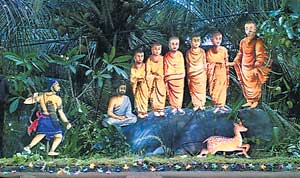
How went on "Thanthirimale" On Last Poson
| Thanthirimale beckons pilgrims | ||
| By Athula Bandara The Sunday Times | ||
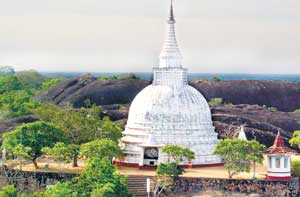
Spreading over an area of about 200 acres, the rocky terrain of Thanthirimale has a scenic beauty that captivates all who come upon it. Located in the midst of thick jungle, just 41 km from Anuradhapura, on its north west lies the famous Wilpattu park. Yet, it is because of its historic and religious significance that thousands of devout pilgrims journey here every Poson Poya. There is a reference in the Mahawansa to Thanthrimale in the story of the Bo sapling that was brought to Lanka by Theri Sangamiththa, during the reign of King Devanampiyatissa in Anuradhapura.
The King who accepted the relic at a place called Dambakiolapatuna, on his way back to Anuradhapura had spent the night on the rocks of Thanthrimale with the visitors. The place was then known as Bamunugama and was in charge of a Brahmin named Thivakka. He was also associated in the planting ceremony of the Sri Maha Bodhi in Mahamewuana Uyana in Anuradhapura. As a token of appreciation a shoot of the Bo sapling was also given to the Brahmin to be planted in his village Thivakka Bamunugama and can still be seen today. Thanthrimale is also archaeologically significant because of its Samadhi pilima and the Sleeping Buddha hewn out of rock. There are four more incomplete statues, for which archaeologists have different interpretations. Some believe that a natural disaster may be the result for them being left incomplete. There is a Pothgula (library) also erected in rock and rock huts which are believed to have been the meditation rooms of Bhikkhus of the time. For the pilgrim there is much to see at Thanthirimale – ruins and lots of Buddha statues, sellipi inscriptions and also a dagoba in ruins, all sadly vandalized by treasure hunters. The water courses around the area are replete with lotus flowers adding to the pastoral beauty of the landscape. The drawings on the walls of huts in Thanthrimale indicate the lives of those who lived centuries ago. Today Thanthrimale has become a place of pilgrimage that every Buddhist yearns to visit at least once in his/her lifetime. Aloka Pooja 2008 The programme is as follows: June 18- Poson Poya Lankadeepa, Siri Ranasinghe, followed by the distribution of uniform and other material to children of the Daham Pasala |
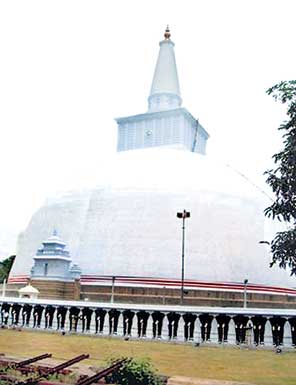
Ruwanveli Seya In Sri Lanka , For the Last Poya Day
| Ruwanveli Seya gets ready for Poson Poya | |
| By D.C. Ranatunga - The Sunday Times | |
It's around six in the evening. We are in the 'salapatala maluva' - the stone-paved compound at Ruwanveli Seya, the hallowed place of worship in Anuradhapura. This is the area where devotees offer flowers and other offerings and worship the stupa. We hear cries of 'sadhu', 'sadhu'. We look towards the main entrance. What a sight! Devotees of all ages – men, women and children – come up the steps and start going round the stupa carrying a deep brown robe. The robe is spread out and they carry it above their heads.
The cries of 'sadhu' continue. It looks a never-ending procession. They are carrying a robe 280 metres long, sufficient to go right round the stupa. We watch the procession gradually moving away from us. Once a full round is made, a few monks climb on to the area just above the three terraces ('pesavas') and start placing the robe to cover the stupa. This is the climax of an annual event after the Ruwanveli Seya gets a new coat of paint in time for Poson Poya when devotees in their thousands throng to the holy city. Annually 'sudu hunu' – a mix of chunam and salt - is applied to give a new look to the great stupa. On completion of the gigantic task, which is administered by the office of the Public Trustee, a 'pinkama' is held. A robe or the Buddhist flag is spread out covering the stupa, 'Buddha puja' is offered, and a monk delivers a sermon tracing the history of the Ruwanveli Seya and explaining the tremendous amount of merit gained by the devotees who undertake this mammoth task. The cost of the operation has been rising year after year and today stands at Rs. 3.5 million. Ten years ago the figure was around Rs. 500,000. The wages for about 50 workmen for a period of nearly three months in itself add up to a tidy sum. Yet there is never a problem in finding philanthropists to undertake the job. If no one comes forward, the Public Trustee publishes an advertisement in the newspapers. The response has always been most favourable. With Poson just a few days away, the dagoba is a blob of white. When lights are switched on at 6.30 in the evening, it's a beautiful sight. The dagoba as well as the compound is well illuminated. A cool breeze blows across. There is silence all round. It's an ideal setting for the devotees to recite the stanzas, to chant 'pirith' and to meditate. For security reasons, gates are closed at 9 p.m. About the stupa Though not the tallest stupa in Anuradhapura, Ruwanveli Seya is the most impressive and imposing possibly because over the years it has been maintained well. Referred to as the Maha Thupa in the Mahavamsa, Great Chronicle, it was built by warrior king Dutugemunu in the 2nd century B C to a height of 73.2 metres. The fact that a large quantity of corporeal relics of the Buddha had been enshrined in the stupa makes it so popular among the devotees. Many are the legends relating to the construction of Ruwanveli Seya. The way the materials had been obtained is fascinating reading. As for the design, a master-builder named Sirivaddhaka is supposed to have taken a golden bowl filled with water, poured a little water into his hand and let it fall on the surface of the ball. Then a great bubble rose up. "Thus will I make it," the master-builder said. King Dutugemunu liked it and rewarded him with cash and kind. |
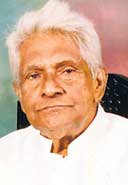
A simple man with many a talent - Kalakeerthi Pandit Wimal Abhayasundara
| A simple man with many a talent Kalakeerthi Wimal Abhayasundara --- The Sunday times | |
Sinhala poet and writer Kalakeerthi Pandit Wimal Abhayasundara, passed away on the morning of Thursday, June 12 at the age of 87. Poet, lyricist, art critic, scholar, veteran author and musicologist, he was born on September 17, 1921 in Welitota in Galle. He had his primary education in his village and his secondary education in Galle. His spoken language as well as written language was Sinhala and he was also conversant with Sanskrit, Prakrit, Pali, Hindi and English. Though he moved away from the village, he loved the rural landscape, the coconut and cinnamon plantations, the sea, the islands of the Madu Ganga by the side of his village.
In the past seven decades during which he had become a well-known literary figure in Sri Lanka, he had published about one hundred books, collections of poems, short stories and novels. Some of his books on poetry and prose have been translated into English, Yugoslavian, Chinese and Malay. Wimal Abhayasundara started his career as a journalist and worked as a sub-editor on both daily and weekly newspapers. In 1955, he was appointed sub-editor in the first Editorial Board of the Sinhala Encyclopaedia. In 1958, he joined the Sri Lanka Broadcasting Corporation as script writer in the Sinhala service. He was promoted to drama organizer and Editor, Publications. He also composed and produced musical programmes and radio operas. In 1964, he followed a six-month course in broadcasting television at the BBC in London on a Commonwealth scholarship. He travelled extensively in countries such as India, UK, France, Switzerland, Germany, Egypt, Yugoslavia, Chjina and Malaysia. He represented Sri Lanka at international poets’ conferences in Yugoslavia and Malaysia. As an author, his interest lay in experimenting with various styles of composition. Though he had a vast knowledge of Sinhala literature, he was also deeply interested in world literature, especially third world literature. Four of his books won State Literary Awards and three won first prize in All-Island competitions. His first State Literary award was for a book of poetry in 1936. His most recent works were Conquering Hearts (in English) and Manesa (Mind’s Eye) in Sinhala, published in 2005. He was honoured with the Kalakeerthi award by the Government of Sri Lanka in 1992 and received the Mahakavi award from the Aganuwara Tharuna Kawi Samajaya in 2006. In 1994, the book ‘Wimal Abhayasundara Samprasadawa’ and in 2007, ‘Aseniya Kusum’ was published in appreciation of his services to literature. At the diamond jubilee conference of All-Ceylon Poets Association, he was honoured with the ‘Kavya Kala Parameshwara’ award. It was his wish that he make his last journey in a simple manner, without flower wreaths, flags, decorations, banners, posters, cutouts and polythene disfiguring the environment. |
Meditation: The key to being mindful
| Meditation: The key to being mindful | |
| By Rajah Kuruppu - The Sunday Times. LK | |
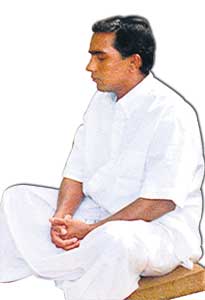
The human being comprises mind and body. Modern medical science is now according an important place to the mind, but over 2, 500 years ago the Buddha emphasized the invaluable role of the mind. In fact, the opening lines of the Dhammapada, a collection of important sayings of the Buddha, state that the mind is the forerunner of all states of being, mind is supreme, mind made are they. Accordingly, Bhavana, commonly translated to English as meditation, is assigned an important role in the practice of the Dhamma. Bhavana means the culture or the development of the mind and perhaps the English word meditation does not adequately describe Bhavana but it could be used for want of a better word, provided the true meaning of the term Bhavana is understood.
There are two kinds of Bhavana-- Samatha or the pointed concentration of the mind on a wholesome subject to the total exclusion of any others and Vipassana Bhavana (insight Bhavana) or to see things as they truly are as anicca, dukkha and anatta or impermanence, unsatisfactoriness and the absence of a permanent, enduring, unchanging self or soul or ego. Importantly, Bhavana also includes sati or mindfulness, to be aware of all activities of the body, feelings, thoughts and phenomena. So, on one hand there is the formal Bhavana where one sits in a given posture and on the other, the informal, where one is aware of one's activities all the time. Objective and results The final objective of Bhavana is to overcome the root mental defilements of greed, aversion and delusion, to see things in their true perspective and realize the Buddhist goal of Nibbana. However, there are benefits to be gained here and now if Bhavana is practised in the correct manner, namely, the decline of negative emotions such as the deep desire for pleasures, aversion, conceit, jealousy and the gradual development of Upekkha or balance of mind to face better the vicissitudes of life, the pleasant and unpleasant experiences. It is often remarked that many who engage in Bhavana do not reflect on their behaviour-- the decline of negative qualities mentioned earlier or the development of positive values such as metta - loving kindness, karuna -compassion, mudita - joy in the success of others and Upekkha - equanimity or balance of mind. This may be due to many confining their Bhavana to formal practice in the recommended posture for a specific period of time in the morning and night and believing that they have performed their task for the day. Actually Bhavana should be undertaken as a full-time exercise where one has sati or mindfulness of all activities throughout one’s wakeful life. In relating Bhavana to everyday life, one should be aware of what is happening in the mind and the body as often as possible. This observation should be undertaken wherever you are, whether it is at home, at the place of work, driving or being driven in a vehicle, exercising, during leisure and ablutions. One should also be alive to one's posture—whether it is sitting, standing, walking or reclining. When one is aware of what is happening in the mind and body, one is in the present. The Buddha advised His disciples to be in the present and not in the past which is already gone and which we have no control of or the future that has not yet come. We have to plan for the future, but that should be done with our feet on the ground in the present. Breath Bhavana One of the best ways to be in the present is to anchor the mind to the anapana sati Bhavana or mindfulness of inhaling and exhaling the breath. The breath is always with us from birth to death and some Bhavana masters say that it is our best friend that will never desert us through life. The Buddha has prescribed a precise posture for this Bhavana -- to be seated upright on the ground or on a chair, looking forward, hands on the lap one over the other and eyes closed or slightly open. However, this does not mean that one should not observe the breath in any posture and at any time. It is said that when one is agitated, depressed or even overjoyed, the concentration on the breath for a short time would bring the mind to a state of balance and develop the great quality of Upekkha or equanimity. This is an important aspect in the mindfulness of the activities of the body. The well known Bhavana master, Ven. Henepola Gunaratana Nayaka Thera, Head of the Theravada Buddhist Meditation Centre and Forest Monastery in West Virginia, USA, in a recent Buddhist discussion with this writer over the English Services of the SLBC recommended the practice of Bhavana on the breath for one minute every hour. This would help he said to calm the mind which is often bombarded with sense stimuli and consequently confused and disturbed. This is relating Bhavana to daily life and it would help to be in the present and engage in the mindfulness of all activities, mental and physical. To be in the Bhavana mode in daily life one should also observe the thoughts. During wakeful hours thoughts occur in the mind, about oneself, others or both. They could be thoughts of the present, past or future. When observing the thoughts it is realized how often they are of the past and the future and seldom on the present except in a well trained mind. Through mindfulness, our task is to wean away from unwholesome thoughts to wholesome ones. In everyday life we have our emotions and experiences, some pleasurable, some not so and others neutral. We have a problem with unpleasant emotions and experiences as we do not like them. One way to dissolve the unpleasant experience is to make it a subject of Bhavana. If there is pain you concentrate on the pain. Unbearable and excruciating pain due to serious ailments has been eventually overcome by practising Bhavana on the experience of pain. Initially, it is said that the pain would be aggravated by being alive to it but by persistent effort it could be overcome. Another unpleasant experience is the problem we have with some people with whom we associate in life. If there is a person who makes life difficult or even miserable, we should treat that person not with ill-will but as a teacher. He teaches us or provides us an opportunity to develop the great quality of patience or santi. We could also observe our mental reaction to the trouble maker and see that the problem is not so much with the other person but our own way of relating or reacting to him. If we react with sympathy, understanding and goodwill considering that that person may have a problem or deficiency and extend compassion to him, a better relationship could perhaps be established. In any event that person provides us an opportunity to observe our own mind in a difficult situation. Pleasant emotions and experiences also give rise to problems. They encourage negative factors such as over confidence and conceit which could lead towards one's own down- fall. So we should be mindful of accepting our successes with a sense of humility and equanimity noting that they are also impermanent and a passing show. If we are mindful of our thoughts we would be vigilant and careful before speaking and acting. Gradually, we will become aware before speaking and acting reflecting whether what we intend to say or do is harmful to us or others. Thus our intended speech or action could be modified or totally withdrawn if necessary. Thus, one should not confine one's Bhavana only to formal Bhavana undertaken in the usual Bhavana posture. It should be extended to the mindfulness of daily activities in wakeful hours, both physical and mental, as far as possible. For the latter exercise the training that is developed in formal Bhavana is undoubtedly an asset. |
The cultural dimension of Poson
| The cultural dimension of Poson | |
| By Lenard R. Mahaarachchi | |
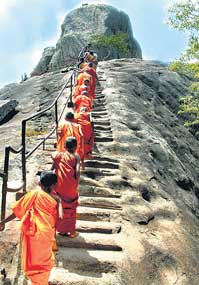
This week, Sri Lankan Buddhists celebrate Poson Poya. It is no exaggeration to say that the Lankan culture and Poson Poya are synonymous. History says it was on a Poson Poya day that Arahath Mahinda, son of the great King Asoka of India, and a group of missionaries came to Sri Lanka to spread the word of the Buddha.
Asoka was a harsh king. He was known among his subjects as “Chandasoka”, meaning “cruel Asoka”, but after embracing Buddhism he came to be known as “Dharmasoka”. He accepted the new religion that was fast spreading in his native India and wished to propagate the Buddha Dhamma in the island adjacent to his country. Arahath Mahinda, after putting King Devanampiyatissa to the test with a series of questions and satisfying himself on the matter of the king’s wisdom, then introduced the Buddhist philosophy to Sri Lanka. This year’s Poson marks the 2,311th year of that historic event. The Sinhala king accepted Buddhism, and the people of the country followed. This acceptance resulted in a cultural revolution, coloured by the teachings of the great teacher, Lord Buddha. The Sinhala culture became a Buddhist culture, and so it has remained ever since. The meeting of King Devanampiyatissa and Arahath Mihindu at Mihintale (the present Missaka Pawwa), was a defining moment in our history. Foreign invasions and incursions have, to some extent, modified the cultural identity of the Sinhala Buddhists, especially in maritime areas where, since the 15th century, the Portuguese, the Dutch and the British ways of life have influenced the local culture. Sinhala customs have their roots in Buddhism. The Sri Lankan Constitution requires that the head of state be a Buddhist. With that first Poson, 2,311 years ago, Buddhism and the Sinhala culture became one. The Poson experience has led Sri Lankans to believe that the Lord Buddha chose Lanka as the place that would preserve his teachings. Lankans believe the nation was reborn on that august day. Non-Buddhists appreciative of the Buddhist way of thinking would gain insights into the country’s ethnic, cultural and religious character. This awareness leads to a deeper understanding of the country. It is only through such an understanding that all communities in Sri Lanka can live in peace and harmony. |
--- The Sunday Times
Saturday, July 5, 2008
We are going to have a new website .................
Star Lanka Online Dot Com
we proudly present our new fixed web site,
www.starlankaonline.com in very near future. Also we are going to keep our download files like Dialog TV Monthly Programme Guide ( Unofficial ) , songs, TV Programmes and many more. That's why we were so silent past few weeks without many posts. But these free blogs remain same as before with new posts.
Many thanks to
Mr. Tharindu Shashindra webmaster of, www.arunella.com
and
Mr.K.D.Manuka Lakshitha , the webmaster of www.srizone.net
. Who are the ones , show us the way.
Await......
With More ....
Star Lanka Online Dot Com,
coming to your PC ...........
Click here
