Your Ad Here

Friday, March 21, 2008

Second century Buddha statue discovered in Taxila

Second century Buddha statue discovered in Taxila

March 19: Islamabad: Pakistani archaeologists have found a rare 2,000-year-old Buddha sculpture in red sandstone in the historical town of Taxila.

The 13 by 12 cm statue, featuring Buddha sitting cross-legged on a throne supported by two lions, is believed to be a 2nd century AD marvel.

"It's the discovery of the century -- a rare 2nd century AD sculpture of Lord Buddha made in red sandstone," Muhammad Ashraf Khan, Director for Exploration and Excavation in the Department of Archaeology and Museums, told reporters shortly after the discovery.

The statue was found during excavations at the site of a Buddhist monastery, located about 10 km north of the Taxila Museum, that existed between the 2nd and 5th century AD.

Under the soles of the Buddha figure are Dharmachakras (wheels of law). His right hand is raised in the 'Abhyamudra' or reassurance gesture with 'Dharmara Mudra' on the palm and a peepul tree behind him, the Dawn newspaper reported today.

The full grown peepul tree in the sculpture denotes the enlightenment of the Buddha. There are also two lions engraved on the pedestal and two figures on both sides of the statue.

The smiling Buddha, with long ears, hair arranged like a spiral shell and clad in 'Ekanshika Sanghati' or monastic drapery, is believed to be a Mathura-style sculpture and not an example of Gandhara art.

"It was brought by monks travelling from Mathura as a gift for the monastery here at Badalpur. It's unique in the Gandhara region that stretches from Jalalabad in Afghanistan to Taxila," Khan said. (The Hindu)


From 2004 posts******************


Buddhist relics unearthed in Taxila
Daily Times (APP), Nov 22, 2004

WAH CANTT, Pakistan -- The archaeology department?s preservation and restoration team has discovered eight antiquities consisting fragments including the sculpture of future Buddha, god Indra and his bodyguard dating back to the first century AD.

The antiquities had been discovered during the preservation work at the ancient and world famous archaeological site of the Gandhara civilisation locally known as the Dharmarajika Stupa and monastery which dates back to 3rd century BC to 5th Century AD situated about 3.5 kilometers north east of the Taxila Museum.

The department officials had confirmed that these antiquities include landmark, precious and rare discovery of a statue depicting ?the reappearance of Buddha?. According to the Buddhist mythology, Buddha would reappear before the end of the universe and the newly discovered fragment depicts the scene.

According to Buddhist belief another Buddha, Maitreya - the future Buddha, will come to earth at a specific time by leaving Tushita heaven to establish the lost truths in their purity. He is the only Bodhisattva known to Hinayana and Mahayan sects of Buddhism. Bodhisattva means a sentient or reasonable being. Bodhisattvas like the Buddha are honoured. It is said that a monk artist from Swat valley visited Tushita heaven to meet Bodhisattva Maitreya and carved the image when he returned to earth.

Another precious and exclusive discovery is the statue of god Indra. The Indra god was the god of ?nature? and according to the Buddhist mythology and Vedic Pantheon the thunder god Indra had attained a prominent position. Buddhist adopted numerous gods from Hinduism but modified their characteristics and importance.

Sidhartha, Buddha, visited Indrasala cave and was asked some philosophical questions, which he answered very easily, thus god Indra and Brahma entreated Buddha to start preaching Buddhism. Another remarkable discovery is the statue depicting the bodyguard of Buddha, which was named in Buddhism as VajraPani.

The fragment of Corinthian capital was also discovered. Corinthian order was used in Magna, Garcia and Sicily from early third century. Its bell shaped capital enveloped with acanthus leaves characterises it. It became favourite order of the Romans. It said that a certain Greek sculptor got the inspiration after he saw a basked full of acanthus leaves over the grave of a beautiful Corinthian girl.

Two female headless figures, one of which depicts three segments of relief of Buddha are also included in the new discoveries. The archaeologists after the preliminary examination of these newly discovered antiquities here at Sub Regional Office in Taxila said that these newly discovered fragments were made of grape black schist and green phylite. The antiquities come from the early stage of the fist or second century AD.

The site where these new discoveries had been made had a significant status in Gandhra civilisation. The Dharmarajika stupa and monastery were probably the earliest in Pakistan, archaeologists said. Either ?Dharma Raja? or the righteous King Ashok of Mauryan dynasty in the 3rd Century BC, built the stupa. The stupa was a source of inspiration and a place of attraction from the beginning of the Buddhist religion and was later reconstructed during the time of King Kanisha, in the 5th Century AD.

Sir Johan Marshall explored the site first in 1920s and a large number of precious antiquities including fragments were discovered.

The techniqe of meditation based on the Eight Fold Path

The techniqe of meditation based on the Eight Fold Path
by R. L. Ihalamulla,
Department of Parasitology,
Faculty of Medicine,

Improved efficiency

The after effect of meditation lasts longer the longer you meditate. Sometimes you feel lazy and tend to postpone things that need to be done. Even if you attend to some work it would take a long time to finish. The after effect of meditation helps you to be more alert and focus better on the task you are engaged in. Thus you'll be able to finish it sooner and more successfully than before. If your mind gets distracted while being occupied in the task, you become aware of it before long and Observation will bring your attention back. This way you'll realize that a job that you took one hour to finish earlier takes only a fraction of that time now. You will be surprised at your own improvement. This means that one can do an increased number of tasks in a given time than before. Also increased alertness will not allow you to waste time. If you are doing nothing and wasting time it will make you aware of it so that you can think of doing something worthwhile. This is when you feel how much you would have lost earlier just by wasting it. So Observation improves your time management skills too. The result is that you are a more efficient and therefore a happier person now. How wonderful!

Some days there are a number of things to attend to. You start the day engaging in one of these which has a deadline, Now the rest of the things, come into mind "Oh, I have to do those jobs also. Or someone will disturb you reminding of these. Then in the middle of all these YOU may get a telephone call regarding still some other work you have to do. Now you get disturbed. So many things to do and yet some more coming in- You get confused. Lose your calmness. A real headache! Stress catalysts created! At this point if somebody talks to you, you are likely to get angry. No soothing utterance could be expected from you. Observation helps you to act with a cool head in such a situation. It'll tell you to choose only those tasks that you could tackle in the available time in that day. Then it will guide you to prioritize what was chosen and then attend to the first priority. If thoughts of other jobs come to mind it -will 'let go' of them. If there is some other external disturbance it guides you to respond calmly. If you get confused or angry by these, it will remind YOU that you are emotionally disturbed. So back on to the right track! This is how Observation will help you to attend to your daily tasks smoothly and efficiently with no stress so that - you can be satisfied at the end of the day.

A happy life

Everything in this world is in a dynamic state of change. We fail to understand this and try to see a permanent entity in constantly changing phenomena. This is the biggest illusion that we are doped with. We are conditioned with it from our childhood by our parents and elders who inculcate this into our thinking. And because of this we tend to get attached to worldly things in life, which results in suffering. So rather than crave for things you should learn to live with them - associate with them, make use of them - all the time observing them without getting attached to them. You do this perhaps like an alien watching the happenings in this world. This is a whole new experience. You begin to see this existence in its real perspective. So relaxing! So pleasing! Because you are no longer involved with or immersed in the scourge of existence of this world. The burden is being taken away and the suffering minimized. This is when you see the others who are possessed with this illusion, suffering because of the attachment to it and realize how fortunate and happy you are. Just do this once and see what a wonderful experience it is.

With understanding derived from logical argument you can minimize pain and thus suffering. Mind and body are two different entities. It is the mind that bears suffering. Suppose you have a wound. The body has the injury but the mind suffers with pain. Not fair! You can easily experience this. When you feel the pain of the wound and if the mind is distracted to something else there is no more pain. It vanishes. So if only the mind feels the pain why should you let it hurt and suffer? The body has the wound. Let it bear the pain. What do you care?

Coping with emotions

It is difficult for most of us to control our emotions. Many unhappy, unpleasant or violent situations could be avoided if one knows how to cope with one's emotions. The most difficult place to cope with your emotions is unquestionably your home. This is where you live 'with yourself: the way you want. This is where your beloved ones are; those that care for you and whom you care and love' most. Then why is it difficult to cope with emotions when living with them? It is once again due to this curse - the attachment; the root cause of the problem. Your attachment is the greatest at home. As such, you expect the other family members to love you and care for you in the same way that you do for them. But if you feel that they don't respond in kind you become hurt. Just a single word uttered by mistake would be enough to start 'fireworks'. Parents and elders expect the children to obey them, respect them at all times. The higher the attachment the greater is the hurt, the pain; that is the suffering. When the younger are teenagers the parent/child relationship in most families are at the lowest; sour and unpleasant. Most of them live like strangers under the same roof. Since the attachment is the highest the parents think that their children also should think and behave in the same way as them. This is when attachment is blind to reason. They are your children alright, yet they are different individuals with different mind sets. Be less attached to your loved ones and property and attend to your commitments and obligations dutifully. The lesser the attachment the more sensible, and reasonable you will be and it would be easier to control emotions.

Another remarkable achievement of the meditation practice is the slowing down of sudden reaction to emotional disturbances. This means though the natural quick reflexes are there, you don't react as fast as before. But you become aware of the situation and think before reacting. This way you avoid the situation getting tense or unpleasant.

Realizing these facts make home a pleasant place for the whole family to live in.

Of the defilements special consideration should be given to anger, hatred, jealousy and vengeance as these are fundamentally associated with the ego factor "I" These result in unpleasantness, unhappiness and could lead to physical harm to oneself and others. When your position or status is challenged, when a subordinate disobeys you, when your spouse or the romantically involved partner or a dear friend disagrees with you or worse, try to quit, you get angry, lost, and insecure and feel that life is hopeless. When you are falsely accused of, insulted or scolded you get angry. Who gets affected by these is the 'self known as 'I’. But there is no permanent self as 'I’.- only a constantly changing phenomenon. Thus it is understood that whoever that got affected is changed; gone-, no more, and a new 'I' has emerged; born. As such, why should the new person get hurt over something that happened to another person? This truthful fact gives you strength to face and overcome anger and other defilements.

The Observation plays a major role in calming down such a situation. If you have developed your Observation you become aware of it once you are emotionally disturbed. And instead of reacting at once as a mundane person would have done, the Observation will help pass over the initial shock and the disturbance and guide you to settle down thus making it easy to solve the causative problem. The same goes for situations when you are overjoyed. If uncontrolled you could become arrogant or overconfident and be tempted to try something impossible by which means you would hurt not only others but yourself as well. Whatever happened to the hardly achieved joy? The Observation could easily have prevented this unfortunate happening. With right understanding of these facts you can stay calm without getting agitated, overexcited when faced with an emotionally disturbing situation.

Life in its true sense and fear of death

Mind is the forerunner of our life. Like all other worldly things mind is also in a state of constant change. It is a continuous process of flux of thoughts arising, existing and passing away. This happens so fast, probably in a millionth of second that we don't realize it. This process takes place throughout our life. This means that birth, living and death of the mind occur at every moment of life. This same process takes place at the time of death but with the difference that the physical body ceases its physiological role and immediately starts to decompose. In other words the thought process of -the mind, from one thought to another continues even at the time of death. That is as the last thought of life dies away the mind has already chosen and conceived in another form of existence. The mind exits from the physical body leaving it behind, lifeless. Thus it is clear that there is no point in being sad or fearful of death, because it doesn't kill our mind. Mind is indestructible. So it continues to exist, of course in another form, human or other in other words., it 'is clear that the physical body which we cared for so much and were attached to so much is not the dominant and the essential component of life's existence. The body is principally a medium made of physical elements of the universe for the mind to experience the sensual pleasures and other feelings brought in by the sense organs. And what causes the sadness and the fear of death? It is the attachment; the attachment to property acquired, beloved ones etc. - that you don't want to leave behind - a cause of "suffering. Therefore, with a clear understanding of their true nature and with the Observation guiding, you can face both life and death meaningfully with no fear.

The Island

Continued on next Poya day

Advent of Maithree Buddha Sasanaya

Advent of Maithree Buddha Sasanaya

Part one of a discussion series on Self in Buddhism

By U. Sapukotana

- Daily Mirror

Homage to the Master who helped us to distinguish the hardwood from the bark and to see the essence of the ‘Tathagata Darshanaya.’

Preamble

( This note is written with the full realization of the limitation of the ‘word’ and language to communicate the Truth which is beyond words or language).

The less known sculpture in the Islamabad museum where in the same statue, Gautama Buddha is shown and the other side shows Maithree Bodhisatta, conveys a strong message. The message is that Maithree Buddha Sasana is the continuation of the Sasana of the Gautama Buddha in its pure form.

In the greatest intellectual dialogue recorded in human history between the Buddha and Arahant Subhuti in the Maha Pragna Paramita Sutra, Buddha explicitly states as follows: Towards the end of the Sasana ( (dispensation)when the original Buddha message is corrupted by other teachings and also by misinterpretations which naturally come with passage of time, the original pure Dhamma will be unfolded. (Chap. 3.4)

It is with conviction and a strong sense of responsibility that we announce to the world that Maithree Buddha Sasana is already established originating in Sri Lanka and is steadily spreading to other parts of the world. It may not be a coincidence that, for the first time in history, a statue of Buddha Maithree (not the Maithree Bodhisatta) has been built in a temple in Matugama which is a replica of the 500 foot statue of the Maithree Buddha, now being constructed in Kusinara.

We have often wondered why this beautiful message so logical, fully in consonance with the Truth as revealed by Buddha Gautama does not reach the ears of many. Two references made by the Buddha gave the answer this question. In the Samiddhi Sutta, prince Jayasena inquires from a young monk Samiddhi what Buddha’s teaching is. The monk succinctly explains the teachings as he understood. Prince Jayasena scoffs at him, ridicules him and goes his way. The monk was frustrated and relates the episode to the Budha, Buddha’s reaction was very revealing. “How possibly can the ordinary person, enjoying the senses, reveling in the senses, lost in the senses comprehend a Truth which is beyond the senses, so profound, so subtle.

Elsewhere, Buddha says ‘This Dhamma, -moving upstream (in the direction of the original source), skilled, deep and subtle is not easily comprehended by those lost in attachment( (Raga) and aversion ( Dosa)and shrouded by the thick veil of illusion “Raga dosa Paretehi nayam Dhammo susambuddho, Patisota gamin nipunam gambiram duddasm anum – Ragaratta na dakkhinti Mohakkhandena Avuna”

We know how much the concept of the ‘person’ the ‘I ‘ is ingrained in us, penetrated to our bone and marrow, through millions of years of conditioning. Hence a teaching which rejects the ‘ego’ and the ‘I’ will not be very palatable to many. Notwithstanding there are people spread out in the four corners of the world, whose innate potential ( Parami) has reached maturity. Few as they are, for their benefit this Dhamma is shared in the true spirit of Bodhisattas.

A brief review of the salient features of the maitri buddha sasanaya ( dispensation)

All Buddhas reveal to the world the same truth, ’the things as they are” ( bhuta tatha tata). some of the key teachings, buried in the sands of time and sometimes distorted with mischievous intent get surfaced as the maitri buddha sasana unfolds itself. some such areas are given below: ( few of them are elaborated in the main note)

  • The total emphasis of the Maithriee Buddha Sasanaya (MBS) is on the escape from birth and death. All that happens between birth and death is sickness and decay. It happens so fast that the naked eye cannot capture this process. Enlightened Vision or Darshanaya which puts an end to the cycle of births and deaths, can be can be reached during this very life. It gives relatively low priority to whatever deed, word or thought that perpetuates life , even in seemingly comfortable circumstances as they are ephemeral. . Every effort should be made to escape from birth and death in this very life given the opportunity of being born as an intelligent human being. To postpone it t to a future birth is absolute folly (stupidity) in view of the longevity of Sansara and the uncertainty as to how we will manifest ourselves in the future .
  • The foundation of the teachings of MBS is the absence of the ‘ego’ entity.
  • ‘Darshanaya’ or ‘seeing’ takes predominance over ‘thinking’ ’intellectualizing’ Ehi passiko Bhagavata Dhammo – come and see for yourself. A problem created by the mind cannot be solved by mind. As Albert Einstein sums up, “ A problem cannot be resolved by the same thinking that created it”
  • The essence of Buddhadhamma is “Uppada vaya”.- “Anicca Vata Sankhra Uppadavayadhammino” ceasing inherent in arising and not Uppada, tithi, bhanga –arising, continuation and ceasing. ( a mischievous interpolation?)
  • Whereas Vedic teachings talk about the ‘cultivation’ of the mind, Buddha revealed a Truth which is beyond the ‘Mind’. Cetovimutti- emancipation from the mind. In the Ratana Sutta’ Buddha speaks of Arahants who have acquired the light by literally ‘burning’ the mind ( Ye suppa yutta manasa dalhena)
  • Understanding the Tiparivatta – the three turning circles referred to in ‘Dhammacakkapavattana Sutta’-is a prerequisite for seeing the Truth of Life. What are the three Vattas we are talking about? They are ‘Kamma vatta’ (deep sleep), ‘Vipaka vatta’ (Light sleep were we see dreams) and “Kilesa vatta’ (the so called awake state dominated by the five senses).The Vattas keep on turning endlessly ‘ad infinitum’ independent of each other. From one Vatta we cannot see the other two. Eg. We cannot see the awake state when we are in ‘deep sleep’ and similarly when we are in deep sleep we cannot see the light sleep or the awake state.
  • Only ‘looking within’ will lead us to the Truth. ‘looking’ within’ ( in effect means observing the process that incessantly goes on in our five senses)-by retracing the steps back to the source- the origin or going ‘upstream’. We go back as far as the point that we cannot penetrate with ‘thinking’ –eg. Deep Sleep. The ‘world’ as the Buddha saw is in this fathom long body. ‘Buddha Nature’ too is within us.- “Samano natthi Bahire.”
  • The most salient feature in the ‘MBS’ is the exploration of DEEP SLEEP. It should be the object of reflection and focus (call it “Kammatthana” in meditation parlance) “Deep Sleep” where ‘I’ nor a ‘person’ nor the ‘world’ exists. Ascetic Siddhatrta’s hypothesis that the ego does not exist was proved when he explored Deep Sleep. There is a state within our own life where the ‘ego’ does not exist. Eg. Deep Sleep. . This bold exploration into the dark recesses of Deep Sleep helped ascetic Siddhartha to attain Enlightened Vision ( This aspect is discussed in detail in the main note.)
  • These Vattas are separated from each other by TIME. Time is a concept hitherto unexplained by even most eminent scientists The message of the MBS is that TIME does not exist in reality as a measurable phenomenon. It stands like a screen or a barrier between the Vattas. This TIME barrier does not exist in the minds of Buddhas or Arahanths. Therefore all three Vattas become one and gets extinguished into nothingness. Buddha sums up his total message.as follows: “Kala Vimutto, Nissaranam, Nibbanam”- Whoever escapes from the clutches TIME, or conquers TIME, is no more attached and attains Nibbana” MBS does not recognize the past, future nor the present moment.
  • MBS recognizes only two states of existences. The human world and the animal world. In ’ Saccha Vibhanga Sutta’, Buddha explains ‘birth’ as follows: ‘Arising of a mass and the acquisition of ayatanas . “ Khandanam Patubhavo, Ayatananam patilabho”. Then what about the imaginary beings like Devas, Brahmas, Bhutas etc. Why did Buddha speak of Devas Brahmas etc. in the Dhammacakkapavattana sutta and elsewhere? Buddha knows that they are creations of the mind. However he had to use the conventional parlance to describe the Truth that he saw. What he says in effect is the following: ‘I have seen the Truth hitherto not seen by ‘your’ Devas, Bhahmas etc.’
  • The texts speaks of the thirty one states of existence including four lower states, six heavenly states, the state of a human being, sixteen Brahma worlds and four Arupa Dhyana states, which goes to make thirty one states. Elsewhere we hear of the thirty two great signs of the Buddha’s body thirty two “Maha Purusha lakshanas” It gives the impression that these lucky ( mangala) signs are sort of ‘tattooed’ in Buddha’s body. This is a gross misunderstanding of the symbolic significance of the signs of a Buddha. It simply means that he has gone beyond the thirty one states of the mind where ordinary people revel in.
  • MBS recognizes that ‘Buddha Nature’ is present within all of us in embryonic form. We do not allow it to blossom because it is covered with a thick veil created by our dense senses.
  • MBS recognizes the world we see with the senses as an illusion. ( Maya). When we take the impressions (Arammanas) from the five senses they seep into the second layer of Rupa , Vedana sanna, sankhara, and vinnana. The end product is the work of the magician – an illusion. It creates a mountain of shadows (Nippanca Rupa) which eventually becomes the force driving us and guiding us to the wilderness of Sansara The senses create a perfect illusion of a ‘ person’ that did not exist in Deep Sleep’ when we get up from deep sleep. The parallel is the Alchemist giving the appearance of ‘gold’ to ordinary metals using a lapis. The raw materials in this case are the four elements. But when filtered through the lapis, ie five senses, it gives the perfect illusion of a ‘person’ whereas there is no ‘person in reality .( The process is discussed in the main note)
  • The world of the senses recognize six truths based on sense experiences. The MBS recognizes only one Truth, the state beyond duality, Yamakaya
  • “Punarutpatti” rebirth as we understand is a Vedic concept. It recognizes ‘Time’ What Buddha taught was “Punarbhava” - “Akuppa me Ceto Vimuiti, Ayamanti ma Jati natthi dani Punabbhavo”. The latter in effect means the continued perpetuation of life through the nourishment it gets from the sense doors.

Wisdom and Samadhi - a two way process

Wisdom and Samadhi - a two way process

A person, who wants to train his heart to become skilful and to know what is behind the deluded tricks of the defilements (kilesas), must not be attached to study and learning in Buddhism to such an extent that it gives rise to the defilements.

But also he must not abandon study and learning, for to do this goes beyond the teaching of the Buddha. Both these ways are contrary to the purpose which the Buddha desired that one should aim at.

Meditation **************************

In other words, when one is practising meditation for the purpose of developing Samadhi, do not let the Citta (mind) grasp at what it has learnt by study, for it will be led into thoughts of the past and future.


Samadhi

One must instead make the Citta keep to the present, which means that just that aspect of Dhamma which one is developing must be one's only concern.

When there is some question or point of doubt in connection with one's Citta which one is unable to resolve, one may then check it by study and learning after one has finished one's meditation practice.

But it is wrong to check one's practice all the time with what one has learnt by study, for this will be mere intellectual knowledge, and not knowledge which comes from development in meditation and it is not the right way.

Summarising the above: If the Citta attains calm with an object of calm (Samatha), that is, with a preparatory repetition that comes from an aspect of Dhamma that one is developing, one should continue with that method.

But if it attains calm only by the use of wisdom, using various expedient methods to overcome difficulties, then one should always use wisdom to help in the attainment of calm.

The results which come from training in both these ways (i.e. Samadhi develops wisdom, and wisdom develops Samadhi), are the development of Calm and Wisdom, which will have a hidden radiance coming from the calm. Samadhi is by name and nature "calmness".

It is of three kinds as follows: **********

1. Khanika Samadhi - in which the heart becomes unwaveringly fixed and calm for a short time after which it withdraws.

2. Upacara Samadhi - of which the Buddha said, that it is almost the same, but it lasts longer than Khanika Samadhi. Then the Citta withdraws from this state.

3. Appana Samadhi - is Samadhi that is subtle, firm, and unwavering, and in which one can remain concentrated for a long time. One may also remain concentrated in this state, or withdraw from it as one wishes.

In Upacara Samadhi, when the Citta has dropped into a calm state it does not remaining that state, but partially withdraws from it to follow and get to know about various things which have come into contact with the heart.

Sometimes something arises concerning oneself and one sees a vision (Nimitta) which is sometimes good and sometimes bad, but in the first stage the nimitta will generally be something about oneself.

If one is not careful this can lead to trouble, because Nimittas which arise from this kind of Samadhi are of innumerable varieties.

Decayed **************************

Sometimes in front of one there appears an image of oneself lying down dead, the body decayed and swollen, or it may be the dead body of someone else.

Sometimes it is a skeleton, or bones scattered about, or may be one sees it as a corpse being carried past.

When such a nimitta appears, a clever person will take it as his Uggaha Nimitta; in order that it may become the Patibhaga Nimitta, because this will steadily lead to Samadhi becoming firm and to wisdom becoming penetrating and strong.

For a person, who has a strong ability in maintaining a detached rational attitude, to be successful in gaining value from such a nimitta he will always tend to develop mindfulness and wisdom (Sati-panna) when faced with it.

But there are a lot of people whose natures are timid and easily frightened, and Upacara Samadhi may do harm to the Citta of a person of this type because this class of Samadhi is of many different kinds and many frightening experiences can occur.

For example, the image of a man may appear, whose bodily shape, colour and social position are all frightening, and he may appear as though about to slash at one with a sword, or to eat one.

If however, one has little fear and is not timid, one can suffer no harm in such circumstances and one will learn more and more methods of curing one's Citta from these kinds of nimittas, or Samadhi.

But with a timid person - who usually tends to look for fearful things - the more he sees a frightening nimitta the larger it becomes, and at such a time he may unfortunately be driven mad.

As for external nimittas which come and go, one may or may not know whether a nimitta is external or whether it arises from oneself. But when one has become skilled with internal nimittas which arise from oneself, one will be able to know which are external nimittas.

External nimittas are associated with many different happenings of people, animals, pretas, bhutas (ghosts of the dead), the son of a Deva, a Devata, Indra, or Brhama, any of which may at that time be associated with one's Samadhi, even as one talks to a guest who comes on a visit.

When such incidents occur they may last for a long or short time depending on how long the necessary conditions last that are required for such happenings.

Conditions **************************

Sometimes however, the first set of conditions dies away and another set of conditions arises continuing from the first set, which is not easily brought to a close for the theme may be of short or long duration. When it dies away and the Citta withdraws, it may have spent several hours in this state.

For however long the Citta remains concentrated in this kind of Samadhi, when it withdraws one will find that it has not increased one's strength of Samadhi, nor made it more firm and durable, nor will it have helped to develop and strengthen one's wisdom.

It is like going to sleep and dreaming, when one wakes one's mind and body will not have gained their full strength.

But when one withdraws from the type of Samadhi in which one became concentrated and remained in this one state, one will find that the strength of one's samadhi has increased and it has become more firm and durable. Like someone who sleeps soundly without dreaming, when he wakes his body and mind will feel strong.

In Upacara Samadhi, if one is still not skilled and does not use wisdom to be careful and watchful on all sides, it may cause much trouble and can drive one mad. Those people who practice meditation generally call this state "Broken Dhamma", and it comes about because of this type of Samadhi. But if it is done with due care it can be of value in connection with some things.

As for the Uggaha Nimitta which arises from the citta, as was explained at the beginning of this chapter, this nimitta is the most suitable basis for the development of the Patibhaga Nimitta, which accords with the principles of mediation of those who want a method which is both skilful and truly wise, because this is the nimitta that is associated with the Ariya Sacca (Noble Truths). One must absorb the impression of the Patibhaga Nimitta into one's heart, then it may be considered to be the Ariya Sacca.

Both Nimittas which arise from oneself and those which come from external sources may lead to trouble if one is a timid person, and it is important to have wisdom and courage when things happen.

But one who has wisdom is not one-sidedly biased against Upacara Samadhi. It is like a poisonous snake, which although dangerous, is sometimes kept by people who can benefit from it.

Significance of Medin Full Moon Poya Day

Significance of Medin Full Moon Poya Day
- Daily Mirror


By Gamini Jayasinghe

The significance of Medin Full Moon Poya day is mainly due to the fact that it was on the first Medin Full Moon poya day after the Enlightenment and seven years after his Abhiniskramanaya Buddha visited His relatives in Kimbulwatapura or Sakya Desa, the kingdom of King Suddhodhana. For Sri Lankans this day is particularly important because it is the climax of Sri Pada pilgrimage season.

From the time of the Abhiniskramanaya or the day when prince Siddhartha left the palace and went in search of the truth , Mokshaya, total liberation, the final emancipation or freedom from transmigration, the state of Nirvana, his father, king Suddhodhana, kept himself linformed of the developments of his beloved son. During a period of six years he heard various news, some of which were heartbreaking. On a number of occasions news was brought to him saying that his son, prince Siddhartha had died. According to legends certain parties had brought human bones to substantiate their statements. However the king rejected them on the contention that Sakyans do not die before their maximum span of life.

To his consolation the happy news that his son had attained Buddhahood was brought to him after six long years. The news was that he had attained Enlightenment and was preaching His doctrine at Rajagaha Nuwara, Veluvanaramaya. King Suddhodhana who was longing to see his son was overcome with happiness. Immediately the king sent one of his ministers as an envoy to invite Buddha to visit his Kingdom, Kimbulwathpura. The envoy was accompanied by more than one thousand followers. His relatives too were anxious to see Him. The king got his people to construct Nigrodharamaya for the Buddha and His disciples.

However to the disappointment of the king and his relatives the envoy did not come back. He and his followers had entered priesthood having heard Dhamma and had not conveyed the message. On nine successive occasions the king sent nine courtiers each with a large following to invite the Buddha to Kimbulwathpura.

Contrary to the king’s expectations all nine attained Archonship and joined the Order. Since Arahantship are indifferent to worldly things they did not convey the King’s message to the Buddha. The disappointed king finally sent Kaludai, who was a playmate of the Buddha. He agreed to go on condition that he would be allowed to enter the Order. He too hearing the Dhamma attained Arahantship and entered the Order. However unlike the other envoys he conveyed the message to the Buddha and persuaded Him to visit His aged royal father, king Suddhodhana. He told the Enlightened One that the rainy season was over and the time was quite good to visit Kimbulwathpura. The Blessed One accepted the invitation and attended by a large retinue of disciples, journeyed the whole distance preaching Dhamma on the way and arrived in Kimbulwathpura in two months.

Arrangements were made for Him to stay in the Park of Nigrodha, a Sakyan. The Sakyans who went forward to receive the Exalted One preceded Him in a procession. Young Sakyans worshipped the Omniscient One but the elders who walked behind Him did not venerate Him as they thought it was not proper when taking the age factor into consideration.

Buddha with His divine eye realized what the Sakyans were contemplating upon. In order to dispel the arrogance of Sakyans the Buddha performed the “Yama Maha Pelahera”, twin or the double miracle – the power said to have been possessed by the Buddha to cause a stream of fire to issue from one part of His body and a stream of water from the other at one and the same time which is a power to issue such streams together from eyes and nostrils which was the result of His having accomplished “Thejokasina” ad “Apokkasina”.

Buddha used the Twin miracle only when it was essential and this was the second occasion when it was performed.

The king seeing this wonderful sight saluted Him immediately, saying that it was his third salutation. Then all the other Sakyans paid Him due respects. Having worshipped the Enlightened One they took refuge in “Thu Sarana “- the Triple Gem. Thereupon the Buddha came down from the sky and sat on the prepared seat. The relatives too sat down to listen to Him. Then a strange phenomenon occurred. Rain broke out but it wetted only those who wished to get wet, and not the others. When the Sakyans marveled at this phenomenon the Buddha preached the Vessantara Jatakaya to show that in a previous birth too he had renounced the worldly life.

Buddha Goes on Begging Alms in the Streets of Kimbulwathpura

Since no one had invited Him for Dana or Noonday meal on the following day He went from house to house in the streets of Kimbulwathpura with Bowl in hand seeking alms together with His disciples. This was reported to the king and having seen the Enlightened One, his son, begging food in the streets rushed to Him having been deeply moved and most humbly inquired of the Buddha why He was disgracing his royal family.

“Members of Royal families never beg food” the king said. “This is the custom of our lineage, O’king” the Buddha replied to the king’s astonishment.

“Surely Lord, our’s is the warrier lineage of Mahasammatha and not a single warrior had gone seeking alms” the king said. “This royal lineage is yours O king, mine has gone seeking alms” “This royal lineage is yours, and mine is the Buddha lineage”

Standing in the street the Buddha then advised the king thus:-

“Be alert, be not heedless, and Lead a righteous life. The righteous live happily both in this world and in the next”

The king realized the truth and attained “Sowan”, the first of the four paths or stages leading to Nirvana. Soon he took the bowl from the Buddha and conducted Him and His disciples to the palace and served all with food. After the meal the Exalted One preached “Anumeveni Bana”

“Lead a righteous life, and not one that is corrupt. The righteous live happily both in this life and in the next.

Hearing Anumeveni Bana the king attained Sakardagami, Once Returner, the second stage of Sainthood, and Queen Maha Prajapathie Gothami attained Sowan, the first stage of Sainthood. On a later occasion hearing the Dhammapala Jathakaya the king attained Anagami – Never Returner, the third stage of Sainthood. On his death bed the king heard Dhamma from the Buddha for the last time and attained Arahantship. When the Exalted One preached Anumeveni bana all but princess Yasodhara came to pay their reverence to the Buddha. Princess Yasodhara remained in her apartment assuming that the Buddha would pay her a visit if she was sincere and virtuous enough.

Buddha handed over His bowl to the king and accompanied by His two chief disciples entered the chamber of Princess Yasodhara and sat on the prepared seat, saying:-

“Let the king’s daughter pay reverence as she likes.” She came swiftly, clasped his ankles and placing her head on His feet worshipped Him.

King Suddhodhana commended her saying that she had given up garlands, comfortable seats and beddings and wore yellow robes hearing that the Buddha was doing so. He also told she resorted to one meal a day and had rejected the offers made by her relatives to maintain her.

The Buddha cited the Chanda Kinnara Jatakaya to illustrate how much love she had towards Him not only in this birth but also in previous births. With this He consoled princess Yasodhara and left her apartment. After the death of king Suddhodhana princess Yasodhara entered the Order with Queen Maha Prajapathie Gothami and later both attained Arahantship.

The second day after Buddha’s visit to Kimbulwathpura was an auspicious day for His step brother Prince, Nanda. It was his consecration ceremony, marriage ceremony and the house warming ceremony. Having observed that Prince Nanda possessed the virtues of putting an end to sufferings of transmigration,the Buddha visited his palace. Prince Nanda received Him most respectfully with devotion and offered Him Dana. After Dana the Enlightened One handed over His bowl to prince Nanda and proceeded to the Viharaya.

Due to respect and brotherly affection prince Nanda followed the Buddha not being able to hand over the bowl back to the Buddha. On the way the Buddha made prince Nanda to realize that all worldly pleasures are temporary and subject to change, decay and death. Although prince Nanda had in his mind the words of his fiancée, Janapada Kalyani who requested him to get back soon he could not ask for permission to go back to the palace. So with the bowl in hand he followed the Exalted One out of respect to Him as Buddha and as his elder brother.

Thus Medin Full Moon Poya Day and the month of Medin are of great significance as it was during this period that the Exalted One started His service to the relatives from both parental families including His father, King Suddhodhana, step mother, Queen Maha Prajapathie Gothami, princes Yasodhara, His son, prince Rahula, step brother, prince Nanda and Sakyan Nobleman, Ananda who was appointed as His attendant and Dharma Bhandagarika.

For Sri Lankans this is the peak period of Sri Pada pilgrimage season which ends in two months on Vesak Full Moon Poya Day.

Stop Tibet violence or I will quit: Dalai Lama

Stop Tibet violence or I will quit: Dalai Lama

By Jonathan Allen

Daily Mirror

DHARAMSALA, India, Tuesday (Reuters) - The Dalai Lama said today he would resign as Tibetan leader if the situation veers out of control in Tibet and denied accusations from China that he was inciting riots.

“If things become out of control then my only option is to completely resign,” Dalai Lama, Tibet's exiled spiritual leader, told a news conference at his base of Dharamsala in northern India.

Tibetan spiritual leader the Dalai Lama speaks to the media in Dharmsala, India, Tuesday, March 18, 2008.

Today, China's premier Wen Jiabao accused the Dalai Lama of orchestrating riots in which dozens may have died and said his followers were trying to “incite sabotage” of Beijing's August Olympic Games.

The Dalai Lama, who fled into exile in India in 1959, denied Chinese accusations that he was masterminding protests and said he was against violence, whether from Chinese or Tibetans.

“Even if 1,000 Tibetans sacrificed their life, not much help,” he told reporters. “Please help stop violence from Chinese side and also from Tibetan side.” The Dalai Lama said he had nothing to hide from the Chinese.

“Investigate thoroughly, so if you want to start investigating from here you are most welcome,” he said. “Check our various offices.

“They can examine my pulse, my urine, my stool, everything,” he said with a laugh, miming as he talked.

The Nobel peace laureate reaffirmed that he wanted autonomy for Tibet within China but not outright independence.

Asked by Reuters what the Dalai Lama meant when he talked of resignation, Samdhong Rimpoche, the exiled government's prime minister, said he would still remain as Dalai Lama, if not as leader of his people.

“If the Tibetan people are involved in violence and unable to be in a non-violent way, he would not be in a position to lead the Tibetan people,” Rimpoche said.

Monk-led anti-China protests in Lhasa, the biggest in almost two decades, turned ugly on Friday, weighing uncomfortably on the Communist leadership anxious to polish its image in the build-up to the Olympic Games.

India hosts the Dalai Lama in the India city of Dharamsala, seat of the self-proclaimed Tibetan government-in-exile and the scene of daily protests in the past week.

More than 2,000 Tibetans gathered on Tuesday from all over northeastern India for their biggest rally in the area in years, demanding the United Nations investigate reports of killings of protesters in China.

Led by hundreds of shaven-headed Buddhist monks in maroon robes, some as young as eight, they waved Tibetan flags and marched through the streets of Siliguri, chanting: “We want justice, we want freedom”.

Friday, January 25, 2008

Priyantha De Silva and Media History In Sri Lanka

A few months ago, I've seen on a blog of TV radio Sri Lanka, a person had insulted me as "What do you know about Media?".I newer gave them an answer and laughed.When my childhood, a music group called "SHA", had came our house to stay about one week. (There was a one who had some relationship with us, in the band). Many singers and songstress like M.S. Fernando, Mariazell Gunathilaka and many others have came our house and had dinner , that my mother had cooked. Those days I was very familiar with singers, specially , with Abewardana Balasuriya.


One day from the SLRC ( Sri Lanka Brodcasting ) had came our house to observe the information that I've posted by a letter.And they came to Matara from Colombo for that reason and got my sign to prove their attendance.They'd erected a antenna to get all the signal from other parts of the island ,in our home garden to search more.
************************************************************************************
In 1994 , I've posted a letter to The Sunday Times and It has published .The most important thing is, The Father Of Television History" in Sri Lanka,Shan Wikramasinghe (Pinier of ITN and TNL ) , had given me a replay next week.As a very reputed man in Sri Lanka, Shan Wikramasinghe, I'm very much glad to received a replay from him.Specially, that was my first letter I've posted to a newspaper and also it has published. Now you can see the copiers.


***********************************************************************************
When receiving a certificate from a minister , Mahinda Wijesekara at BMICH, Colombo.


************************************************************************************

After that I've followed a "Media" course in the BMICH, from Mr. Sunanda Mahendra, Palitha Perera, Edvin Ariyadasa, and many more from the media sector.This's the certificate I've received for whole media"


************************************************************************************
This the 1st place Media certificate Ive won
from the SLBC a long time ago.I've won , got the 1st place from the Island wide

Thursday, January 10, 2008

Why ? Sri Lanka ....

WHY SRI LANKA ?


Extracted from,
sujata.wordpress.com


Why does anybody want to live in Sri Lanka, if there are other choices? Why deal with corruption, stupidity, headless bodies and bodiless heads, if you have a choice.

These are questions that seem to come up more often than I like.

What did the great sage of India have to say about location? I turn to the Mangala Sutra, A discourse on blessings, in Buddha’s own words, and translated to English by Henepola Gunaratana Thera.

To reside in a suitable location

To have past good deeds doneTo set oneself in the right direction

This is a blessing supreme

(Patirupadesavaso ca; Pubbe ca katapunnata;

Attasammapanidhi ca; etam mangalam uttamam)

There it is. The second verse in the Mangala Sutra. Buddha did not go as far as realtors to say location, location, location, but he did say to get your location right. First decide what is suitable for you.

For me what makes Sri Lanka unsuitable as a location is not the usual list of corruption… etc., but the Buddhist monks who are calling for war, and the chanting of pirit that nobody understands and pansil nobody intends to keep. Mixing of Buddhism and Nakshtra can be added to the list.

What attracts me also has much to do with Buddhism. Picking Sepalika flowers off the meadow on a poya morning and visiting Mihintale on Poson night. Those associations tie me down to this place. [Sepalika is the only flower (?) that you might offer after it has fallen. So delicate with a fragrance so subtle.]

If a truly Buddhist community is the object, one is perhaps better off in Los Angeles, USA or other foreign place where there are communities of true practitioners. To me, somehow, the Buddha, Dhamma, and Sangha there fail to connect with the sounds, smells and sensations that I associate with Buddhism.

What else does Sri Lanka offer or not offer?

Mangala sutra begins with,

Asevana ca balanam panditanan ca sevana;

Puja ca pujaniyanam etam mangalam uttam

To associate not with the foolish

To be with the wise

To honor the worthy ones

This is a blessing supreme.

To find a monk worthy of obeisance or a friendship worth sustaining is indeed a blessing supreme. As a returnee home after many years I have much to discover. At first glance I saw all monks here either as hate mongers or mudalalis, but, then I found you need to look deeper. For example, until recently I did not know that the very old monk I have seen round the temple I visit is the most venerable Davuldeniye Gnanissra thero, the chief incumbent of Amarapura Nikaya. One of these days I might get a chance to talk to him.

Interestingly, the Mangala sutra, [according to my limited understanding], has very little to say about social action. It essentially says to care for ones mother, father, spouse, children and relatives. Be good and do good to those around you.

Fourth and fifth verses in Mangala Sutra:

To be well caring of mother, of father

Looking after spouse and children

To engage in a harmless occupation

This is a blessing supreme

Selfless giving, living the just life

Open hands to all relatives

And blameless action

This is a blessing supreme

But take the last set of blessings. It is that set that grabs me most and makes me want to repeat it day after day, moment after moment, hoping the real meaning would sink in.

Last set of blessings, Mangala Sutra:

A mind unshaken

When touched by the worldly states

Sorrowless, stainless, and secure

This is the blessing supreme

How can you remain unmoved by corruption, stupidity, headless bodies and bodiless heads? Apparently, in later years, the Buddha watched his Shakya clan get decimated by the Kosala kings and did not intervene [Pankaj Mishra in, An End to Suffering: The Buddha in the World]. Buddha intervened in a fight over a river but at some point he had to give up, I suppose.

Michael Ondaatje got it right. To me, the running theme in his two seminal works—English Patient and Anil’s Ghost—is about finding inner strength through your craft when the world around you is falling apart. In the English Patient, the young Canadian nurse Hana saw her best friend blow up in a land mine and decided to opt out with one hopeless patient and care for him. What I remember most about Kip, the young Sikh mine sweeper, is his almost robotic attention to his task.

All the characters in Anil’s Ghost find solace in their craft and in each other in the middle of a strange war. Anil, the forensic anthropologist; Sarath, the archaeologist; Ananda the artist, and lastly Gamini the doctor even as he tended to the body of his brother’s body, a victim of the same war.

Mangala Sutra, third verse:

Great learning and craft

And a discipline well-trained in

And whatever utterance is well-spoken

This is a blessing supreme

Difficult times or not Sri Lanka is the place for me and the Mangala Sutra tells me to stay put, apply my craft as best as I can, take care of those around me, speak kindly, speak well, and above all, stay unshaken or try at least.

—————————————————————————-

Mangala Sutra or Great Discourse on Blessings

(Translation, by Dr. Henepola Gunaratana Nayaka Thera, Bhavan Society, High View, West Virginia, USA)

Thus have I heard. One time the exalted one was living near Savatthi, in Jeta’s Grove, the monastery of Anathapindika. Then, in the middle of the night, a certain deity of astounding beauty, lighting up the entire Jeta’s Grove, approached the exalted one. Drawing near, she paid homage to the Exalted One and stood to one side. Standing thus the deity addressed the Exalted One in verse:

Many deities and humans have pondered on blessings,

Desiring their well-being. Tell me the blessings supreme.

Buddha’s reply:

To associate not with the foolish

To be with the wise

To honor the worthy ones

This is a blessing supreme.

To reside in a suitable location

To have past good deeds done

To set oneself in the right direction

This is a blessing supreme

Great learning and craft

And a discipline well-trained in

And whatever utterance is well-spoken

This is a blessing supreme

To be well caring of mother, of father

Looking after spouse and children

To engage in a harmless occupation

This is a blessing supreme

Selfless giving, living the just life

Open hands to all relatives

And blameless action

This is a blessing supreme

To cease and abstain from evil

Complete restraint from intoxicants

To be diligent in virtuous practices

This is a blessing supreme

To be reverent and humble

Content and grateful

To hear the Dhamma at the right time

This is a blessing supreme

To be patient and obedient

The seeing of recluses

To discuss the Dhamma at the right time

This is a blessing supreme

To austerely and purely

To see the Noble truths

And to realize Nibbana

This is the blessing supreme

A mind unshaken

When touched by the worldly states

Sorrowless, stainless, and secure

This is the blessing supreme

Those who have fulfilled all these

Are everywhere invincible

They find well-being everywhere

Theirs is the blessing supreme


http://sujata.wordpress.com/2006/05/30/why-sri-lanka/

Meditation and Ultimate Happiness 1

Calming the Mind

Meditation can have several functions. It is about calming the mind but it is also about freeing oneself from habitual states of greed, hatred and delusion. Each of these is a source of suffering and therefore unhappiness. Although the Buddha's teaching starts with suffering or dukkha, the first noble truth, it ends in freedom from suffering - nibbana or nirvana (the third noble truth). The Buddha's teaching therefore is about achieving this freedom from suffering - ultimate happiness (though beyond what we might ordinarily conceive as happiness).

Though nibbana is the ultimate goal, how is it that Buddhists might find happiness in a world that they know is full of change, uncertainty, unsatisfactoriness? Even when happiness is possible, there is no escape from old age, sickness and death. What Buddhism does teach is that there are skilful ways of living. These include, following certain moral precepts and working on various meditation techniques that are conducive to well-being.

The five precepts are moral guidelines that - because they are skilful - lead to happy states. Not killing or harming living beings, not lying, not stealing, not indulging in inappropriate sexual activity, not drinking or taking drugs, mean that unhappy states are less likely to occur. To harm a living being, for example, has bad karmic consequences. It can lead to feelings of remorse and regret for what one has done. It will lead to suffering, whatever, according to the Buddhist doctrine of kamma.

Metta

A strong element of Buddhism is cultivating strong states of mind. These include resisting a tendency towards anger and fostering loving kindness (metta) and compassion (karuna). Many Buddhists actively practice meditation techniques that develop good will to all beings. In certain schools, there is the practice of seeing each individual being as if they were your mother. The kindness and good will you would extend to your mother, you extend to others universally. Also there is the compassion of empathizing deeply with another's suffering. If they suffer, it is your suffering too - there is no separation!

So, how do we find happiness in this world? One message from Buddhism is the deep truth that one finds happiness by seeking the happiness of others. There is no other way. This isn't a soft option. To love is to give endlessly, to fail repeatedly, to see the weaknesses in oneself on a daily basis, to fail an to fail again... but then to get up and try again.

Extracted from : http://buddhism.about.com


Sunday, December 9, 2007

Meeting Ajahn Brahm in a relaxed mood

Meeting Ajahn Brahm in a relaxed mood

By D. C. Ranatunga

http://www.sundaytimes.lk

About an hour’s drive from Perth in Australia brings us to Serpentine, a quiet hilly suburb where renowned meditation master Ajahn Brahmavamso has his monastery. It’s around ten in the morning and the Thai devotees who had brought the alms spread them out on a table in the alms hall and move out with plates of rice in their hands. They form a queue to serve the monks as they come in. We also join them.

Sharp at 10.30, Ajahn Brahm appears with around 15 monks following him carrying alms bowls. Ever-smiling, he greets us with ‘ayubowan’ as he approaches and accepts a spoonful of rice. The monks walk into the alms hall to serve themselves and we walk upstairs and await their arrival to bless us before they eat. We move out as they start taking the ‘dana’.

The meditation hall

“Have your meals and come up for a chat,” Ajahn Brahm tells me. We join the other lay visitors and share the food. The Bodhinyana Buddhist Monastery is in a quiet natural forest - 100 acres in extent. The ‘kuti’ – 21 in all – are spread out amidst the trees. A ‘kuti’ is occupied by a single monk. The monks spend their time meditating.

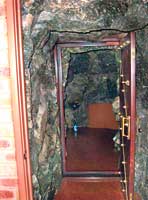
As much as he preaches the need to lead a simple life, Ajahn Brahm practises what he preaches. A junior monk took us to Ajahn Brahm’s ‘kuti’, built in the style of a rocky cavern just sufficient for him to move about. He uses a thin cushion to sit and meditate. He sleeps by spreading four cushions on the floor. The sound-proof room gets ventilation through small pipes laid in the walls. “Aren’t there facilities for laymen to spend time at the monastery,” I ask Ajahn Brahm. “Not right now,” he says. “Very soon we will provide residential facilities for up to 60 guests in a nearby retreat centre we are building.” A 140-acre block of land has been purchased for this purpose.

Ten individual cottages are being built at the Jhana Grove Retreat Centre containing six bedrooms in each. They are being designed in a way that will allow a great degree of privacy thus maximising the benefit of meditation practice. Connected to the cottages by a central walkway will be a large air-conditioned meditation hall with three adjoining halls to practise walking meditation. A well equipped kitchen along with other facilities for laundry and storage are being provided.

Ajahn Brahm’s kuti

Ajahn Brahm is keen to see that the elderly and the infirm are drawn to the Retreat Centre. “I have observed that those suffering from illnesses, cancer patients in particular, benefit through meditation. At the Retreat Centre we will provide facilities for such persons to learn meditation techniques and strategies in a peaceful environment that is also physically comfortable,” he explains. Serving as patron of the Retreat Centre is the former Premier of Western Australia, Dr. Geoff Gallop who used meditation to help recover from a recent illness.

“Stress has become a major factor throughout the world. It affects the lives of so many individuals. It leads to the break up of families. Meditation relieves stress and tension. It enhances one’s health,” Ajahn Brahm says. “I am hopeful that within 15 months we will have the Centre ready. Thereafter we will offer residential meditation retreats free of charge,” Ajahn Brahm assures.

The project is estimated to cost over Aus$ three million. Funds have been steadily flowing in. The project is undertaken by the Buddhist Society of West Australia. As we get up to leave the monastery, Ajahn Brahm invites us to “Ajahn Brahm’s new year’s eve party” on 31st night at the society’s headquarters. “There won’t be any alcohol but we can contemplate on the effects of alcohol. We will chant ‘pirith’ and bless everyone for the new year,” he assures us.

About Buddhism

Today's Visitors